It’s been a New York week—well, I guess every week is like this in New York. Actually, I only listened to three live performances, although there’d be something worthwhile to hear every night and I in fact had noted a couple of more possible concerts in my calendar. That’s what I do: I scan the opportunities to listen to some interesting music in advance and mark them in my Google calendar, so that I won’t forget about them or won’t be at a loss if one evening I just feel like catching some act. The reason why I thought of jotting down this week’s crop is because the three acts were all quite different from each other but represented broad categories of music that are all close to my heart. All were also played in quite intimate settings and mostly with acoustic instruments.

First, on Tuesday night (October 4), there was a duo performance by two of my favourite instrumentalists at the Living Room in Manhattan’s Lower East Side. As it happens, I also know both Oran Etkin and Ben Allison personally and they are both the nicest boys in the business. What I didn’t know is that they played together—and apparently it is a perfectly new thing. Their performance was part of celebrating the Independent Music Awards—Oran had just won the ‘Best World Beat’ award for his album Kelenia—and there was a succession of winning bands at this bar-cum-performance space. Oran and Ben had a half hour slot in the middle of the evening, which they filled with three pieces of fantastic communication with acoustic wooden instruments. All compositions were Etkin originals, starting with the hypnotic Kelenia from his African music project. This time played only on bass clarinet and contrabass, the tune produced a wonderful atmosphere with its ostinato-like theme. This was followed by Wake Up, Clarinet!, an entertaining number from Oran’s popular children’s album. It’s easy to see why kids would find it irresistibly fun when the cheerful bearded guy has a great time communing with his clarinet. The duo’s last piece was Lacy—dedicated to the soprano saxophone innovator Steve Lacy—a quirky jazz tune in which the musicians’ interplay was again seamless, with Ben providing a solid basis for the music as he pulled double stops on his bass.


(Exceptionally, these pictures are not mine, but by Yoko Takahashi, so that I could get into the photo with the guys.)
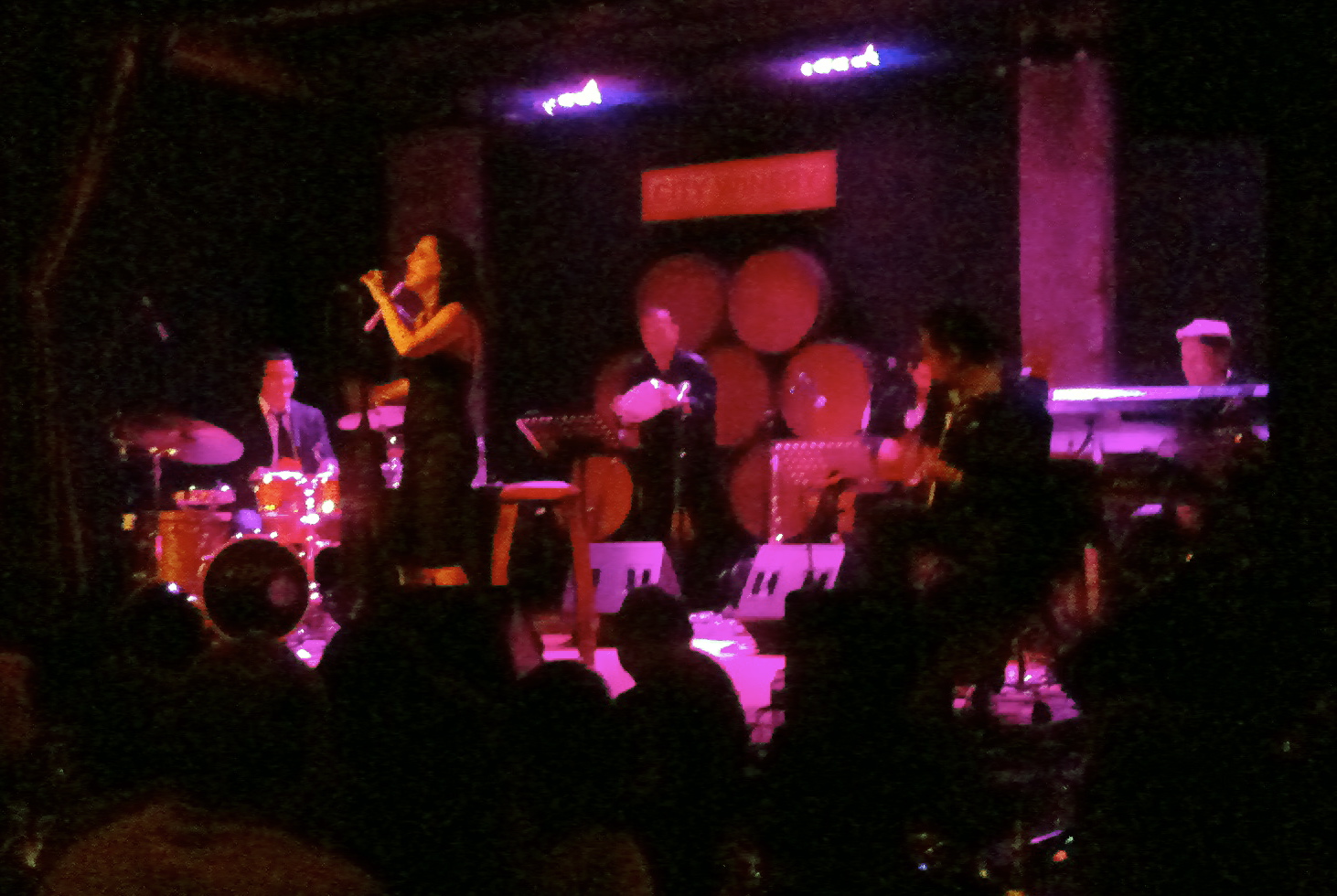
The following night I headed to the City Winery to catch a concert with Bebel Gilberto, the famous contemporary Brazilian singer. The star spent last summer as artist in residence at City Winery and performed several sold-out concerts. I only managed to get my act together and buy a ticket to the last extra one organized as an in August due to high demand. Alas, the concert was rescheduled due to the rare Hurricane Irene that hit New York just on the evening when Gilberto was supposed to perform. It thus took more than a month to organize the concert until Wednesday, October 5. In August, the extra concert was supposed to be an intimate evening only with the songstress and an acoustic guitarist. When I entered the crowded hall on this Wednesday evening, it was clear we would be now treated to the full band. There was a drum set, keyboards and amplifiers on stage. There was tangible electricity in the air—and the audience would not be disappointed. The diva, dressed in a tight black dress, was at her best, chatting with the audience in between the tunes, with a glass of wine constantly at her side. The daughter of legendary Brazilian musicians, Joao Gilberto and Miúcha, Bebel carries the torch of the bossa nova tradition that her parents were amongst the core group creating. Despite the five-piece band, the music remained very intimate and the volume at a very moderate level. She performed a long set consisting of hits from her own albums as well as a number of older songs. Personally, I was most taken by Jorge Continentino, whose alto flute provided an atmospheric ambience to most of the songs. On one tune, he switched to a horizontal bamboo flute, which he handled very nicely and entirely in tune (not always so easy with a bamboo flute). There was also a trombone in the band, which together with the alto flute produced a pleasant mellow addition to the music. At one point of the evening, Bebel asked an audience member to pass a candle from the table to her. Then she started the birthday song, approached the trombonist for a hug and passed the candle on to him. The birthday boy was so moved that he started to weep. “More than 20 years of friendship,” Bebel declared to the audience. Clearly, the star has a faithful relationship with her musicians. We were allowed to witness some intimate moments of her singing accompanied only by Bebel’s long-term guitarist, Masa Shimizu. On some of the later pieces of the evening, the tempos increased. Continentino switched his small pipes to a large curved baritone sax with which he joined in funky riffs with the trombonist. All in all, a superb concert.

Then, on Sunday, Yoko and I headed to one of our favourite Sunday afternoon places, the Noguchi Museum in Queens. The afternoon Music in the Garden promised shakuhachi music with Elizabeth Brown. We couldn’t have been luckier, as after a cool spell of autumn weather New York was experiencing Indian summer. We sat out in the garden with some 50 other listeners enjoying a most beautiful sunny afternoon amongst Isamu Noguchi’s sculptures and the verdant trees. Elizabeth Brown is an award winning composer and performer on the shakuhachi, the western flute and theremin. She took her place under a large aspen whose leaves had already turned largely bright yellow. Her set alternated traditional shakuchachi honkyoku—Oshu Sashi and Sokaku Reibo—with her own compositions, Hermit Thrush (1991) and From Isle Royale (2005). Her own pieces combine contemporary music aspects with traditional Japanese tonalities. Both pieces were inspired by the sounds of birds she had listened to while composing the music in the middle of nature. Here, the meditative sounds of shakuhachi mixed with the more urban soundscape of the inevitable helicopters and cars crossing Queens. For the last piece, Shika no Tone—another honkyoku tune in Kinko-ryu style—Elizabeth Brown called Ralph Samuelson to join her. She introduced Ralph “her mentor, teacher and friend.“ The two flutists moved to the opposite sides of the garden creating a lovely echo mimicking the distant cry of the deer that the tune’s title implies. Moving slowly closer to each other, the stereo effect created by the two shakuhachis was purely lovely.


Originally, I had intended to just describe these three exquisite concerts in such disparate styles and venues all played during the same week in this city—hence the title of this blog. But as I failed to complete writing this in time, I feel compelled to add to the mix. On the following Sunday, October 16th, we took our friend Masako, visiting from Tokyo, to Le Poisson Rouge to listen to a piano recital by Peter Hill. The concert was constructed around the music of Olivier Messiaen, whose premier interpreter the British pianist is. He made a smart strategic move by starting the modern concert with J.S. Bach, making the connections that both Bach and Messiaen were organists and both also superb improvisers. The beautiful start served its purpose of focusing the attention of the audience in the concert venue that doubles up as a restaurant. The rest of the evening consisted of pieces by Messiaen, with the exception of one piece by Toru Takemitsu composed in memoriam of the French composer. The highly sympathetic Peter Hill explained that he had selected the program around Messiaen’s compositions inspired by birdsong (something in common with Elizabeth Brown’s shakuhachi music!), starting with La Colombe that Messiaen had written in 1926 when he was just 18. Later pieces from the 1950s and Cantéyodjayâ that Messiaen composed while in Tanglewood in 1949 demonstrated how his musical language had evolved. The last number was lovely, contrasting the dark night when the composer had been driving in France with his wife, with the competing coloratura of a pair of larks and a nightingale they had observed. Messiaen was an accomplished ornithologist who incorporated birdsong systematically in his music. I was absolutely delighted to have decided to come to the concert. Messiaen’s music was not very familiar to me and this recital, enhanced with Peter Hill’s commentary, truly opened up his music to me. As an encore, Hill played a piece that Messiaen had written as a sight reading exercise for his students. Apparently, the master had written many such exercises but this was the only one that had survived—a tragedy of 20th century music, as recounted by Hill.

Then finally, on Tuesday, October 18th, Masako’s last night in New York, she and I went to the Jazz Standard while Yoko was rehearsing for her own forthcoming performance. The work we heard was Race Riot Suite composed by Chris Combs and performed by the Jacob Fred Jazz Odyssey. The lengthy suite in 12 parts turned out to be an incredible tour de force by both the composer and the orchestra. I had picked the show only based on the description, which explained that the suite had been composed to tell the story of the evolution and destruction of Greenwood, a highly successful African-American neighbourhood in Tulsa, Oklahoma (the centre of Greenwood was known as the “Black Wall Street”). On May 31, 1921, in an occurrence of exceptional racial conflict, white mobs invaded Greenwood and as a result at least 40 people were killed and over 800 were hospitalized. Some 35 city blocks were destroyed by fire and an estimated 10,000 people were left homeless. The all-white Jacob Fred Jazz Odyssey hails from Tulsa and consists normally of four musicians: Brian Haas, Josh Raymer, Chris Combs and Jeff Harshbarger. A unique feature of the band is that to the normal piano trio is added a lap steel guitar played by Combs, the writer of the Race Riot Suite. For performing the Suite, the band was strengthened by three horn players: Steven Bernstein (trumpet and slide trumpet), Mark Southerland (tenor and soprano saxes) and Peter Apfelbaum (tenor and baritone saxophones). This was one of the best and most innovative pieces of new jazz music that I have heard in a long while. The composition builds upon a long tradition of New Orleans jazz and ragtime and contains clear nods towards the great composers and band leaders, such as Duke Ellington and Charles Mingus. The expression is contemporary and the harmonies very interesting, with the steel guitar’s wails often blending in with the horns. Every player contributed wonderful solos throughout the music, so I would just highlight a couple that stayed with me. Overall, I loved Apfelbaum’s work on both of his saxes. The tenor was exceptional warm (and contrasted well with Southerland’s stormier approach) and there was an interesting moment when the baritone soloed only against Haas’ piano accompaniment (and what a rare treat it was to hear a second excellent baritone player in just two weeks!). Overall, Haas provided some entertaining piano playing, while Bernstein’s trumpet channelled Roy Eldridge and Cootie Williams transported into the 21st century. Harshbarger and Raymer on bass and drums soloed less, but ensured that there was a solid rhythmic structure—at times chaotic, but always firmly rooted—to this complex music. This was programmatic music at its best.

First, on Tuesday night (October 4), there was a duo performance by two of my favourite instrumentalists at the Living Room in Manhattan’s Lower East Side. As it happens, I also know both Oran Etkin and Ben Allison personally and they are both the nicest boys in the business. What I didn’t know is that they played together—and apparently it is a perfectly new thing. Their performance was part of celebrating the Independent Music Awards—Oran had just won the ‘Best World Beat’ award for his album Kelenia—and there was a succession of winning bands at this bar-cum-performance space. Oran and Ben had a half hour slot in the middle of the evening, which they filled with three pieces of fantastic communication with acoustic wooden instruments. All compositions were Etkin originals, starting with the hypnotic Kelenia from his African music project. This time played only on bass clarinet and contrabass, the tune produced a wonderful atmosphere with its ostinato-like theme. This was followed by Wake Up, Clarinet!, an entertaining number from Oran’s popular children’s album. It’s easy to see why kids would find it irresistibly fun when the cheerful bearded guy has a great time communing with his clarinet. The duo’s last piece was Lacy—dedicated to the soprano saxophone innovator Steve Lacy—a quirky jazz tune in which the musicians’ interplay was again seamless, with Ben providing a solid basis for the music as he pulled double stops on his bass.


(Exceptionally, these pictures are not mine, but by Yoko Takahashi, so that I could get into the photo with the guys.)
The following night I headed to the City Winery to catch a concert with Bebel Gilberto, the famous contemporary Brazilian singer. The star spent last summer as artist in residence at City Winery and performed several sold-out concerts. I only managed to get my act together and buy a ticket to the last extra one organized as an in August due to high demand. Alas, the concert was rescheduled due to the rare Hurricane Irene that hit New York just on the evening when Gilberto was supposed to perform. It thus took more than a month to organize the concert until Wednesday, October 5. In August, the extra concert was supposed to be an intimate evening only with the songstress and an acoustic guitarist. When I entered the crowded hall on this Wednesday evening, it was clear we would be now treated to the full band. There was a drum set, keyboards and amplifiers on stage. There was tangible electricity in the air—and the audience would not be disappointed. The diva, dressed in a tight black dress, was at her best, chatting with the audience in between the tunes, with a glass of wine constantly at her side. The daughter of legendary Brazilian musicians, Joao Gilberto and Miúcha, Bebel carries the torch of the bossa nova tradition that her parents were amongst the core group creating. Despite the five-piece band, the music remained very intimate and the volume at a very moderate level. She performed a long set consisting of hits from her own albums as well as a number of older songs. Personally, I was most taken by Jorge Continentino, whose alto flute provided an atmospheric ambience to most of the songs. On one tune, he switched to a horizontal bamboo flute, which he handled very nicely and entirely in tune (not always so easy with a bamboo flute). There was also a trombone in the band, which together with the alto flute produced a pleasant mellow addition to the music. At one point of the evening, Bebel asked an audience member to pass a candle from the table to her. Then she started the birthday song, approached the trombonist for a hug and passed the candle on to him. The birthday boy was so moved that he started to weep. “More than 20 years of friendship,” Bebel declared to the audience. Clearly, the star has a faithful relationship with her musicians. We were allowed to witness some intimate moments of her singing accompanied only by Bebel’s long-term guitarist, Masa Shimizu. On some of the later pieces of the evening, the tempos increased. Continentino switched his small pipes to a large curved baritone sax with which he joined in funky riffs with the trombonist. All in all, a superb concert.
Then, on Sunday, Yoko and I headed to one of our favourite Sunday afternoon places, the Noguchi Museum in Queens. The afternoon Music in the Garden promised shakuhachi music with Elizabeth Brown. We couldn’t have been luckier, as after a cool spell of autumn weather New York was experiencing Indian summer. We sat out in the garden with some 50 other listeners enjoying a most beautiful sunny afternoon amongst Isamu Noguchi’s sculptures and the verdant trees. Elizabeth Brown is an award winning composer and performer on the shakuhachi, the western flute and theremin. She took her place under a large aspen whose leaves had already turned largely bright yellow. Her set alternated traditional shakuchachi honkyoku—Oshu Sashi and Sokaku Reibo—with her own compositions, Hermit Thrush (1991) and From Isle Royale (2005). Her own pieces combine contemporary music aspects with traditional Japanese tonalities. Both pieces were inspired by the sounds of birds she had listened to while composing the music in the middle of nature. Here, the meditative sounds of shakuhachi mixed with the more urban soundscape of the inevitable helicopters and cars crossing Queens. For the last piece, Shika no Tone—another honkyoku tune in Kinko-ryu style—Elizabeth Brown called Ralph Samuelson to join her. She introduced Ralph “her mentor, teacher and friend.“ The two flutists moved to the opposite sides of the garden creating a lovely echo mimicking the distant cry of the deer that the tune’s title implies. Moving slowly closer to each other, the stereo effect created by the two shakuhachis was purely lovely.


Originally, I had intended to just describe these three exquisite concerts in such disparate styles and venues all played during the same week in this city—hence the title of this blog. But as I failed to complete writing this in time, I feel compelled to add to the mix. On the following Sunday, October 16th, we took our friend Masako, visiting from Tokyo, to Le Poisson Rouge to listen to a piano recital by Peter Hill. The concert was constructed around the music of Olivier Messiaen, whose premier interpreter the British pianist is. He made a smart strategic move by starting the modern concert with J.S. Bach, making the connections that both Bach and Messiaen were organists and both also superb improvisers. The beautiful start served its purpose of focusing the attention of the audience in the concert venue that doubles up as a restaurant. The rest of the evening consisted of pieces by Messiaen, with the exception of one piece by Toru Takemitsu composed in memoriam of the French composer. The highly sympathetic Peter Hill explained that he had selected the program around Messiaen’s compositions inspired by birdsong (something in common with Elizabeth Brown’s shakuhachi music!), starting with La Colombe that Messiaen had written in 1926 when he was just 18. Later pieces from the 1950s and Cantéyodjayâ that Messiaen composed while in Tanglewood in 1949 demonstrated how his musical language had evolved. The last number was lovely, contrasting the dark night when the composer had been driving in France with his wife, with the competing coloratura of a pair of larks and a nightingale they had observed. Messiaen was an accomplished ornithologist who incorporated birdsong systematically in his music. I was absolutely delighted to have decided to come to the concert. Messiaen’s music was not very familiar to me and this recital, enhanced with Peter Hill’s commentary, truly opened up his music to me. As an encore, Hill played a piece that Messiaen had written as a sight reading exercise for his students. Apparently, the master had written many such exercises but this was the only one that had survived—a tragedy of 20th century music, as recounted by Hill.

Then finally, on Tuesday, October 18th, Masako’s last night in New York, she and I went to the Jazz Standard while Yoko was rehearsing for her own forthcoming performance. The work we heard was Race Riot Suite composed by Chris Combs and performed by the Jacob Fred Jazz Odyssey. The lengthy suite in 12 parts turned out to be an incredible tour de force by both the composer and the orchestra. I had picked the show only based on the description, which explained that the suite had been composed to tell the story of the evolution and destruction of Greenwood, a highly successful African-American neighbourhood in Tulsa, Oklahoma (the centre of Greenwood was known as the “Black Wall Street”). On May 31, 1921, in an occurrence of exceptional racial conflict, white mobs invaded Greenwood and as a result at least 40 people were killed and over 800 were hospitalized. Some 35 city blocks were destroyed by fire and an estimated 10,000 people were left homeless. The all-white Jacob Fred Jazz Odyssey hails from Tulsa and consists normally of four musicians: Brian Haas, Josh Raymer, Chris Combs and Jeff Harshbarger. A unique feature of the band is that to the normal piano trio is added a lap steel guitar played by Combs, the writer of the Race Riot Suite. For performing the Suite, the band was strengthened by three horn players: Steven Bernstein (trumpet and slide trumpet), Mark Southerland (tenor and soprano saxes) and Peter Apfelbaum (tenor and baritone saxophones). This was one of the best and most innovative pieces of new jazz music that I have heard in a long while. The composition builds upon a long tradition of New Orleans jazz and ragtime and contains clear nods towards the great composers and band leaders, such as Duke Ellington and Charles Mingus. The expression is contemporary and the harmonies very interesting, with the steel guitar’s wails often blending in with the horns. Every player contributed wonderful solos throughout the music, so I would just highlight a couple that stayed with me. Overall, I loved Apfelbaum’s work on both of his saxes. The tenor was exceptional warm (and contrasted well with Southerland’s stormier approach) and there was an interesting moment when the baritone soloed only against Haas’ piano accompaniment (and what a rare treat it was to hear a second excellent baritone player in just two weeks!). Overall, Haas provided some entertaining piano playing, while Bernstein’s trumpet channelled Roy Eldridge and Cootie Williams transported into the 21st century. Harshbarger and Raymer on bass and drums soloed less, but ensured that there was a solid rhythmic structure—at times chaotic, but always firmly rooted—to this complex music. This was programmatic music at its best.

