Showing posts with label Buddhism. Show all posts

Saturday, September 28, 2019

Qingchengshan beauty in the mist


[This trip took place in September 2018 after the Asian Evaluation Week that was held in Chengdu, Sichuan.]


It was a grey morning with a constant drizzle in Chengdu when my friend Nanthi and I decided to stick to our plan to head towards Mt. Qingcheng, a sacred mountain where it is said Taoism was born. We grabbed a taxi and headed to the Chengdu North railway station where we arrived less than half an hour later. We had consulted the train schedule and left ourselves ample time to catch the targeted train. This was good, as we would need ample time to figure out how the system worked.
The rainy square in front of the station was crowded with people. There were many who looked like migrant workers from the countryside. A tiny elderly couple – or perhaps they were just middle-aged whose life had taken a toll on them – were walking with huge backpacks on their backs. Some seemed to have camped by the station keeping the rain out with plastic sheets. A tall, slim woman in an elegant red dress and matching high-heel shoes was leading a couple of older peasant-looking folks along – relatives from the countryside, perhaps even her parents (what a difference a generation and life in the big city makes!).
Initially, we headed towards the station gate and pronounced “Qingchengshan” (‘shan’ being the Chinese word for mountain) to the young lady occupying the booth that we first approached. Her face didn’t register any understanding of the message, but soon a uniformed guard appeared from the side and pointed us toward another large building across the vast square. Nanthi, being his stubborn self didn’t want to follow the instructions – after all, he argued rather logically, we were at the gates to the railway station from where the train would likely leave – but I convinced him to go look at the other place. We crossed the square and first arrived at a fence with a sign “Emergent Exit” (apparently it wasn’t quite ready yet) but to the right of it, there were stairs that led to a place clearly identifiable as ticket counters. So we placed ourselves in two lines to see which one would move faster. I had used my smart phone translation to pull up “Qingchengshan” (青城山) in Chinese on the screen. Soon enough we had our tickets in hand. The one-way trip put us back by ¥19 or about $2.75.


We returned to the station gate where we had started and presented the tickets. Once the nice lady had inspected our passports, we were allowed into the spacious waiting room of the station. There were perhaps a dozen or two other people there, but the large room appeared almost empty. Now that we had made it in, we actually had some time to look around in the few shops around there. There were a couple of grocers that sold whatever you might need on a train trip, from snacks and beer to small souvenirs. Food-wise, the choice was between McDonald’s and a local place that specialized in deep fried chicken feet. Luckily we had had a good breakfast.

 Our train left on time and we had numbered seats, so boarding was orderly even though the train became rather full (apparently, other passengers had been able to time their arrival to the station better). It was a bullet train that reminded me of the shinkansen in Japan: new, clean, sleek and fast. Like in Japan, the train attendants would stop and bow as they entered the compartment. Leaving from the northern part of the city, the tracks first traversed residential areas where everywhere there was major urban renewal taking place. Chengdu has grown to a metropolis of 14 million people. All over, old shabby looking buildings were being torn down to be replaced by massive modern apartment blocks.

As there were a few stops on the outskirts of the city, the bullet train didn’t travel at top speed but it still reached 190 km/h at some stretches. While the American flagship train, Acela, could in theory reach the speed of 240 km/h, it never travels that fast on its route from Washington, DC to New York and Boston due to the poor condition of the old tracks. On that stretch, there are a few patches where the train can go up to 160 km/h, but also passages where the top speed is just 40 km/h. I am convinced that this lack of upgrading and maintenance of infrastructure will be the downfall of the USA. But there are too many politicians, especially in the Republican party, who consider trains and other forms of public transport to be socialism and therefore not to be funded.


In about 40 minutes we reached the Qingchengshan station about 60 km northwest of Chengdu. The station was modern and clean. In front of it there was again a wide square on the other side of which we spotted a tourist information booth. Again, our initial approach caused some consternation but the person at the booth managed to fetch a young woman with adequate English to cater to us. We ended up taking a taxi to the entrance of where the Mt. Qingcheng cultural protected area starts. Beyond that, no motorized vehicles were allowed but there were electric vehicles, not unlike large golf carts, that shuttled people from the parking lot to the traditional gate of the area. We invested in a ticket to save some time instead of walking and were soon speeding soundlessly through a road lined with beautiful forest.


Once we reached the gate to the mountain, we disembarked. From here on, we would walk. The entrance to Mt. Qingcheng is a sight in its own right: a striking structure with pagoda-like tiled gables, guarded by imperial guardian lions carved from stone on both sides. The area outside of the entrance itself was surrounded by beautiful evergreen forests. All the buildings were traditional in style. But passing through the gate we entered another world of lush green vegetation and surprising peacefulness despite the many people around us. The air was pleasantly cool but very moist. A stream forming small waterfalls ran from higher up in the mountains. Mt. Qincheng is located at the southwest part of the traditional Dujiangyan irrigation system.


We followed the path that was covered with meticulously maintained wooden planks. We first arrived at the Natural Pavilion, which according to the sign integrates, “to a great extent,” the Taoist ideas of “syncretism between heaven and man, leaning from the nature, and the three begetting all things of the world.” The sign also informed us of the more than a hundred kiosks and pavilions on Mt. Qingcheng, which are exquisitely decorated and feature “quietness, depth, queerness, peril, grandness, beauty, aliveness, profoundness, etc.” Our expectations were raised.


Continuing our way up the hitherto mercifully gentle slope we arrived at a lake at a higher plateau. The scenery was breathtakingly beautiful with green mountains shrouded by low-hanging clouds on the other side of the still lake. A decorated ferry crossed the lake ferrying travelers across. We saw no other foreigners anywhere. Soon we, too, were on the ferry that quickly became crowded. The crossing took only a few minutes and we disembarked on the other side.


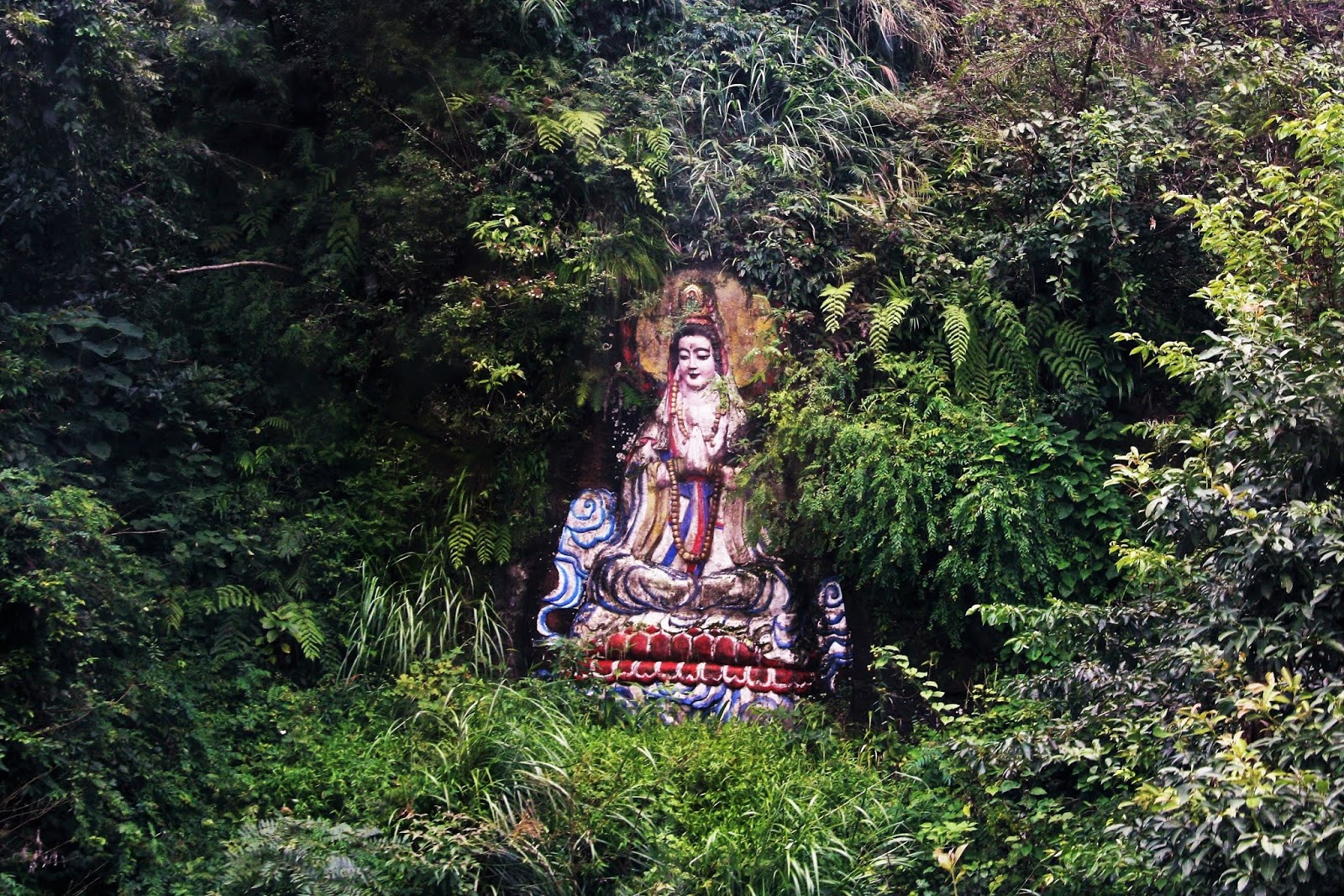


Here was a cable car station and we boarded a gondola that took us up to a high peak. From the gently swaying gondola we could see that the mountainside was covered in thick, almost inpenetrable green vegetation, but there were Buddhist objects hidden in the shrubbery. Having placed them where they were must have taken plenty of determination and effort.


We first arrived at the Ciyun Tower, a wonderfully beautiful structure but with no apparent religious meaning.

We continued on foot across the mountain forest with moss-covered rocks on both sides until we reached a further peak. Mt. Qingcheng is 1,260 meters tall and we must have been close to the highest point. From here the view was exactly like in a classic Chinese ink wash painting from Tang Dynasty (618-907). The view was across a valley with several other peaks standing at various distances giving the impression of depth continuing in eternity. The fog made the landscape look monochromatic.


Continuing our climb, we arrived at the Shangqing Palace. The palace was originally built during the Jin Dynasty (265-420) but was subsequently destroyed and rebuilt during the Qing Dynasty (1644-1912).  The place was decorated with red flags of Buddhism and equally red candles burned in the incense burners. An old monk and a young temple maiden with a long braid down her back were guarding the site. What a blessed life they must lead, I thought.

In the area there are many of Taoism’s most revered buildings amongst the gorgeous natural landscape, each more beautiful than you could imagine.


We continued our hike towards the summit of Mt. Qingcheng from where the views were magnificent. Unfortunately, because of our limited time it was impossible to see even half of this unique place and its incredible cultural history. We had to descend again so that we would be able to catch another train and get to Chengdu by evening. Along the way, we encountered numerous gorgeous buildings, some of which contained shops where one could purchase refreshments and Buddhist items, such as prayer beads.


We retraced our steps, took the cable car down and crossed the lake to the opposite direction. In the process we had walked for several kilometers and given the gradient, I could feel it in my leg muscles. Luckily, though, I did not have to submit to be carried down in a bed suspended between two long bamboo poles. This mode of transportation was readily available. The men in charge cheerfully ran along the mountain paths with their load resting in the crib. Their lungs and circulation must have an incredible capacity to absorb oxygen.


Further down we came across kiosks that sold a large variety of dried mushrooms and other products from the mountain. No doubt they would all have medicinal qualities – perhaps some bore the secret to the porters’ extraordinary stamina.


We returned passing by the Enchanting Pavilion and the Happiness Pavilion until we were back at the Nature’s Pavilion heading towards the Celestial Hall until we reached the clear stream and the gate to Qingchengshan at the elevation of 780 meters above sea level. Here a sign explained that, according to monitoring results, the negative oxygen ion concentration here was 180 times that of the city. This was the result of the particular geological conditions, the dense forest vegetation and the humid climate of Mr. Qingcheng. The sign further explained that when the negative oxygen ion concentration reaches a certain degree, “it will make people breath smoothly and feel refreshed, thus is good for immunity system and health.” Based on my experience today, I have no reason to doubt these beneficial effects on the health of both my body and mind.

Friday, September 27, 2019

Excursion to the Western Mountains


[In September 2019 I attended the annual Asian Evaluation Week in Kunming, Yunnan. In the late-1990s when I was with the United Nations University based in Tokyo, I had a joint project in Yunnan with the Kunming Institute of Botany, which allowed me to visit Kunming and travel around the beautiful province of Yunnan on several occasions. This was my first time back in 21 years. Just earlier this week, I visited my then collaborators with whom I have kept in touch through all these years, Guo Huijun and Liang Luohui. Guo who was a young promising researcher when we worked together has last year been appointed President of the Southwestern Forestry University, a major research university with 22,000 students. Liang, now affiliated with the Chinese Academy of Sciences was the one who introduced me to Yuanmei Jiao.]

Huating Temple
It was a foggy morning and there was a palpable threat of rain in the air when Zhijuan picked us up from the hotel in southwest of Kunming. Miki and I were ready for a short excursion to the hills just 12 km outside of town. Zhijuan Zeng was a graduate student of geography at Yunnan Normal University. Her professor, Yuanmei Jiao, had assigned her to accompany the foreign visitors on this trip. Dismissing our praise for her hospitality and kindness, Yuanmei assured us that the day trip would be good for Zhijuan’s English practice. (Zhijuan’s presence would definitely make the trip easier. A year ago, having attended the same annual meeting in Chengdu, my friend Nanthi and I took another mountain and temple tour by ourselves. We managed well, despite the language barrier.)

Zhijuan, Miki and I took a taxi to the foot of Xi Shan (西山) or Western Mountains. Driving through the town, gave a clear indication of how the city has grown both vertically and horizontally in the intervening two decades I have been away. Thankfully, it still has retained much of its charm, thanks largely to the genuinely welcoming people.

When we reached the base of the mountain, we switched to a bus that would take us further up. The Xi Shan is a protected area and a popular recreation spot for locals because of the clean air and beautiful scenery. My friend Liang, a Yunnan native, says that he comes here at least once a month when he needs some rest for his soul. We first got off the bus at a temple halfway up. Huating is a Buddhist temple with a history that reaches back to the Yuan Dynasty (1271-1368). The temple itself was first established in 1320 but it got its name – Huating – only in 1441 by Emperor Yingzong of the Ming Dynasty (1368-1644). The temple, having been built of wood, suffered several calamities during its history but was always reconstructed. This is a common practice with temples in East Asia and the fact that something has been destroyed and rebuilt many times over the centuries does nothing to reduce its historical value. The current Huating Temple stems from the 1920s. Huating is a National Key Buddhist Temple according to the Chinese government.

The temple consists of two main halls, the Four Heavenly Kings Hall and the Mahavira Hall. When you enter the Four Heavenly Kings Hall, you walk in between large statues of Heng and Ha, two ancient Shang Dynasty generals in Chinese legend, before reaching the statues of Buddha and the bodhisattva Skanda (guardian of Buddhist monasteries) at the center.


Zhijuan explores Huating grounds
Although not particularly large, the Huating is very beautiful and has a peaceful atmosphere. Temple gardens are often important repositories of local biodiversity, as the groves have been spared from cutting down for long periods. There were a few other visitors, all Chinese. Two of the women stopped to pray at the Buddha.


Having spent a good hour admiring the Huating and soaking in its peacefulness, we returned to the roadside to wait for another bus to take us further up the hill. We were lucky as the rain never came. In fact, from time to time the sun would peek out from between the clouds.

We got off at the final stop of where the entrance to the mountain peak was located. Here there were considerably more people but, again, no other foreigners in sight. Soon after the gates, the path started to climb. The famous Longmen Grottoes have been carved into the hillside during a 72-year period starting in 1782 during Qing Dynasty. The grottoes are connected by narrow stone-paved paths and extremely steep steps. I soon started to feel the exercise in my lungs. We were between 2,250 and 2,300 meters above sea level and the thin air together with the strain of the climb were getting to me. Even Miki confessed that he was feeling tired. Although I had been in Kunming for a week and the city itself lies at 1,800 meters’ altitude, I hadn’t gotten accustomed to the elevation. This being a weekday, there were lots of old people on the path. I admired their stamina.


Taking the excuse of studying some historical construct or admiring the view, I rested at every level place during the climb. The 23-year-old Zhijuan didn’t seem to grasp that we were getting rather exhausted but she accepted the frequent stops. Having said that, the views from the hill down to Dianchi Lake and beyond to the city were quite stunning. The air was still rather misty, which limited the visibility. Still, in the balance, I was pleased that the sun wasn’t blaring upon us from a cloudless sky.

The hillsides were extremely steep and at times the path passed through grottoes so low that I had to crouch to get through. The workers who constructed the trail 250 years ago clearly were smaller than I. 
Dianchi Lake with Kunming City in the distance


We eventually reached the destination: the Dragon Gate complex resting on a hillside so steep that the drop is absolutely vertical to the lake shore. Having spent some time admiring the place and taking photographs of each other with the view, just like all the local tourists, it was time to head back. The way down was easier on the lungs, but walking down the narrow stone steps that were moist as a result of the earlier fog, was hard on the legs as one had to tense the thigh muscles constantly in order not to roll down the hill.

The excursion was short but refreshing. Back in the city, we still had daylight to enjoy a leisurely walk around the beautiful Cuihu park with its lakes and waterways covered with lotus waterlilies. Unfortunately, the flowering season was over and only a few of the plants still bore gorgeous flowers. I personally was most happy to be walking on flat land.


Wednesday, December 11, 2013

Autumn in Kyoto


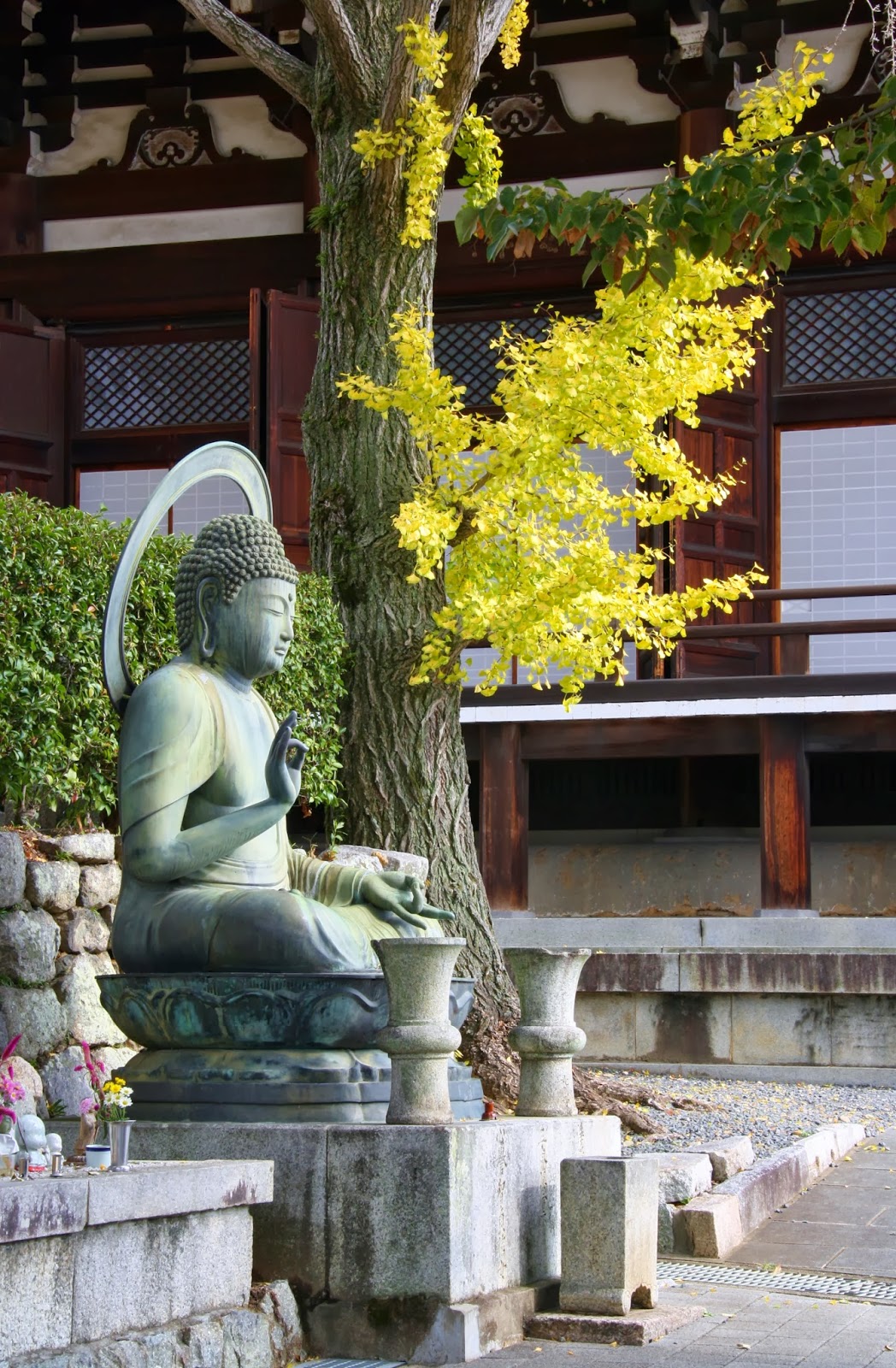
Visiting Kyoto in the autumn when the days are crisp, the skies are blue and the leaves are aflame is a special kind of treat. The temples in the hills surrounding the city become destinations of modern day pilgrimage for thousands and again thousands of visitors who come to revel in the rarefied atmosphere. The Japanese are known to appreciate nature and the changing of seasons is of particular importance to the culture. Still in this postmodern society cuisines change with the seasons reflecting what foodstuffs are available at a particular time of the year. One of the fundamentals of the Japanese aesthetic is the ephemeral nature of beauty. The lush green forests turn to bright red and yellow before the leaves fade into shades of brown prior to dying and falling.

Since I arrived just over a month ago, I have spent much of my free time visiting the temples and the shrines. Luckily for me, I am staying in Sakyo ward in the northeast of the city, just next to the Kyoto University main campus, which gives me ready access to many of the most revered temples in the Higashiyama—East Mountain—area.

On my second Sunday in town, my old friend Taka picked me up from my apartment and we spent a long day walking around the temples in this area. We started with Kurodani, with the Konkai-Komyoji temple founded in 1175, one of the eight main temples of the Jodo sect of Buddhism. I can actually see this handsome structure perched on the side of Higashiyama from my apartment building. Like many temples in Kyoto, Kurodani was destroyed and rebuilt several times after it was recovering from unrest or other mishaps. In 1934 it was destroyed by a fire but again reconstructed in its old image in 1942. In the Japanese tradition, this does not in any way reduce the value of the historic building. After all, these are wooden structures and therefore vulnerable to fire. In the appreciation through all five senses, the smell of new wood as the temple is being rebuilt adds to its charm.

Just north of Kurodani is Shinnyo-do, a temple of the Tendai sect, with a lovely garden. As we visited, the Japanese momiji maples were at their best autumn colours almost obscuring the tall pagoda. For some unfathomable reason, Shinnyo-do has remained in relative obscurity, although it is a very old—established in 984—and beautiful place. Consequently, even now the temple gardens were relatively less crowded (with emphasis on the word relatively).


Crossing the Shirakawa river valley, we continued to Honen-in, a small temple established relatively late in 1680. It received its name from the priest Honen (1133-1212), founder of the Jodo-shu sect. Honen-in was originally built as a training hall for Buddhist chant, Shishigatani, closely associated with Honen. There is nothing spectacular about Honen-in, but to me it is one of the loveliest of all the temples. Its garden is a true haven of tranquility.


Our next destination was further up, one of the most famous temples of all, Ginkakuji. A Zen temple, Ginkakuji was established in 1482 during the Muromachi Shogunate. Its formal name was Higashiyama Jishōji but it is commonly known as Ginkakuji, the silver pavilion. Ginkakuji was originally built by the Shogun Ashikaga Yoshimasa as a restful place of retirement for himself, that would afterwards be designated as temple. At its heart is a two-storied pagoda, Kannon-den, between a rock garden and beautiful pond. The temple area is quite large and extends up on a steep hillside from where the view over the Kannon-den and its garden down onto the city is magnificent.


Having already walked for hours in the fresh air, we headed towards the oldest ramen shop in the city, Ramen Masutani. Still in mid-afternoon there was a brief wait outside before we could enter. The place has served its limited choice of ramen-noodles here for some 60 years. With the exception of a bowl of rice, there is nothing else on the menu. The drink choices are water or tea. The pork ramen that I had was one of the best I’ve ever enjoyed – and not only because of hunger.

Thus fortified, we were ready to continue walking and headed down the famed Tetsugaku-no-michi or the Philosophers’ Path. The autumn sun was already starting its descent and the late afternoon was golden. We followed the path alongside many people on their afternoon stroll or on their way to one of the many cafés or restaurants, the Japanese always well-dressed and stylish. One segment of the path is famous for having a large cat population. They appear to be semi-domesticated and many people stop to pet or feed them.

We still had the strength to visit one more temple, the Eikando Zenrin-ji. The sun was already fading behind the mountains and dusk had settled on the valley. The Zenrin-ji temple was established on this site in the Heian period around 853. Some two centuries later, Eikan (1033-1111) became the head priest of the temple. He was known as a devoted soul, intoning the Nembutsu chant as many as 60,000 times every day, and never sparing his efforts to help poor people. He thus earned everyone’s respect and at some point of time people started calling the Zenrin-ji simply Eikando. It is one of the temples with the most beautiful autumn leaves or kouyou. There is a small rock garden in front of the main temple and through the gates I could see four young ladies wearing beautiful kimonos resting on the wooden steps admiring the garden. Such a lovely sight, and one that could have been the same hundreds of years ago.


We circled the temple and climbed up behind it. The lights were already coming on inside and in the garden lanterns. Suddenly we ran into the four women in kimonos and start chatting with them. They were friendly and gorgeous in their exquisite dress, so I could not help but ask for their permission to take their photograph.


On the following weekend I was alone and decided to walk across the city from east to west. Kyoto is a fabulous walking city. The traffic is well organized, although especially around the universities one has to be careful of the bicycles, and there is always something nice to observe. At some 1.4 million inhabitants, it is not a huge megalopolis either. Having said that, the distances may be longer than they appear on the map—on this Saturday I estimated having walked around 12 kilometres, crossing the Kamogawa river and heading towards the mountains on the opposite side of town.

My first stop was the Kitano-Tenmangu shrine, one of the very important shrines in the country. Unlike the temples, this was a Shinto shrine. One of the most delightful aspects of Japan’s spiritual life is its flexibility. It is said that 80 percent of the Japanese are Buddhist, and 90 percent are Shintoist. There is no contradiction here and celebrations and rituals are conducted in one or the other largely depending on their appeal. Shinto, as an original Japanese nature-based religion—or philosophy—is quite attractive, although it did get slightly tainted in connection with the militarism of the first part of the 20th century. Kitano-Tenmangu is dedicated to Sugawara Michizane, a scholar and politician who was wrongfully accused and exiled to the southwestern island of Kyushu where he died in 903. After his death there were severe earthquakes and storms that caused considerable damage, which were widely thought to be caused by his wrath. Consequently, the Imperial Court posthumously granted him the title of Karai TenJin (God of Fire and Thunder). As I visited Kitano-Tenmangu it was peaceful with many women and little girls wearing beautiful kimonos.


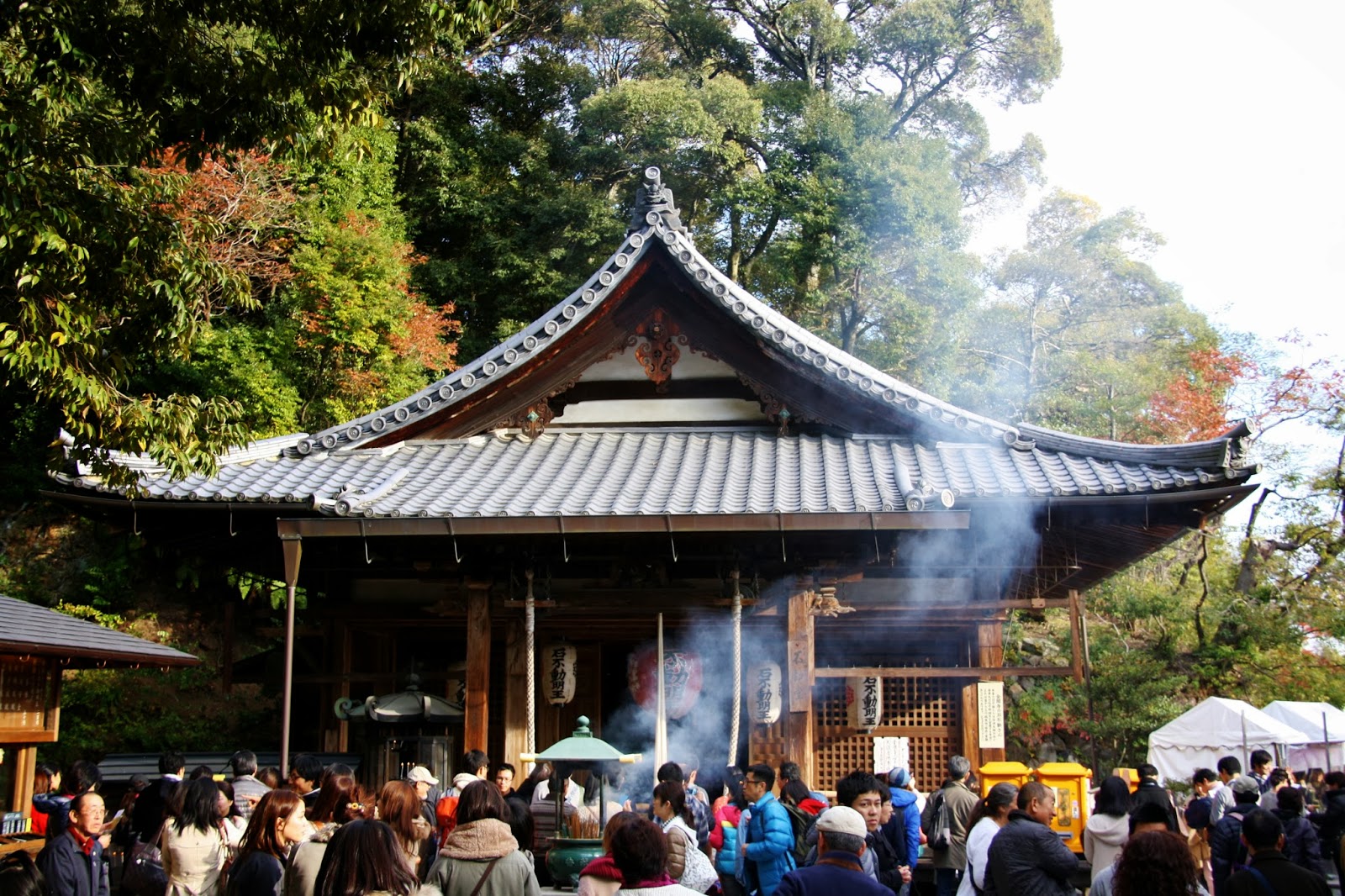
My main target that day was the Kinkakuji, one of the most famous temples in the city and the country, indeed the world. Unlike Ginkakuji, which does not have any actual silver, Kinkakuji is covered with gold foil on lacquer. Located in the foothills in the northwest of the city, there was a bit of a hike to reach the place. When I did, I realized that I certainly was not the only one with the same idea. There must have been thousands of people: Japanese, Chinese, other Asians, Westerners. According to Taka, the fastest growing group of tourists in Japan are Thai, as their economy grows and the exchange rate of Yen to Baht has gone down.


The temples of Kyoto are generally wealthy. They usually charge a reasonable entrance fee but with the hundreds of thousands of visitors every year this translates into considerable sums. The temples’ income is also tax free. This has resulted in the fact that this common patrimony of humankind is very well preserved and maintained. There is also money left over, as can be often seen from the monks’ residences and the luxury cars that are parked in front of them. In Japan, the image of penniless Buddhist monks leading an ascetic life is not entirely accurate.


Kinkakuji in all its glory is unique in the world. It is breath-taking as it stands in front of the immaculate pond that reflects its image on the calm surface. Behind and around it, the dark hills were speckled with stunning colours. The Golden Pavilion is a shariden or a Buddhist hall actually containing some relics of Buddha. It is said to represent Muromachi era Imperial aristocratic style and combines elements of Chinese architecture. The pavilion itself is part of a Zen temple called Rokuon-ji. The Muromatsu era Shogun Ashikaga Yoshimitsu (the grandfather of the builder of the Ginkakuji) acquired the area in 1397 and built his villa Kitayama-den (North Mountain villa) there.

Heading back east to my own den, I passed by Daitoku-ji, another Zen temple of the Rinzai school, established in 1315. In later centuries it became an important cultural centre and was associated with, i.a., the legendary military leader and politician Toyotomi Hideyoshi (1537-1598) and tea ceremony master Sen-no-Rikyu (1522-1591). As I entered the area, I noticed that one of the sub-temples was exceptionally open to visitors. Oubai-in’s history is closely related to the famous lord Oda Nobunaga who commissioned the building of a hermitage to the memory of his father, which afterwards was named Oubai-in. Lord Oda Nobunaga appointed Toyotomi Hideyoshi as the military governor of Kyoto. When Oda Nobunaga was murdered in 1582, Toyotomi Hideyoshi built a mausoleum to him at Oubai-in. The relatively small temple derives its name from a place in China with deep Buddhist roots. The main building and its Chinese style gate were renovated in 1586. The gardens of Oubai-in are exquisite and peace reigns inside. There is the Hatou-Tei rock garden, and Jikichu-Tei, a Chisen style garden created by Sen-no-Rikyu. I felt very lucky to be able to visit this delicate and serene place.


The glow of the autumn leaves is indeed ephemeral (although, as Taka pointed out, at least it lasts for some weeks, unlike the three-day peak of the sakura or cherry blossoms in the spring time). The other day we walked back to Shinnyo-do on our way to an amazing lunch at a small restaurant called Nashimote that grills fish and meat on charcoals (but that’s another story). Just in the intervening weeks the temple garden had lost half of the leaves and the greens and yellows were now distinctly blood red and rust brown. This was another kind of beauty, no longer as exuberant as before, but more subdued and sensitive.


Now that it’s already almost mid-December (oh, how time flies!), the kouyou season is almost over. The days are still sunny and comfortable, but the nights are getting cold. The persimmon fruit—kaki—hang orange from bare branches. The nearby Okazaki shrine, dedicated to fertility and safe birth as symbolized by the rabbit, appears deserted, although from somewhere deep inside I can hear a group practicing ancient gagaku music.


Tonight I took my washtub, towel and soap and wandered into the neighbourhood public bath, sento, to soak in a hot tub with other men from the area. (One thing that Japan has in common with my native Finland is the healthy natural relationship with nudity and total strangers never hesitate to lounge together naked.) It is clear that winter is coming and the autumn leaves on the ground will soon be covered with snow.