The year that just ended can hardly be described as a good
one. The carnage of the civil war in Syria

The rock music world experienced many notable losses, as
well, starting with David Bowie who died on January 10 at age 69, ending with
George Michael passing away on Christmas Day at just 53. In between, Prince’s
death on April 21st (at 57) probably received the highest attention, as did
that of Leonard Cohen (November 7th at 82). Other notable departures
from the popular music scene included the pianist Leon Russell (November 13th
at 74) whose sound was more influential than many listeners realized; another
highly influential behind-the-scenes force, Rod Temperton (October 5th
at 66); the laid back southern pianist/singer Mose Allison (November 15th
at 89); and Greg Lake (December 7th at 69), the fabulous bassist,
vocalist and composer of King Crimson and Emerson, Lake and Palmer fame.
Others, such as the Belgian-born harmonica master, Jean ‘Toots’ Thielemans
(August 22nd at the tender age of 94) whose music everyone has
heard, whether they realize it or not; the magical Brazilian percussionist Nana
Vasconcelos (March 9th at 71), and the legendary drummer Alphonse
Mouzon (also on Christmas Day at 68) were great losses to the musical world.
Finland lost one of its more prominent jazz musicians, bassist Make Lievonen
(December 14th at 69). Although I grieve for all of these fabulous
artists, I will here briefly focus on two forceful creators who were amongst
the most important to me personally: Gato Barbieri and Jeremy Steig.

The saxophonist Leandro ‘Gato’ Barbieri (b. November 28th,
1932, in Rosario, Argentina; d. April 2nd, 2016, in New York) was my
hero during my teenage years. I remember the first album I heard from him, ‘El
Pampero’ (1971). It completely blew my mind. It still holds a central place in
my record shelf. This was a live recording. The tunes were long – just two to a
side – with nearly constant soloing by Gato against a South American beat
provided by three percussionists, Bernard Purdie, Sonny Morgan and the above
mentioned Nana Vasconcelos. The band was completed by electric bassist Chuck
Rainey and Lonnie Liston Smith whose piano added freer fills into the mix. I
was sold. Especially, the tune ‘Mi Buenos Aires Querido’ with the gorgeous
saxophone intro caught my heart and made me long for the sensuous capital of tango on
Rio de la Plata. Gato in his trademark black fedora hat was the coolest cat I
knew (apologies for the pun). Even my mother warmed up to his warm, huge and highly
distinguishable sound on the tenor sax.
I immediately went back to look for his earlier recordings
to find that they were mostly free jazz, inspired by Ornette Coleman. In the
mid-1960s Gato divided his time between Rome and New York performing and
recording with Don Cherry, Carla Bley and others in the avant garde movement. Only with the 1969 album ‘The Third World’
did he find the voice that would combine elements from Coltranesque jazz with
tunes and rhythms from South America. Other recordings followed, including
‘Bolivia’ (1973), which brought forth the lyrical side of Gato, with melodies
borrowed from the South American jungles and pampas. Mind you, this was not
what you would normally call ‘Latin jazz’, because Gato’s music never flirted much with
salsa or even bossa nova. His roots were more firmly in the music of his native
country, Argentina.

This was most clearly demonstrated by the film score Gato
made for Bernardo Bertolucci’s scandalous ‘Last Tango in Paris’ (1972) for
which the composer won a Grammy. The dramatic and sexy score became an
international hit record with Gato’s powerful tenor at the lead accompanied by
a tango orchestra featuring a bandoneon and strings. Its melancholy laments of
forbidden, fleeting love pulled my heartstrings more than most other music
ever. The legend has it that Bertolucci had planned a role for Gato in the film
but the latter turned out to be such a wooden actor that the plan was scrapped.
Nevertheless, when he made a cameo appearance as a stranger practicing the
saxophone, whom the lovers, the middle aged Marlon Brando and 19-year old Maria
Schneider, could see through a window, I was I heaven.
"Always in the tango is tragedy — she leaves him,
she kills him. It's like an opera but it's called tango … The lyrics and the
melodies are very beautiful. It's very sensual," Barbieri is quoted as
having said in 1997 (Billboard, April 2, 2016).
Then followed in rapid succession the series of Chapter albums recorded for Impulse!:
‘Chapter One: Latin America’, ‘Chapter Two: Hasta Siempre’ and ‘Chaper Three:
Viva Emiliano Zapata!’ (1973-1974). The third introduced a large orchestra arranged
and conducted by Chico O’Farrill, and some truly beautiful music, such as a
version of the classic ballad ‘Cuando vuelva a tu lado’. A fourth in the
series, ‘Chapter Four: Alive in New York’, released in 1975, was as the title
suggests a concert recording.
Not all Barbieri records were masterpieces. Having earlier
recorded for the jazz labels Flying Dutchman and Impulse!, his new label,
A&M took Gato to a more commercial smooth jazz direction. I could still
find great merit in records like ‘Caliente!’ (1976), even if I missed the
earlier rougher productions. The intensity, lyricism and warmth never
disappeared from Gato’s playing. His collaboration with Carlos Santana on a
rendition of the latter’s composition ‘Europa’ can still bring tears to my
eyes.
There was a long hiatus in his recording after a dispute
with the record label in 1982. During the 1980s he released a couple of albums
that received little attention. Throughout the period he toured extensively
performing around the world. His wife of 35 years, Michelle, died in 1995, and
he himself went through the first of his bypass heart operations. His comeback
album after the break was the 1997 ‘Qué pasa.’ By that time, Gato had married
again, to Laura, with whom he would spend the remaining two decades of his
life. During the 2000s he would only release a couple of albums, but he
continued to perform in concerts. I last saw him at the Blues Alley club in
Washington, DC, more than a decade ago. He was in great form performing the
music that he loved, not the smooth jazz version of it.
"Music was a mystery to Gato,
and each time he played was a new experience for him, and he wanted it to be
that way for his audience,” Laura Barbieri is quoted as saying (Rolling Stone,
April 3, 2016). In 2015, Gato
Barbieri received a lifetime achievement Grammy Award from the Latin
Recording Academy. He is greatly missed but the consolation may be that there
is no better way to remember him than through his sensuous, melancholy music.
Another artist and human who made a
huge impression on me was Jeremy Steig (b. September 23, 1942, in Manhattan; d.
April 13, 2016, in Yokohama). I also started listening to him as a schoolboy in
Finland in the 1970s. I often biked over to my friend Timo’s house on
afternoons to listen to music. We’d have a wide scale, ranging from Edgard Varèse
to Eric Dolphy to Frank Zappa, as long as it was novel and interesting. Timo was
the one who introduced me to the records of Jeremy Steig and the music hit me
like a rock from the very beginning. Both Timo and I were aspiring flute
players, so discovering a rare jazz flautist who was as versatile and creative
as Steig was a real treat for us. At that time, almost all jazz flutists were
primarily saxophonists who doubled on the smaller instrument, but Jeremy Steig
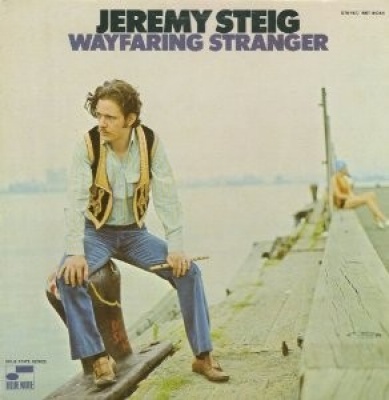
was a flutist first. The first record I remember hearing was ‘Wayfaring
Stranger’ (1971), which featured a small group of leading contemporary jazz
musicians, such as Eddie Gomez and Don Alias, but playing to a funky rock beat.
The music was free in a loose format with largely improvised interplay. Again,
I went back to older albums by Steig, such as the 1968 ‘Jeremy & The
Satyrs’ which embodied the psychedelic spirit of the era.
 Jeremy Steig had grown up in the straight
jazz tradition and had been on the New York scene since the early-1960s. He
released his first album as a leader, ‘Flute Fever’, in 1963. The album
featured a traditional piano trio with young Denny Zeitlin. His greatest claim
to fame in mainstream modern jazz was, however, ‘What’s New’ recorded with the
pianist Bill Evans, backed by Eddie Gomez and Marty Morell, in 1969. The song
list consists of standards, such as ‘Straight No Chaser’, ‘Lover Man’ and ‘Autumn
Leaves’ but the treatment was novel and the playing enormously creative and
interactive. Jeremy later told me how in those days, there were no fancy music
schools for jazz musicians to take a shortcut to fame; the only way was just to
practice and play and try to get the chance to be accepted to sit in with the
established stars in clubs. To me, one of the best collaborations was the
rather free form album ‘Outlaws’, recorded in 1976, with just Eddie Gomez on
bass and Jeremy Steig on flute and alto flute.
Jeremy Steig had grown up in the straight
jazz tradition and had been on the New York scene since the early-1960s. He
released his first album as a leader, ‘Flute Fever’, in 1963. The album
featured a traditional piano trio with young Denny Zeitlin. His greatest claim
to fame in mainstream modern jazz was, however, ‘What’s New’ recorded with the
pianist Bill Evans, backed by Eddie Gomez and Marty Morell, in 1969. The song
list consists of standards, such as ‘Straight No Chaser’, ‘Lover Man’ and ‘Autumn
Leaves’ but the treatment was novel and the playing enormously creative and
interactive. Jeremy later told me how in those days, there were no fancy music
schools for jazz musicians to take a shortcut to fame; the only way was just to
practice and play and try to get the chance to be accepted to sit in with the
established stars in clubs. To me, one of the best collaborations was the
rather free form album ‘Outlaws’, recorded in 1976, with just Eddie Gomez on
bass and Jeremy Steig on flute and alto flute.
Jeremy
Steig’s flute playing was truly unique. He had perfected his jazz chops but then
moved more towards a crossover style, adopting techniques that incorporated
singing into the flute and ample use of overtones. What contributed to his
special sound was a motorbike accident at 19 that left a side of his face
paralyzed. He re-learned to play and rebuilt his face muscles, but never fully
recovered from the damage. In the 1960s Jeremy would sit in with both jazz and
rock groups at live performances in New York’s Greenwich Village. He observed
that he could still solo “with integrity” over the funky beats of rock bands. “We decided that we’d invented jazz-rock … Of course,
there were about 50 other people who had come to the same conclusion,” he later
mused (New York Times, June 2, 2016).
It was in Greenwich Village where I caught Jeremy Steig on one
of his rare live appearances in 2007 (see my review of the gig). The gig was amazing, with
Jeremy playing as innovative music as ever, alternating between the regular and
alto and bass flutes (one of his last records – the 2007 ‘Pterodactyl’ – consisted
of only overdubs with flutes of different sizes from piccolo to bass). After
the show I went to talk with him and his wife Asako who was acting as his
manager. We established a good rapport and followed up with a dinner in a nice
restaurant in the Village on another evening not long after. A common element
was found in the fact that we both had spent a lot of time in Japan. As it
happens, Asako hails from Morioka, not far from my wife’s hometown in the same northern
Japanese prefecture, Iwate. Asako and Jeremy established a home in Yokohama,
which is where Jeremy passed away.
Over the long dinner we discussed many matters, around and
beyond music. Jeremy considered himself retired, “senior citizen”, as he
repeatedly mentioned. He hadn’t made new records since the above mentioned
‘Pterodactyl’ and the excellent 2007 quartet recording ‘Flute on the Edge’,
both produced and released on his own label. He seldom performed but he
continued to paint, which had long been his other artistic passion. In fact, he
produced the cover art for several of his albums and lately he and Asako created
a series of ‘digital picture books’ with his art. Jeremy’s interests were wide
and included politics. I remember him raving about the book, Confessions of an Economic Hit Man by
John Perkins, which detailed how American firms had taken over developing
countries by convincing them to take huge loans for construction and
infrastructure projects.
Sadly, Jeremy Steig never became a household name, even amongst
jazz aficionados. Still his music was highly influential in many respects. He
made appearances as sideman on recordings by famous artists ranging from Art
Farmer and Urbie Green to Johnny Winter and Tommy Bolin. One of my favorites is
his performance on a rather obscure, but lovely pop tune, ‘Hurricane’ by Dee
Carstensen. As Jeremy would tell, the most money he ever made through his music
was in 1994 when the Beastie Boys sampled his 1970 ‘Howlin’ for Judy’ for their
hit ‘Sure Shot’.

