Showing posts with label Pollution. Show all posts

Sunday, September 28, 2025

The Wild Side of Japan


Beyond the neon skylines, crowded subways, and hi-tech innovations lies another Japan – a wilder world of mountains, forests, and rice paddies that reveal the country’s deep relationship with nature.


The hills are shaped like traffic cones, except that they’re green. Many of them reach up to over 1,000 meters; the tallest ones nearly 3,000 meters. They stand on both sides of the road – Akita Expressway – blocking any view beyond them except for the sky, which that day was overcast. The forested slopes look virtually impenetrable. There are signs warning of mountain goats, tanuki-raccoon dogs – and bears – along the roadside.

Tohoku, consisting of the northern prefectures on the main island of Honshu, has been called the wild side of Japan. If Japan conjures up images of avant-garde high-rises, hi-tech attractions, and people in dark suits or outrageous anime costumes rushing at subway stations, then you should visit Tohoku. It is another world up here.

We were speeding through the mountains in Kikuchi-san’s Daihatsu Cocoa overtaking many larger vehicles as she pushed the little car to 120 kph. Mami, which is her name, is a hotelier and restaurateur in Iwate and a dear old friend of my wife Yoko. She was taking us from their mutual hometown of Oshu to Akita City in the adjacent prefecture with the same name. The road cut across the north-south mountain range that forms the backbone of Honshu, from Iwate Prefecture in the east to Akita Prefecture in the west, from the Pacific ocean to the Sea of Japan coast. Cutting through the mountains can be taken literally: there are about ten tunnels, most of them short but a few about 2.5 km long. Altogether, one spends more than 10 km driving under the huge mountain masses. What an engineering feat it has been to construct these tunnels!

In between, the road rises to higher ground and occasional bridges cross fertile valleys in the shadow of the steep mountains. These valleys are intensively utilized for farming. Small clusters of farmhouses are surrounded by green rice paddies.
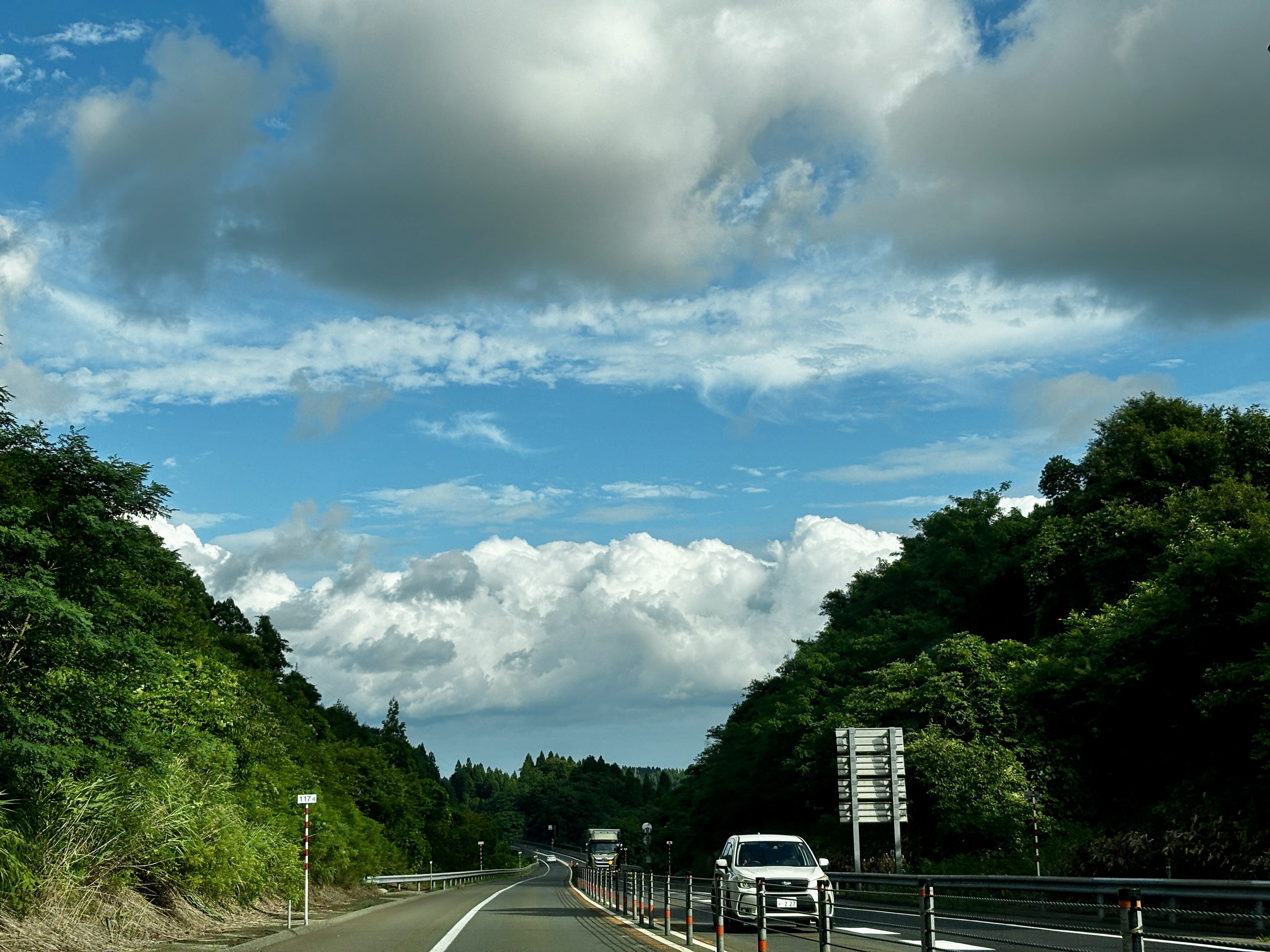
Akita Expressway cuts east to west through the mountains (photo by author).

Rice is the staple in Japan. But it is also more than just food, as the anthropologist Emiko Tierney Ohnuki explains in her book, Rice as Self: “As a metaphor of self, rice paddies are our ancestral land, our village, our region, and ultimately, our land, Japan. They also represent our pristine past before modernity and foreign influences contaminated it” (p. 10). Later she explains, “The notion that each rice grain has a soul and that rice is alive in the hull are fundamental to the meanings assigned to rice in Japanese culture…” (p. 55). The rice paddies prevail even as the countryside empties of people and the farming population ages. This phenomenon also explains the widespread resistance to foreign rice by Japanese consumers, even as rice prices have soared this year and been a major contributor to rising inflation.

Tohoku, with its relatively cold climate, has experienced several rice famines in the recorded history, many of them linked to natural disasters, such as cooling climate after volcanic eruptions. Latest in 1934, the rice crop in Iwate failed due to cold weather, causing many poor farm families to send their children to Tokyo and beyond as laborers, or to work in the water trade, or to join the military, all of which contributed to the pre-war unrest. In better times, Tohoku rice is arguably the best in the world, thanks to the clean environment and water.

Japan’s environmental history is at best checkered. The case of mercury poisoning in Minamata on the southwestern island of Kyushu starting in the late 1950s is perhaps the most famous incident of industrial pollution with dramatic consequences to people’s health. But there were plenty of others where the environment and human health were sacrificed to the altar of progress in post-war Japan, such as the Itai-Itai disease caused by cadmium poisoning discovered in 1967 or the PCB poisoning in and around Kitakyushu the year after. Opposition to industrial pollution was silenced, communities divided, and victims shunned, as the country focused on rebuilding and getting rich at any cost.

Since those years, much has been done to improve the environment. Environmental consciousness is high: practically no one litters, recycling is religiously practiced, and the cities are clean. Air and water pollution are now controlled. The largest urban conglomerations – Tokyo, Yokohama, Osaka, Kobe, Kyoto – are concentrated in the Central and Western Kanto and Kansai areas.

The Japanese culture has been largely based on the desire to control nature. This has its traditional expression in Japanese gardens in which nature has been forced into beautiful, but artificial depictions of, well, idealized nature. The tortured, but gorgeous bonsai trees are another example. For many Japanese, nature is at its most beautiful when it is well regimented.

Another factor playing into the tendency to control nature is the prevalence of natural hazards. Japan consists of a chain of volcanic islands in the middle of the largest ocean of the world, the Pacific. The country is prone to earthquakes that happen daily (although larger ones are of course rarer). Despite its name, the ocean frequently acts in ways anything but pacific, sending typhoons and tsunamis to the coasts. The eruption of the iconic volcano, Mt. Fuji, is long overdue. If a natural hazard exists, Japan is bound to have it in quantities. Consequently, Japan is also the best prepared nation towards natural hazards: even massive earthquakes tend to have relatively few victims.

There are exceptions, the most prominent one in recent history being the earthquake that hit Tohoku on the Pacific side on March 11, 2011. The 9.1 magnitude earthquake and the ensuing tsunami flattened out much of the Sanriku coastal zone in Miyagi and Iwate prefectures and killed almost 20,000 people. The tsunami also caused the meltdown of the Fukushima nuclear power plant resulting in the worst nuclear accident in human history, barring the Chernobyl accident in current-day Ukraine in 1986.

Up in in the mountains between Iwate and Akita, nature is largely unspoiled thanks to a low density of human population, little urbanization and even less industry. That in itself is largely the result of the mountainous topography, the harsh winters, and the relatively short growing season. Yet, virtually all flat valleys are under cultivation.

The topography is also what has saved Japan’s forests. This is one of the most forested countries in the world outside of the tropics, with 67% of land area covered in forests. Japan in the post-World War II years extensively replanted forests, with species like sugi and the Japanese cypress. According to environmental historian Catherine Knight, about 40% of Japan’s forests are currently man-made plantations, not naturally occurring ecosystems.

The forests would most certainly have been decimated had it been easier and more economical to exploit them. Instead, it is said that Japan has outsourced deforestation, especially to Southeast Asia where its companies have long maintained logging operations thereby saving the forests on the home islands.

What is evident even up here in Tohoku is the careful management of natural hazards and nature itself. Mountainsides where roads cross them are protected by engineering works to prevent landslides, which can be caused by earthquakes or just erosion of the slopes.

Japan has been referred to as the “construction state.” The Ministry of Construction and the numerous big and small companies operating in the sector wield significant power. They provide substantial employment and spend remarkable amounts of money as they fix the real and sometimes self-created problems.

In the decades following World War II, most rivers in Japan, notably near urban centers on the Kanto Plain, were straightened and channelized in concrete to control natural flow and meandering. Contrary to expectations, however, these works meant for flood control often had the opposite effect, while also harming ecosystems along the rivers. The government, to a degree, recognized the mistakes and mended its ways, leading the River Bureau of the Ministry of Land, Infrastructure, Transport and Tourism to reverse engineer riverine habitats since the 1990s. Today, Tohoku’s largest river – and to me the dearest – Kitakami-gawa flows quite freely from its origins at Mt. Nanashigure to the Pacific Ocean.

But the time of the construction follies is not over. Following the March 2011 earthquake and tsunami, which destroyed virtually all small fishing ports on the Sanriku coast, many survivors left. Especially younger people moved to Sendai and other cities. Few of the refugees had any intention to return to the coast. Given this and the fact that the tsunami threat will not disappear, to me the sensible thing would have been to develop the coastline to an area for nature and recreation. Instead, the government has invested tremendous amounts of resources to massive earth moving and construction works to raise the coastline, in the process destroying much of the nature literally flattening hills. This for a handful of mostly old people who may return. That just demonstrates the natural tendency of the authorities and the construction industry to find an engineering solution to any problem.

Driving through the central mountains, however, these problems are far away. Yet, just like Sanriku coast, the countryside in the remote sparsely populated areas is further emptying. Most of the young people have moved to cities and the small farmers have few heirs to take over their plots (although there is a small back-to-the-land movement driving some younger urbanites to a more organic lifestyle in the rural areas). One might think that depopulation might lead to rewilding of the land – a popular concept in some parts of Europe – and there may be some benefits to the wildlife. However, the traditional farming system – satoyama – is surprisingly well adapted to the natural ecosystem. The rice paddies themself are ecotopes of their own, with a vibrant fauna and flora. There are studies that suggest that losing this agricultural landscape is a threat to the biodiversity that has evolved in them.

Japan is making measurable progress on climate and environmental fronts and is rolling out a nature-positive economy strategy, which includes the “30 by 30” conservation target, aiming to protect 30% of land and marine regions by 2030. Yet, challenges remain, not least as global temperatures rise affecting climate and weather in this island nation.

Tohoku’s rugged landscapes remind us that Japan’s story is not just one of futuristic glory and control of the environment, but of coexistence with nature, which offers lessons in resilience and balance that Japan, and the world, will need more than ever.


Monday, February 21, 2022

Confronting Storms, Fires, and Pestilence: Meaningful Evaluation for a Hazardous World

The world as we know it would appear to have suddenly become more hazardous than ever before in our living memory. This may not actually be so considering the entire hazardscape, but the types of societal threats have changed. The sweet complacency of the affluent West has been disrupted. Instead of history ending in an unstoppable march of globalisation and economic growth, we are suddenly faced with natural and social calamities that threaten the sustainability of our common future. 

Before looking at the role of evaluation in development and transformational change, the root causes of destruction are examined, along with the maldistribution of the repercussions of this destruction. It is argued that evaluation must take a broad view within a complex system that includes the natural environment if it is to make a contribution to a world that is socially, economically, and environmentally sustainable.

The full article is available (open access) in the journal Evaluation Matters—He Take Tō Te Aromatawai 7:21.

Friday, August 23, 2013

Minamata - from mercury victim to savior

In January 2013, governments agreed to a legally binding global instrument to govern mercury use. The Minamata Convention on Mercury was born after a four-year period of negotiation. Almost 30 national governments from the North and the South have provided financial support to the establishment and implementation of the Convention. The Government of Japan—alongside Norway, Switzerland, USA, Uruguay, and the Nordic Council of Ministers and the European Union—is one of the big sponsors of the Convention that bears the name of a small fishing village in Japan that came to be synonymous to environmental pollution. Japan has come a long way from the days when Minamata pitted the national and local government against the victims of Minamata disease and their advocates, becoming a highly divisive issue in the island nation.

Minamata is close to my heart for many reasons. It touches upon concerns that are central to me, namely ecosystem health and trampling on local people’s rights by big business and authoritative government. In brief, the history of the Minamata pollution case is as follows. In 1956, four patients with severe but undiagnosed symptoms were brought to the Minamata City Hospital on the southwestern Japanese island of Kyushu. All had similar symptoms, including severe convulsions, high fever and intermittent loss of consciousness, before they lapsed into coma and died. As this disease was undiagnosed, a local doctor, Dr. Hajime Hosokawa, started investigations into the cases and engaged local health centers in an epidemiological study. He found that in the nearby fishing villages altogether 17 other people had died of similar attacks. There were also reports of local cats succumbing to the ailment following uncontrolled convulsions.

What all of the victims had in common was that they all had consumed large amounts of fish and seafood from the Minamata bay. The epidemiologists soon honed in on environmental pollution as the cause of the disease. Studies found that the sludge from the bay contained high concentrations of various industrial chemicals, so the researchers contacted Chisso, a chemical company that had its plant in Minamata. From the very beginning, Chisso was uncooperative and refused to release any information to the researchers. It was clear, however, that for many years Chisso had released its untreated wastewater directly into Minamata bay. Similarly, Kumamoto University engineering department that had collaborated with Chisso stonewalled the medical researchers. When the medical team released its findings that showed that the probable cause for the disease and deaths was heavy metal poisoning, Chisso produced its own report that disputed these findings.

Finally, the medical team was able to conclude that the culprit beyond any doubt was methyl mercury that the chemical plant had discharged into the bay. There were massive concentrations of mercury in the sludge from the bay, as well as in the fish and the people who had died from eating it. The epidemiological study was able to produce a conclusive map showing one-to-one distribution of the poisoned fish and the occurrence of the disease. The company had kept its use of mercury in the plant as an industrial secret. Chisso continued its own studies but in 1959 was forced to conclude tentatively that mercury was, indeed, the likely cause of Minamata disease.

Case closed, one would think. Far from it, as it turned out. Chisso was the main source of income for the remote region that had suffered greatly in the Pacific War. Following the war, Japan adopted a self-sacrificing strategy to rebuild at a frantic pace and at any cost catch up with the West. General Douglas MacArthur ruled in an imperious way in Tokyo as the Supreme Commander of the Allied Powers occupying Japan promoting American values and morals. It had been decided not to punish many of the militarists from wartime Japan, especially the wealthy industrialists who had supported Japan’s military ventures, so as to support quick economic development. Japan would be formed into a Western-oriented bulwark against the communists in China, Russia and North Korea (MacArthur was later relieved of his duties as the commander of the American forces in the Korean War by President Truman, partly because of the former’s suggestion to use the atomic bomb against the communist targets). The Japanese wholeheartedly agreed: democracy should not come in the way of this project. People’s rights and the natural environment were secondary considerations to be sacrificed for economic growth.

Consequently, Chisso’s success was to be protected. Although the link between its waste disposal and the increasingly widespread Minamata disease causing the death of numerous people was undisputed, the plant continued to release mercury into the bay until 1968. The community in and around Minamata was conflicted. Many people depended on the industry for their livelihood and the victims tended to be poor fisherman families from the coast. The fact that the terribly painful disease caused physical and mental symptoms, such as grotesque convulsions and lapses into crazed mental states, further contributed to the fact that many of those not affected considered the victims freaks who should not be allowed to derail progress.

An American photographer Eugene Smith documented the suffering of the victims in powerful photographs, which touched me deeply. In 1972 he was physically attacked by Chisso employees trying to stop him from publicizing the case to the outside world. Chisso throughout refused to negotiate directly with the victims and insisted on third party mediation by the local and national governments. These clearly sided with the company to ward off any lawsuits that were being put forward by the victims and their advocates.

Funding was cut from research teams working on the Minamata disease. Academics, such as Jun Ui, who conducted research around the issue from a social science point of view were ostracized by the establishment. A brilliant writer and a conscientious researcher, Prof. Ui was unable to secure tenure in Tokyo or anywhere in mainland Japan and finally ended up in the University of Okinawa in the Ryukyu archipelago halfway towards Taiwan.

In 1990 I moved to Japan and only a few months later became involved in the Minamata case. I was working with the United Nations University in Tokyo as coordinator of environmental research when we were approached by officials from the Kumamoto prefectural government where Minamata is located asking our cooperation to turn Minamata’s reputation from an environmental disaster to an environmental model. The then vice-rector Prof. Roland Fuchs and I traveled to Kumamoto and Minamata to learn about the plans. This was still a time when legal cases from the pollution events in the 1950s and 1960s were lingering in the courts unresolved, but the local government had decided to move on. True to Japanese approach to things, technology and engineering were to be the solutions. The entire bottom of the semi-enclosed Minamata bay had been dredged and the polluted sludge had been sealed off by a plastic sheet, which then was covered by clean soil. The opening of the bay to the ocean was blocked by a net, which would prevent fish from crossing and spreading pollution. A bamboo forest was being created to symbolize harmony with the nature. Our local government hosts, Mr. Tanaka, a serious young man, and his boss, more animated Mr. Kamakura, were very proud of the work being undertaken—and rightly so.

It struck me how beautiful the natural landscape in Minamata was. There were no major signs of environmental pollution and the industry didn’t dominate the scenery. We flew in through the southern city of Kagoshima, over the active volcano Sakurajima that was sending up plumes of white smoke even as we landed; then drove up the western coast of Kyushu on a road between forested mountains and the sea. Minamata itself was a quiet and peaceful town by the secluded bay. It was easy to see why the pollution had had so drastic impacts in the area, as the bay was really self-contained and the outlet to the wider ocean quite narrow. I remember taking morning walks on this and several later visits in the years to come around a small island just off the coast connected by a narrow causeway and enjoying the complete peacefulness. Of course, a partial cause of the peacefulness was that the area had been somewhat depopulated as a consequence of the disaster and the later decline of Chisso.

The government had built a multipurpose hall with hotel facilities on the site. The modern complex was complete with a karaoke bar with beautiful hostesses imported from the Philippines. We visited the National Minamata Disease Research Institute that had been established in the vicinity. As the facts were still being obscured and the government insisted on such low numbers of proven victims from the pollution that they seemed highly improbable to us, we asked the doctor in charge of the research institute what he thought were the real numbers. “Virtually everyone living in this region was affected to a smaller or a larger degree,” he responded with a convulsive tick to his eye.

We agreed to cooperate with the local government in organizing an international conference in the new hall in Minamata, provided that we would be fully in charge of selecting the international speakers and that they would have complete academic freedom to speak about the issues. This was agreed to and we were hosted to a fabulous seafood dinner in a traditional inn by the mayor of Minamata City. Given that mercury and other heavy metals don’t just disappear from the nature in a few years or decades, I remember observing with Roland whether our meal would glow suspiciously in the semi-darkness of the dining room.

The conference on ‘Industry, the environment and human health’ was held in November 1991. The two-day meeting featured keynote speeches by experts on global mercury pollution, Dr. Jerome Nriagu of Environment Canada and Prof. Phillippe Grandjean of Odense University in Denmark. There was a session focusing on the Minamata case with leading Japanese researchers, including Dr. Masazumi Harada of Kumamoto University, and the second day was largely dedicated to exploring similar problems from other parts of the world. One of the speakers was Prof. Geraldo de Assis Guimarães who had studied the impacts of widespread mercury use in gold extraction in the Amazon region. Prof. Guimarães was a warm somewhat pudgy man, speaking from his heart about the subject he had dedicated his life to. His English was good but spoken with a strong Brazilian accent and we came to appreciate his favorite phrase: “This is very important!”

Although it was a scientific conference, the event attracted a large audience of around 1,000 people, mostly local inhabitants, and was covered widely by the media, including several Japanese TV stations, demonstrating the interest that Minamata disease continued to raise. It was heartening to meet with the local people and to witness their dedication to environmental issues. The international participants were also taken to visits to the National Minamata Disease Research Institute, the Meisuien rehabilitation institute for the victims, and even to Chisso Corporation, which now was collaborating in the environmental rehabilitation, while still resisting any responsibility for the original cause.

The conference was a great success and it was celebrated with a lavish party held in a fabulous garden restaurant on a hill overlooking Minamata bay. Kamakura-san was ecstatic, gulping sake and dancing the night away with anyone who wanted to join or by himself if needed. When the exclusive fireworks started from a barge on the bay, Prof. Guimarães approached me with a glass in hand. “This is very important,” he intoned with a broad smile.

The scientific advisor to the conference, Richard Carpenter emphasized the necessity of risk assessment. Although the engineering works in the bay appeared solid, it would still be important to monitor the condition and the effectiveness of the sheet in place to contain the polluted sludge. The government representatives wanted to downplay this aspect and objected to including the recommendation into the report of the conference, so that it would not alarm the citizens and draw attention to a possible risk in the perfect rehabilitation plan. Although the event was fully financed by the authorities, we invoked our agreement regarding academic freedom and included the damning segment in the report. For a while it strained our relationship, but it was soon mended and we had the pleasure of cooperating with Kamakura and Tanaka on a second Minamata environmental conference already the following year.

The Minamata case continued to be fought in the courts. The judiciary branch in Japan doesn’t enjoy quite the same extent of independence as in the West and it was obvious that the plaintiffs were facing an uphill struggle, despite an initial victory in a first suit for compensation in 1967. The legal cases lingered for many long years as a consequence of deliberate delaying tactics. It was only in July 1994 when the Osaka District Court finally decided on a suit filed by 59 plaintiffs in 1982 ordering Chisso to pay rather low compensation (¥3-8 million—or about US$30,000-80,000—per surviving victim), while entirely exonerating the national and Kumamoto prefectural governments from any responsibility. By the time of the verdict, 16 of the plaintiffs had already died. In the following year, 1995, there was a mediated settlement reached between the main group of some 2,000 Minamata disease victims and the government.


So it is more than comforting that a new global Convention on Mercury is named after Minamata and strongly backed by the Japanese government. The Convention will open for signature by governments in Minamata in the coming October. In the meantime, the governments negotiating the Convention selected the Global Environment Facility to serve as the key element of the financial mechanism of the treaty. This is another personal connecting point, as when I left the UN University in 1999, I joined the GEF in its monitoring and evaluation unit in Washington, DC. As it happened, Roland Fuchs was also living in the national capital region by then and we could continue our interactions there. But that’s another story.