Showing posts with label concert. Show all posts

Sunday, May 18, 2025

Irakere pa gozar


What an evening. The packed Strathmore music center hall could barely contain itself during the 2-hour show by the Cuban pianist and band leader Chucho Valdés and Irakere, the band he established half a century ago. And here they were again, under the steerage of their legendary leader.

The 83-year old maestro was in excellent shape The sheer virtuosity of all of the players was stunning, but that’s not the point. The point is the musicality and the originality of the music, the joy and the genuine warmth. Irakere is primarily a jazz band but in a Cuban show people expect to dance. The usual strategy, Valdés has said, is for the band to play jazz for the first half of the concert, then switch to pure salsa.

There were three percussionists—one primarily on congas, another with bongos and other smaller percussion, and one behind a drum kit—who with their seamless interplay and polyrhythms provided the backbone of the music. The drummer was Horacio “El Negro” Hernández and one of the percussions was Roberto Jr. Vizcaino Torre, but I missed the name of the other. They were supplemented by the bassist José A. Gola on his 5-sting fretless guitar.

There were four horns, each with a distinct sound. Every one of them could hold their own with any bebop player. Early on in the concert, a lyrical Latin balled featured the tenor sax player Carlos Averhoff Jr. soloing on a soprano (his father, Carlos Averhoff Sr., was himself an influential saxophonist). I swear, this was possibly the best soprano sax solo I have ever witnessed—and I’ve seen them all, from Wayne Shorter down. The sound was just amazing and the fluidity of how he soloed before returning to the melody was reminiscent of Irakere’s original sax star, Paquito d’Rivera.


The maestro himself was dressed in white trousers and a dark blazer, sporting his trademark beret. He walked a bit stiffly but his pianistic abilities remain undiminished. He seems to be able to produce whatever he imagines on the keyboard—and his imagination is equally endless. There were moments when he’d play fast tremolo chords on his right hand, while soloing on the left. Take another early piece in the concert, a tango. It started with a Valdés solo intro which contained musical elements from Latin to free jazz—and a sudden quotation from Mozart for a few bars. In the main tango theme, the rhythm section joined in. Suddenly the swing changed totally and the tune turned into a piano trio jazz piece with a walking bass accompanying Chucho’s fast speed improvisations. Equally suddenly and seamlessly, the jam turned into a brief mambo as the percussionists rejoined, before leading back to the original tango.

We heard strong solos from the alto saxophonist Luis Beltrán and both trumpeters who provided a study in contrasts. The lead trumpeter Eddie de Armas Jr. played with the rubbery fluidity, associated with Duke Ellington’s long-time lead trumpeter William “Cat” Anderson, reaching stratospheric heights. His colleague, Osvaldo Fleiter, played some neat solos on flugelhorn, but the sound of his trumpet was broad and clear as a traditional Spanish horn player’s.

At midpoint, Chucho announced the arrival of the singer. Emilio Frias entered the stage in all black, except for a golden blazer. After that, the evening turned into an unmitigated salsa party. Despite the change in atmosphere, the band continued to play the complex arrangements sharply and with nuance. The dynamic range was remarkable, as a high point was reached with the horns blaring, only to be followed by a soft and sensitive sequence with delicate harmonies. On occasion, Valdés abandoned the piano and crossed the stage to stand in front of the horn section conducting them with his movements.


My jazz heart was rejoicing as people kept dancing and swaying during the lengthy instrumental passages. At one point, all horn players were trading fours on top of a one-chord salsa vamp producing truly inspiring snippets.

The crooner entirely captivated the audience, making us dance and sing along. The horn players produced the background vocals responding to the lead singer’s exhortations. I watched their elegantly synchronized, almost minimalistic dance steps while the rhythm was boiling.

When it came to end the show, the band didn’t just bow and walk away. They gathered into a cluster at the center stage. The horn players kept on playing their riff while the singer continued to sing as they all exited stage left. Needless to say, the audience would not allow their exit to be the end: loud claps and calls were rewarded by a lengthy encore.

I feel lucky that I finally, after all these decades of fandom, managed to catch Chucho Valdés and Irakere live.

Friday, October 27, 2023

Three Exceptional Female Musicians at Strathmore


Over the past month, I've had the privilege of attending performances by three remarkable female artists who graced the stage at the Music Center at Strathmore, situated in North Bethesda, Maryland. What made these experiences even more delightful was that each artist brought her unique cultural background to the forefront, adding depth and diversity to the music they shared.

The first of these performances, on September 29, featured the Paris-based Malian singer-guitarist, Fatoumata Diawara. Her show was a masterpiece, beginning with subtle, nuanced songs, transitioning into hauntingly beautiful melodies, and culminating in a spirited, unforgettable finale. What stood out was the international composition of her band, with members hailing from different corners of the globe – keyboards, guitar, bass, drums – each contributing their exceptional talents. In particular, the rapport between the bassist and the drummer was remarkable. Regrettably, I wasn't able to catch the names of all the band members, nor could I locate them afterward. The sole African in the group was the Cameroonian drummer; the rest were of different backgrounds, adding a unique flavor to the performance. Fatoumata herself showcased her guitar skills during about half of the set, delivering skillful solos in the Afropop style, which contrasted distinctly with the band's Brazilian guitarist. Notably, Fatoumata has proudly declared herself as the "first female solo electric guitar player in Mali," although I suspect she could expand that distinction beyond the geographical boundaries of her native country.

Most of Fatoumata's lyrics are sung in Bambara, her native language. While I couldn't grasp the meaning of her words, I've learned that her songs draw from her region's tradition of "songs of advice" and tackle various social and political issues, from female circumcision to the rise of fundamentalist Islam in the Sahel. Her powerful yet beautiful voice was captivating. Moreover, it was refreshing to hear her speak between songs, touching on African themes and the challenges faced by women, without venturing into the realms of intersectionality or gender fluidity that are so common topics in today's discourse.

The performance reached its climax as the leader donned a traditional Malian mask and engaged in exuberant, controlled movements, presumably rooted in Malian tradition. The show's conclusion transformed into a dance celebration, with several women invited to join the band on stage. The entire audience couldn't help but join in the festivities.


On October 6, the Music Center once again attracted a large crowd, this time for Anoushka Shankar's performance. While Fatoumata Diawara had drawn a significant African presence, this evening witnessed a substantial South Asian audience. The pre-show atmosphere was enriched by an art exhibition featuring works by local Indian artists. As always, the bars on two levels of the concert hall were bustling, creating a lively ambiance. On the orchestra level, a DJ played soft Asian-influenced music, accompanied by a lone white woman confidently dancing to the rhythm.

Anoushka's music, while equally emotionally charged, had a more subdued quality compared to her African counterpart. The musicians performed seated on stage, bathed in a soft ellipse of light within the otherwise dim concert hall. The Music Center is known for its exceptional acoustics, which enhanced this highly nuanced performance. Anoushka, daughter of the legendary sitar virtuoso Ravi Shankar (and half-sister of Norah Jones), who also mentored her in her formative years, proved herself as a phenomenal sitar player. Her repertoire extended beyond the boundaries of classic Indian music, revealing clear influences of jazz, all while maintaining its foundation in Indian classical music.

The London-based ensemble, featuring Arun Ghosh on clarinet, Sarathy Korwar on Western drums, Pirashanna Tevarajah on Indian percussion, and Tom Farmer on double bass, showcased their mastery of both musical traditions. This quintet had premiered in India in December 2022 and received acclaim as one of Anoushka Shankar's most exceptional lineups over her nearly three-decade-long career. Each member displayed virtuosity, creating exquisite moods in intense jams as well as in meditative pieces. I do have to highlight Arun Ghosh, whoes clarinet performance was particularly outstanding—perhaps the best I’ve ever heard live—with moments of soaring brilliance and mournful resonance.

Anecdotes and insights provided by the leader added a personal touch to the evening. Anoushka mentioned that it was Sarathy Korwar's birthday, and, interestingly, he had been born in Bethesda but had never returned since infancy. Throughout the performance, the camaraderie among the musicians was palpable, and Anoushka's brief remarks between tunes conveyed her genuine warmth.

Although there was no dancing during this concert, it culminated in a standing ovation, indicating the audience's appreciation. I had hoped to greet the star and purchase a signed copy of her new mini-album, but by the time I reached the lobby, the line had grown so long that I decided to forgo it and head straight to the subway.

Nearly two weeks later, on October 19, it was time to experience Hiromi's Sonicwonder. The Grammy-winning Japanese pianist and composer was on tour to promote her recently released album, which shared the same name. In Japan, she goes by her full name, Hiromi Uehara, but in the West, her first name is sufficient, making her distinct from other artists. The band she led was another tight-knit ensemble of four incredible musicians, with the bassist Hadrien Feraud occupying a central role. The Frenchman's skillful play on the 5-string bass guitar seamlessly complemented Hiromi's performance. The drummer, Gene Coye, played a pivotal role in maintaining the rhythm. His marked the third performance by an exceptional drummer in this series of concerts, all of whom were previously unfamiliar to me.


What stood out for me was the trumpeter, Adam O'Farrill, whose melodic and expressive playing brought a calming element to the energetic repertoire. His broad sound and judicious phrasing added depth to the performance.

Hiromi showcased her incredible piano skills during the concert, alternating between the grand piano and two smaller electronic keyboards, sometimes playing them simultaneously. Her technical prowess as a pianist is truly remarkable. The majority of the pieces played were up-tempo, with frantic bursts and lightning-speed runs by the piano-bass-drums trio, which at times left me somewhat exhausted. Consequently for me, the highlight of the evening was the solo piano rendition of the Beatles' "Blackbird" that Hiromi performed as the first encore. This was no ordinary folk interpretation; Hiromi, a highly physical player, used both hands to expand the harmonies into new dimensions. It was a nuanced and sensitive rendition of the classic pop song. The band returned for a final performance, leaving the audience in awe. Sonic wonder, indeed!


These three concerts unequivocally demonstrated that creative music is alive and well around the world. The performances by these three incredible women, from Mali, India, and Japan, brought together extraordinary international ensembles, uniting musicians of diverse backgrounds and talents to create music firmly rooted in tradition, yet offering a fresh and unprecedented musical experience. 

Sunday, March 24, 2019

Monterey Jazz Festival on Tour @ The Music Center at Strathmore, March 21, 2019


It was an entertaining and varied night, even though it was the same combination of six musicians throughout, and it led to two standing ovations from the large crowd at the Strathmore in North Bethesda. There were hundreds of people in the audience despite the pouring rain that had led to a flood warning across the entire capital region.

The program had been put together by Christian Sands, a phenomenal pianist with a highly unique style. Taking a youthful orchestra on tour to celebrate the legendary Monterey Jazz Festival that is now in its 62nd year was a great idea. Another innovation was to have the frontline horns performed by two young ladies, Bria Skonberg and Melissa Aldana. The classic jazz quintet was completed by the bassist Yasushi Nakamura and drummer Jamison Ross. The singer Celine McLorin Savant would come and go throughout the evening.

This outfit, it turned out, was capable of wide-ranging versatility in terms of style, while mostly maintaining its post-bop sensibilities, combining both original pieces as well as well-chosen and not worn-out compositions by others. Sands had contributed a few of the ensemble pieces that swung in a straight beat, but always with a twist, with the horns blowing the lead. Sands has an ability to write jazz tunes that are original and complex, yet still pleasing. They also provided ample solo space to all players, not least the horns.

The Chilean Melissa Aldana is undoubtedly one of the best sax players around today. Despite being only 30, she is a very mature player who is fluent in the jazz vernacular. Last year I heard her with her own quartet blowing hard at the DC Jazz Festival. She possesses full control of her horn frequently utilizing its full range – she seems to enjoy the low honks on her big pipe. Her sound is full and sonorous. She is also a highly creative improviser. Watching her is a visual reminder that playing a musical instrument is not only an intellectual and emotional exercise, but also a physical one. Her whole body follows the movements of her music, and she rises on the tips of her toes as she climbs up the scales.


Compared with her South American counterpart, Canadian Bria Skonberg has a more limited vocabulary on the trumpet. She is a solid player with a clear sound and wide range. But her chops just aren’t as smooth and inventive as those of Aldana’s. Skonberg played fine and handled the at times complex horn parts perfectly, but her soloing in the more modern idiom left something to be desired. This is understandable given Skonberg’s past focus on more traditional jazz.

The rhythm section of Yasushi Nakamura and Jamison Ross worked perfectly together. Nakamura is a powerful bass player who is also very inventive in his approach. His sound is strong and solid. In contrast, Jamison Ross’ drum work tends to be quite fluid. He keeps the time but in a loose manner creating light polyrhythmics on his small set. This pair complemented each other excellently.

Ross also got his shining moment on stage. He introduced himself as someone who has been singing all his life and who admires singing drummers, like Grady Tate. He then proceeded to perform a soulful ballad which allowed him to demonstrate his clear high-pitched voice and similar melodic fluidity as evident in his drumming.

Cecile McLorin Salvant was a new acquaintance to me – but not to my friend Freddie with whom I had come to the concert. She turned out to be a highly skilled vocalist (she used to study classical and baroque singing in France before turning to jazz) – but not gimmicky like so many other jazz singers. There was nothing artificial about her singing. Apart from one Betty Carter number, all of the songs that she would perform throughout the night were her own, a few of them written only a couple of weeks ago, still without titles. They were all beautiful and had at times funny and very human lyrics. The only issue may have been that they were all ballads, quite slow and featuring her voice in a rubato setting (Freddie confirmed that’s her style). Sands had strategically spaced them out throughout the program, so that speedier numbers livened up the mood in between.

Having said that, a highlight of the show was one of Cecile’s yet unnamed songs to which Melissa had written an extended introduction that featured elaborate arpeggios on the tenor sax and very sensitive interplay with the piano.

If I had to pick one number, though, that was the high point of the evening for me, I would have to select Christian Sands’ masterful rendition of an aria from Puccini’s Tosca. He started it as a solo piano number, his style mixing some jazzy harmonies into the classical tune. Later the bass and drums joined in but the mood remained serious building to a powerful crescendo before returning to the melancholy theme. Sands who is always an extraordinary player here made a performance that brought tears to my eyes.

Naturally, as these things go, the latter part of the concert provided some funkier stuff, including a Sands piece for the quintet in the tradition of Sonny Clark and Horace Silver, and a Yasushi Nakamura original – Yasugaloo -- a boogaloo with a strong beat and funky horn riffs. It also featured a powerful bass solo from the Tokyo-born composer.

Bria Skonberg had a chance to demonstrate her bravado in a solo number, a traditional jazz show tune by Valaida Snow. Snow (1904-1956) was a rare female jazz trumpeter at her time and a good one: Louis Armstrong called her the “second best trumpet player in the world” (after himself, of course), which earned her the nickname “Little Louis.” Here Bria was in her natural element, singing the lead vocals, interacting with the enthusiastic audience and playing the trumpet solos with a flair that was genuine to the era. During this number she seemed to switch her personality to free expression from her somewhat more restrained performance during the earlier part of the evening.

Cecile McLorin Salvant returned once again for the encore. Standing on the edge of the stage, she started her song without a microphone, her voice carrying beautifully over the large concert hall. This was a highly unusual encore and final number, a hauntingly beautiful story of a love that was lost performed only by Cecile, Bria and Jamison singing in ethereal harmonies with the latter providing atmosphere with mallets on his drums. The beautiful evening was thus over.

Sunday, June 10, 2018

Pharoah Sanders @ DC Jazz Festival


The annual DC Jazz Festival had a fabulous start for me. It came in the shape of Pharoah Sanders and his group that performed on Saturday, June 9th, at the City Winery. Despite having been a fan since the 1970s, I had actually never witnessed the legendary saxophonist perform live. I had invested in a prime seat at a table next to the stage and ordered a carafe of nice Sauvignon Blanc, so I was ready for the experience. And it didn’t disappoint me. In the bar waiting for the show to start I happened to sit next to a young man who drew my attention because he was reading an actual physical book while sipping a glass of Pinot Noir. Matthew had recently moved to DC for his first job after college. I was delighted to find that such a young person was a great fan of Pharoah Sanders. And not only that: the book he was reading turned out to be the Kenyan author and academic Ngugi wa Thiong’o’s Devil on the Cross. My faith in the future of humankind restored, I was in a suitable mood to receive Pharoah’s delivery of the universal language of music.


The group started with a lengthy meditative piece, a trademark of the master on which he played soothing long sounds on his tenor against a background of a bowed bass and drums played on soft mallets. The pianist ventured into a thoughtful solo while the leader sat down and listened with his eyes closed. The first piece then turned into a second, a medium-tempo modal tune with Spanish overtones. It provided a superb vehicle for all of the musicians’ solos. The piano solo reminded me of McCoy Tyner or Lonnie Liston Smith, both Sanders collaborators in the past. The drummer produced a highly musical solo against a steady rhythm provided by the bassist, his kit placed low with even the cymbals in a horizontal position. His work was complemented by that of the fierce looking percussionist wearing long-horned headgear.


Sanders at 77, his long beard now totally white, initially appeared slightly wobbly, taking short steps and sitting down frequently, but as the concert progressed he gained strength moving across the stage in tandem with the rhythms of the music. It was clear that he enjoyed the performance and listened appreciatively to his younger sidemen. He drew the audience along into a celebratory mood.


Sanders’ name is inextricably linked to that of John Coltrane. In 1964 Trane asked him to sit in with his band and, although Sanders never formally became a member of the group, he was a regular collaborator until Coltrane’s death in 1967. His own debut album as leader also came out in 1964. In those times, Sanders played unmitigated aggressive free jazz and had a raw, abrasive sound, which belied his history as a be-bop and R&B sax man. After Trane’s death, he collaborated for a while with the great man’s widow, the pianist and harpist Alice Coltrane. In the 1970s, Sanders’ style softened and became distinctly more lyrical, gaining influences from Asian music without losing its edge. This was the side of him we heard at the City Winery: a tenor sound that was mostly smooth and beautiful only to be punctuated by abrupt shrieks and honks.


Then another surprise move from the master as he launched into a rendition of the classic ballad A Nightingale Sang on Berkeley Square. It was a powerful yet lyrical performance that transfixed the audience. At the end of his solo, Pharoah even briefly allowed a rare glimpse at his be-bop chops.


The superb concert ended with a joyful romp in calypso style. It inspired the old master himself to dance to the music produced by his excellent band. Needless to say, the room exploded in a standing ovation as the music ended. Unfortunately, we were not treated to an encore, but we could all go home with a satisfied mind and a smile on our faces.

Wednesday, December 28, 2016

DC Jazz Summer 2016

The Nation’s Capital is a cultural town with the best museums and the Smithsonian Institutions that are all free, the Kennedy Center with its top class performing arts, and a generally well-educated and wealthy populace who take advantage of the opportunities (admittedly, the education and wealth are highly unevenly distributed). In jazz, however, the city can’t compete with New York. Looking back, the summer of 2016 was nevertheless highly satisfying.


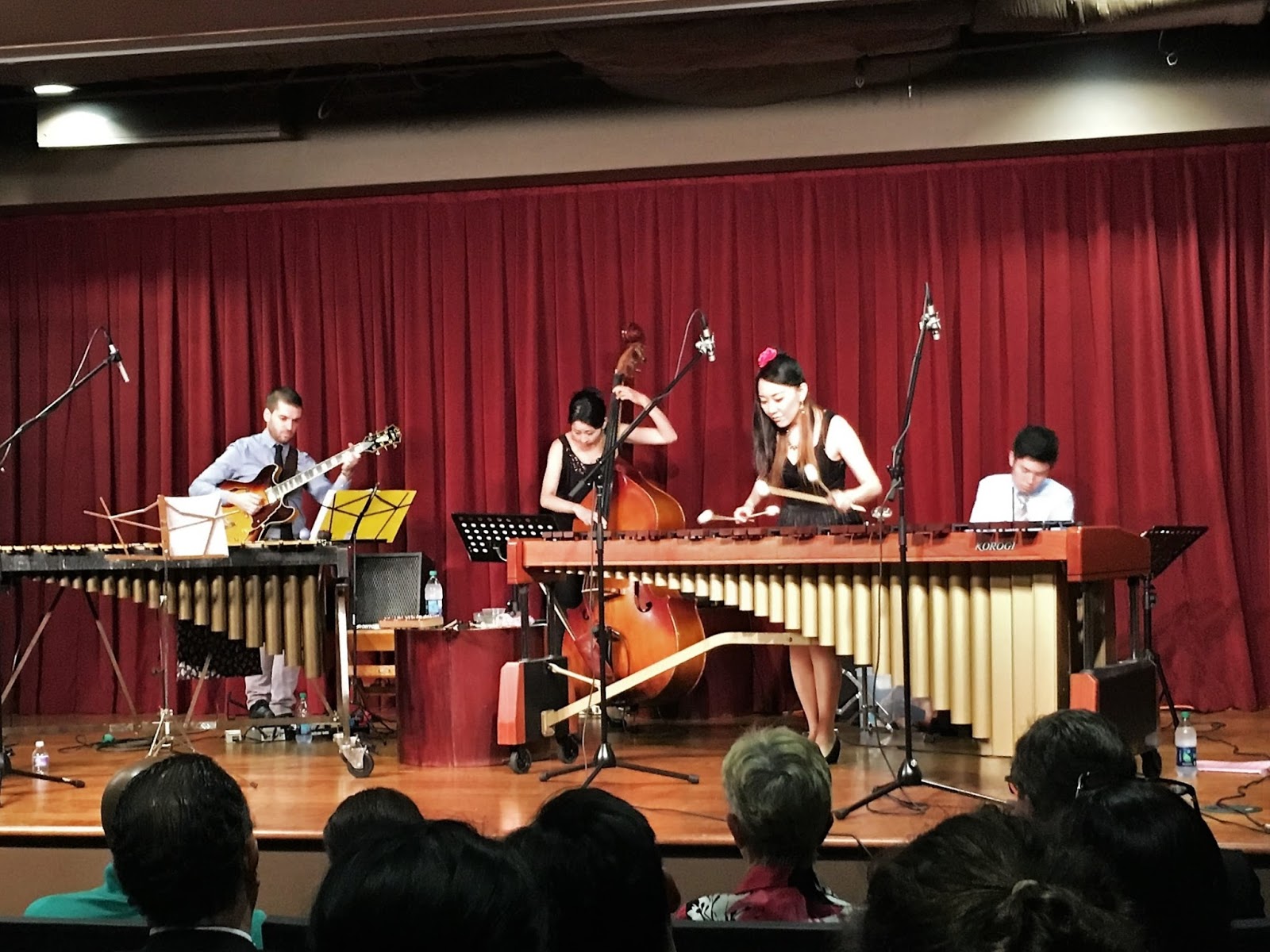
Every June sees the DC Jazz Festival in full swing with lots of concerts and live events in different settings. My season started on June 18, when I caught the Mika Mimura group as part of the Jazz Fest. The concert took place at the Japan Information and Culture Center, which has a medium-sized hall styled like an old-fashioned theater. Mika Mimura is a marimba and vibraphone artist born in Osaka, Japan. She has released two CDs under her own name consisting mostly of her own compositions, ‘Precious’ in 2009 and ‘Dreamii’ in 2014. At the JICC she played with a group consisting of the Argentinian guitarist Ignacio Hernandez, and her compatriots Kuriko Tsugawa on bass and Ken Yanabe on percussion. Mika Mimura displayed some impressive mallet work on pieces like‘The Flight of the Bumblebee,’ but was somewhat overshadowed by her mentor, Warren Wolf, whom she had invited to make a guest appearance at the concert. Wolf, a much in demand musician and teacher from Baltimore, displayed such grace, musicality and relaxed charm that his act was hard to compete with. I was also particularly taken by Tsugawa’s bass work that was both subtle and musical. Educated at Berklee College of Music and based in New York, she is a composer and leader in her own right. All in all a highly satisfying evening.

On the following night (June 19) I headed to the Hamilton for a double booking with two of today’s finest Hammond organists, Cory Henry and Joey DeFrancesco. The Hamilton, close to the White House, is one of the best music venues in DC area and, indeed, anywhere. It’s a fairly large space, with tables in front of the stage, a bar on the side towards right, and another bar up the stairs right in front of the stage. The latter is my favored location, but the advantage with the venue is that no matter where you are seated or standing, the view to the stage is unobstructed and the acoustics are very good. So I ordered some wine and got comfortable waiting for the show to start. Cory Henry was a new acquaintance to me but his turned out to be the better part of the evening, at least for me. As the name of his band, The Funk Apostles, would suggest, we were in for some serious funk that night. But the point is that this was not just rhythm music to make you move. Cory Henry’s music is imaginative and creative, the compositions are often complex with intricate harmonies and chord changes. On top of that, Henry’s own playing is both funky and sophisticated at the same time.

As a longer established musician, Joey DeFrancesco was billed as the main attraction of the evening
and the performance was very good. Unfortunately, the more traditional organ trio sounded a bit sedate after the riotous Funk Apostles. DeFrancesco’s organ sound fits well in a nightclub setting and his sidemen, on guitar and drums, performed in a highly skilled fashion in the standard jazz genre. A couple of times the leader would add to the nightclub atmosphere by singing some mellow jazz tunes or taking up his soft blown trumpet. The intensity picked up when he introduced his new tenor sax player. The evening closed with a lengthy jam session when Cory Henry joined the DeFrancesco band on stage. This final interplay with the two virtuoso keyboardists egging each other on was definitely a highlight of the night and received a roaring response from the full house.

On June 22nd the Finnish Embassy hosted an event with Nordic jazz. The modern building on Massachusetts Avenue is exceptionally beautiful, with a high ceiling, simple light wood fixtures and tall windows giving over a forested lot that was still the light green color of early summer. The embassy is also an excellent venue for music due to its good acoustics (and the open wine bar at the side).

First on stage was Sigmar Matthiasson NYC Quartet. The New York based bassist and composer is one of the best known jazz musicians emerging from Iceland. His multinational NYC Quartet consisted of Taulant Mehmeti on guitar, Baden Goyo on piano and Ayman Boujlida on drums. The music was contemplative and dreamlike, broadly in the category that is exemplified by ECM records.

The second performance of the evening was somewhat rougher. The Finnish pianist and composer Mika Pohjola presented a trio with Kyle Struve on drums and Jerome Sabbagh on tenor sax.  The lack of bass took some time to get used to but Mika’s strong left hand was mostly able to fill the void.

On the last week of June I had to travel to Canada for work and subsequently spent three weeks in Japan in July, so there was a month during which I missed whatever Washington could offer music-wise.


Soon upon my return, on July 31, I headed to the Blues Alley in Georgetown where the great  LA-based Poncho Sanchez was making a rare East Coast appearance with his Latin Jazz Band. He told the audience this was his first performance in DC in the past 30 years. I myself last saw him perform in Hollywood in the late-1980s, so this Georgetown reunion was long overdue. This was his last sold out night after several evenings of performances and it turned into a fabulous show. The venerable Blues Alley is a small and intimate venue – Dizzy Gillespie is said to have called it the finest jazz and supper club in the country. It worked perfectly for Poncho’s band, with the leader on congas, percussion and vocals, backed by Joey De Leon (timbales), Rene Camacho (bass), Rob Blake (trumpet and flugelhorn), Robert Hardt (alto and tenor saxophones, flute), Francisco Torres (trombone), Angel Rodriguez (bongos, congas), and Andy Langham (piano). Francisco Torres also serves as the musical director of the band. Blake played some very good trumpet and a lovely solo on the flugelhorn. Hardt shone on the tenor sax, especially in a blues number by Albert King, but it was his beautiful work on the alto sax that particularly caught my ear. He also played one excellent flute solo (I would have liked to hear more). The most innovative player, however, was Andy Langham who was as avant garde as you would ever hear a Latin pianist play. After the show I was so hyper that I couldn’t make myself go straight home. Instead, I crossed M Street and walked up Wisconsin Avenue to El Centro D.F. to wind down with a couple of more glasses of wine in a Latin setting.


On Saturday August the 13th I decided to leave town and headed to the Chesapeake Bay and the small resort town of North Beach. The traffic was heavy as many others had had a similar idea, but I reached the shore well before lunchtime. The weather was brutally hot and humid. The temperature hit +36oC that afternoon and there was absolutely no wind. I was sweating profusely when I found a popular Mexican place, Plaza Mexico, in which to cool down. After my break, I wandered around the beach and watched people swimming in the bay. Then I stumbled upon what was labeled the 1st Annual North Beach Jazz Festival. I entered the small and cozy courtyard – the Yard at 7th Street Market – where the action was. There was a tent where cold beer and hot BBQ were sold. A few tables and chairs were scattered in front of a small stage where a band was playing. There may have been twenty or thirty people in the audience. I found a shady corner and set to listen to the music. 

The first band was fronted by a trumpet player backed by four gentlemen on electric piano, guitar, bass and drums. The music appealed to the audience, myself included, as it swung in a relaxed manner in the summer heat. The predominant mode was 1970s-80s style rock jazz, as exemplified by a decent rendition of Herbie Hancock’s ‘Cantaloupe Island.’


After a short break, another band set up on stage. This one was led by local guitarist, DeonCleanCutt. His two sons belonged to the band as well, the younger playing the drums and the older teenager the trumpet and flugelhorn (he clearly had adopted some of the cool mannerisms of Miles). The fourth member of the band was a bass player from California who was visiting his friend here on East Coast. The bass player no doubt was the most accomplished of the musicians, having performed with such jazz stars as David Murray. The music played by this family group relied more on straight blues and jazz. 

All in all, the festival was an extraordinarily sympathetic event, even if the local bands were nothing spectacular. Mental note: make sure to find out when the 2nd Annual North Beach Jazz Festival takes place next summer.


On August 18, I again got the urge to listen to some live music, so I checked the schedules of the known places in the city to find out that Cyrus Chestnut would be performing at the Blues Alley. So I headed back to Georgetown to catch the later show at 9 pm. Am I ever so glad that I did! The piano trio is a versatile format that gives ample space for the players to stretch out based on their abilities and musical imagination. These are qualities that Cyrus Chestnut is not short of. The sensitive, innovative, open minded, creative, genre bending pianist seems totally unhindered by trivial matters like technique. In his hands, original numbers as well as standards get such a breathtaking treatment that the audience can only gasp in amazement. Again, it was impossible for me to return home without stopping at a bar to calm down.


Then on August 27 it was back to the Hamilton. This time the attraction was Al Di Meola whose Elegant Gypsy meets Romantic Warrior tour was making a one-night stop in the capital. The two-hour musical trip that Al Di Meola treated us to rekindled my enthusiasm for the music of this amazing artist whose music I have to confess I hadn’t really listened to since the 1980s. Despite the complexity and virtuosity, the music at the concert was always warm and lyrical. The band played a lot of new material, including from Di Meola’s fresh album ‘Elysium’ (it is an excellent and beautiful one), although fans would get treated to many of the old favorites as well. 

The concert was divided into three segments. The first part focused on fusion numbers that displayed some of the most advanced playing of the evening. A key member in the band was a tall young black man playing some very inspired electric violin. The second part saw Di Meola switching to an acoustic guitar and the mood changed. The final part was again electric but the focus was on more straightforward jazz rock. The set opened with a powerful version of Led Zeppelin’s ‘Immigrant Song’ in which a wailing violin played the part of Robert Plant. Some beautiful Santanaesque Latin beats followed. The Hamilton’s high ceiling was again raised when the band, which played like a dream, received several standing ovations and a raucous call for an encore, an encore that was highly rewarding.

September 2 was a night that I had prepared for. I had bought the tickets months ago as they became available. Despite the threat of rain, Chicago drew a crowd of some 7,000 to the Wolf Trap in Northern Virginia. Still going strong, Chicago played a two-hour non-stop show to an enthusiastic audience. The band was fronted by the three-man horn section consisting of the original members: Lee Loughnane, James Pankow and Walter Parazaider. The gentlemen have aged graciously but still put up a very vigorous performance, each playing inspired solos as well as the section parts that were as tight as ever. Old tunes from the band’s earliest albums, like ‘Make Me Smile’ followed each other. The original keyboardist, singer and composer Robert Lammm was there, although his role was somewhat more low key than in the past when his distinct keyboard and vocals defined the Chicago sound alongside the horns. The “new” members have not changed the Chicago sound noticeably. The keyboardist Lou Pardini (who joined the band in 2009) played a major role, also as a singer, but more as a substitute for Lamm. The drummer Tris Imboden (joined in 1990) was powerful as Daniel Seraphine in the original setting. He was supplemented by the biggest innovation in current Chicago: a percussionist. Walfredo Reyes Jr., was fabulous and some of the most exciting moments included his solos. The guitarist, Keith Howland (joined in 1995), spent much time upfront creating fiery solos, without copying the original guitarist Terry Kath (who accidentally shot himself in 1978 – what an American way to go). We also heard big hits, such as ‘If You Leave Me Now,’ performed by the bassist Jason Scheff, who channeled Peter Cetera almost perfectly both on vocals and the bass guitar. To me, a much more important ballad was ‘Color My World’ sung by Lee Loughnane and featuring Walter Parazaider’s classic flute solo, which all of us aspiring jazz and rock flutists at the time emulated. The two-hour concert ended with two of the band’s biggest hits from the early period, ‘I’m a Man’ and ’25 or 6 to 4.’ Needless to say, the multitude in the audience went crazy.

As if by some divine intervention, the rain had held itself throughout the concert, but at the moment the music ended the skies broke into a torrential downpour soaking us as we walked out of the park. It was futile even to try to stay dry as the paths and the roads soon turned into ankle-deep wildly flowing streams.

Once I get started it’s hard to stop. My jazz summer continued well into September. No more concerts by big visiting names, but there is local jazz talent who can attract a decent crowd to some of the locales around town. On the day after the Chicago concert, I ventured into Columbia Station, a long-standing club on 18th Street up in Adams Morgan and enjoyed a couple of sets of modern quartet jazz led by Knute, a local tenor sax player. 

A couple of weeks later, on September 24th my regular neighborhood haunt Acacia Bistro hosted a jazz marathon with several local bands. My choice was to listen to Jordon Dixon, a solid tenor saxophonist playing very good post-bop backed by a guitar, bass and drums trio. I had never seen my favorite neighborhood joint so packed.


By now the summer is but a memory and it is hard to imagine the heat as the cold winter winds chill one’s bones. But although the summer is gone, the music remains. Washington, DC may not be New York and one has to make more of an effort to find music, it still is a fine city.

Tuesday, November 29, 2016

Chick Corea - The Leprechaun at 75

Last June Chick Corea turned 75 and the famous Blue Note club in New York is celebrating the prominent composer, pianist, band leader with a series of nightly concerts between October 19 and December 11. On November 6, as I had meetings in New York the following days, I decided to go one day early and took the Delta Shuttle from the Washington Reagan National airport to La Guardia on the Sunday afternoon with barely time to stop by my Midtown hotel, take the 6 train down to the Village and walk over to the West Side to meet my friend Alan and his kids Emma and Ian at the club. We arrived early to secure good seats at the bar from where we would have an unobstructed view of the stage.

The Chick Corea series at the Blue Note celebrates the many faces of Chick Corea and features a broad cross section of the different combos he’s led and played with, including his famous Elektric Band, acoustic quartets and quintets, piano duets with Herbie Hancock, Brad Mehldau and Gonzalo Rubalcaba, two evenings with Gary Burton and the Harlem String Quartet, another two evenings with the Trondheim Jazz Orchestra, an evening with John McLaughlin (his partner from Miles’ Bitches Brew album), ending with four nights of Return to Forever meets Mahavishnu. Corea’s versatility and scope are indeed amazing.

 Over the past few decades I’ve caught Corea in various formats, starting with his 1970s performance at the Pori Jazz Festival in Finland with the original Return to Forever band. This was pure magic to me. Corea had previously worked with Miles Davis on a number of electric albums, which were path breaking in their hypnotic psychedelia. He had also made his own music in a more traditional piano trio format (his 1968 Now He Sings, Now He Sobs, featuring Roy Haynes and Miroslav Vitous, was a breakthrough). But the new band was something entirely different, something that no-one else had done before. It featured Corea on a Fender Rhodes, Joe Farrell on the flute and soprano sax, Stanley Clarke on bass and Airto Moreira on drums and percussion. Their regular singer, Airto’s wife, Flora Purim had just had a baby and was replaced by a less impressive male singer, but this hardly mattered. The band played music from their eponymously titled first album, which I had recently purchased and had hardly listened to anything else since then. Stanley Clarke was barely out of his teens then, but his work on the big bass was amazing and his interplay with Airto – unusually behind a regular drum kit beating a flat ride cymbal – made the music soar light as a feather (the title of their yet-to-come second album). I was just a kid, sitting on the floor in front of the stage in Pori Theater, and I was totally mesmerized (I can still remember the feeling). I could not imagine anything more beautiful than the ringing sounds of the flute and the Rhodes conjuring exotic soundscapes.

The last time I saw and heard Chick before this latest night was a couple of years ago at New York City’s Highline Ballroom, that time with an acoustic trio featuring Brian Blake and Christian McBride. This more conventional setting was anything but, as the three innovators created new music on old instruments. I was also there one night for the master’s 70th birthday celebration, also at the Blue Note. That evening the band featured Hubert Laws, the amazing flautist who was one of my greatest idols in my teen years.

This time it was the Leprechaun Band, named after the 1976 album. The band featured two other legends in addition to the maestro: Eddie Gomez on bass and Steve Gadd on drums. They had a frontline of three horns: Steve Wilson, Michael Rodriguez and Steve Davis. As per the commemorative program booklet, the evening found them “reimagining the game-changing music from The Leprechaun, My Spanish Heart and The Mad Hatter.” These three were among my all-time favorite Corea albums (although it’s hard to say, as most of them are excellent). Chick himself was in superb form alternating between acoustic and electric pianos and synthesizers (no Rhodes, though). He remains as boyish as ever and it would be hard to believe him to be his age.

Apart from his trombone, Steve Davis was in charge of the horn section, which worked together perfectly. Michael Rodriguez played crisp trumpet, although there was a debate between Alan and Ian about the merit of his solos, with the son defending Rodriguez’ work against some skepticism from his father. No-one could disagree, however, that some of the most beautiful solos were produced by Steve Wilson. Again, I was enthralled by his flute work. Where does Corea find all these stunning flutists? As a flute player myself, I have always appreciated the prominence Chick Corea gives to the instrument in his compositions.

Some of the most memorable pieces included ‘Friends’ from The Mad Hatter and ‘Reverie,’ a ballad that featured a gorgeous alto sax lead by Steve Wilson and beautiful unison work by the three horns. The set ended with a rendition of Pino Daniele’s ‘Sicily.’ This was a lovely homage to the wonderful Italian musician, composer and singer who passed away only last year at the age of 59. Needless to say, the audience that packed the Blue Note did not relent before an encore. And we got an incredible treat: ‘Spain’ as a duet between Chick and Steve Gadd. This, perhaps the most famous composition by Chick Corea, now performed only on grand piano and drums sent us to the cold New York City night radiating heat from the inside.

Sunday, June 2, 2013

Tokyo to New York @ Spectrum, June 2, 2013

On this hot and muggy first Sunday of the summer I took myself across the Williamsburg Bridge to Lower East Side to cool down with contemporary music. As I was early, I took a walk around the block. On the next block on Orchard Street there was a street fair with many stalls selling food and other stuff. All of the many bars had their fronts open and thirsty customers were sitting with their beer mugs observing the procession of scantily clad denizens on the street.

At Spectrum on Ludlow Street the atmosphere was much more subdued. A couple of dozen people had gathered in the long and dark living room where a stage was established at the far end. The side walls were lined with bookshelves. On the right side, they were filled with books; the left side was covered by thousands of CDs. I sat down on a comfortable black sofa next to the CDs and took a long sip of the aloe mango juice I had bought on the street. The occasion was a concert—Tokyo to New York—displaying new music by Japanese and American composers. The performance featured music by more than 20 contemporary composers ranging in age from early-20s to mid-80s. There were three musicians—Thomas Piercy, Mika Tanaka and Elizabeth Brown—performing on Western and Japanese instruments. The secret behind the darkness in the room turned out to be that the music was combined with a show of photographs arranged by Christina Boers projected on the back wall.

The first segment of the concert started with a solo piece ‘Mienai Sakebigoe’ on hichiriki written and performed by Piercy. This moved on to a piece by Masatora Goya, ‘Toro Nagashi’, which had Tanaka join the hichriki, playing delicate ornaments on the piano. Hichiriki, a Japanese double reed instrument used traditionally in ancient gagaku court music, has a flexible pitch and a nasal sound vaguely reminiscent of oboe. With Piercy switching to clarinet, the duo performed a U.S. premier of a piece by Akira Uchida, the soothing and hauntingly beautiful ‘New Moon’. This part of the concert ended with a hectic piece by Katsuhiro Oguri called ‘Movement 2012’ (also a U.S. premier, like several of the tunes following), depicting the chaos of New York City traffic. The photographs that accompanied it were on the same topic. The first theme of the piece culminated in a climax with a long high tone from the clarinet matching a photograph of a black man showing an equally piercing middle finger. This launched Tanaka into an atonal boogie on the piano, which appealed to my jazz sensibilities.

After the duo finished their frantic performance, Elizabeth Brown followed with a shakuhachi solo from her own Isle Royale suite. This one was ‘Loons’, a serene piece of beautiful work for the vertical bamboo flute.


The second segment of the concert featured eleven short pieces by as many composers drawn from a series of more than 50 commissioned one-minute works under the title ‘Nihon no Shiten’. The composers were Armando Ayala, Greg Bartholomew, John Bilotta, Andy Cohen, Douglas DaSilva, Andrew Davis, Jim Fox, Michael Frazier, Nina Sinakova, Daniel J. Thompson and David Wolfson. They varied between lyrical and quirky.

Another interlude followed with Brown playing another part of her bird-themed suite, ‘Black-throated blue warbler’. I have heard her play parts of the suite before in an earlier concert and can appreciate the beauty of the nature-inspired music that utilizes the unique timbre of the bamboo. The shakuhachi is a difficult instrument (Elizabeth and I talked about it briefly before the concert agreeing that it made the Western flute feel simple and straightforward) but she has established a beautiful sound and command of the instrument.

The final part of the concert started with Mika Tanaka playing her own solo composition, ‘In the Garden’, a lovely but not a radical tune. Then followed five duo pieces:  ‘YUU’ by Yohei Kurihara, ‘Sketch from Japan’ by Kazushi Iwaoka, ‘You’ by Mieko Ishii, ‘Old Men Waltz’ by Yoshihiko Banno, and ‘Space’ by Kyoko Yamaguchi. I particularly enjoyed Iwaoka’s ‘Sketch’, which utilized alternately Japanese and Western scales seamlessly contrasting the two modes. ‘Old Men Waltz’, a melancholy atmospheric piece was to me one of the high points of the afternoon. Its theme referred to the inevitability of old men waltzing away from the scene, making way to younger men; an inevitability understood by both the young and the old.

The final piece of the concert, ‘Amalgam – A’ by Hifumi Shimoyama was very interesting because it brought together shakuhachi, clarinet and piano producing very unique, surprising tonalities. Piercy explained how he had visited Shimoyama at his home in Tokyo. The composer lives in a modern high rise. When you enter his apartment, to the left is a highly modern, stylish living space, while on the right you enter into a traditional Japanese abode. This dichotomy is also evident in his music.


Meanwhile, on the sweltering street the Lower East Side was alive. Although the sun was not yet setting, there were lines to venues with live music of a different variety as I headed towards the subway on Delancey. I was glad that I had cooled off the afternoon at the Spectrum where I had been both stimulated and calmed down.

Saturday, September 1, 2012

Japanese Spirit and Music


The performance on the Sunday night, August 26, was entitled 'Japanese Spirit and Music - Voice, Shakuhachi and Shinobue.' The concert featured two Japanese music duos (with additions). It was held at the Michiko Rehearsal Studio close to New York’s Times Square. A somewhat unusual place, but very functional for the purpose, once one managed to get there through the tourist crowds on Times Square.

The first pairing was Nobuko Miyazaki and Emi Inaba. The set started with a solo shinobue, a Japanese transverse bamboo flute, by Miyazaki. She was soon joined by Inaba, a proficient pianist and composer, for a set of tunes that had all been composed by one these young ladies. The first one, on which Miyazaki played the Western flute, left me wondering whether this would be a concert of romantic but somewhat meaningless semi-classical pieces played by two good musicians. I was proven wrong, luckily, as the pace changed rather quickly afterwards. The next piece, Echo, an Inaba composition, was already quite different and quite fun! It immediately demonstrated Inaba’s compositional talents.

The following piece was hers, too, Traveller. The musicians explained how they had met nine years ago in London where Inaba had been a student of composition; how she had wanted to write a piece to play with her friend: and how she had asked about the shinobue and its scales in order to know how to write for the unusual instrument. In fact, playing shinobue or any other traditional bamboo flute with a piano with its fixed tuning is a challenge to the flutist This turned out to be one of the highlights of the performance, a tune with a beautiful theme, followed by changing dynamic and rhythmic patterns. The pianist played some complex yet attractive patterns involving both hands, first in octaves, then in harmonies, which the flute followed. The piece, as the one that followed it, was an enchanting mix of Japanese and jazz sensibilities. Despite these clear jazz influences, all of the music appeared written through with no improvisational elements.

A solo piano piece confirmed Inaba’s skills both as a pianist and, primarily, as a composer. Again, the tune moved dynamically between a sweet and harmonious beginning and an innovative and strong middle before returning to the original melody.

On March 11, 2011, Japan was struck by a tsunami that destroyed a stunning amount of the coastline and killed some 15,000 people. Nobuko Miyazaki told the audience how she had visited the devastated area in Iwate just a couple of weeks ago. She had then composed the tune that was played next as a prayer dedicated to those who perished in the disaster. It was a beautiful piece played on the shinobue, with some powerful inputs from the pianist. The set ended with another jazzy piece by Emi Inaba.  All in all, a nice performance, which was hard to pigeonhole: just two clearly very talented musicians trying to balance their act between Western and Japanese music.

None of this ambiguity was present when Emme and Akihiko Obama performed. In fact, Obama started their part of the event with a classical Japanese shakuhachi solo piece, Daha. He played it with a jinashi shakuhachi, a longer version of the classic Japanese bamboo flute with a deep sound. He switched to a shorter flute when Emme joined him (he would use five different flutes of varying lengths throughout the performance, so I won’t get into that anymore). This was an innovative version of a minyoo, a Japanese folk song arranged for just voice and shakuhachi. After the first song together, the couple proceeded to play Edo no komoriuta, a beautiful lullaby from Old Edo before it became Tokyo. The version—again just by voice and the bamboo flute—contained some amazing interplay between the musicians. It takes some out-of-the-box thinking when in the arrangements for a voice-shakuhachi duet the rhythm would be provided by the singer!

The next piece, Splendour of Sound, was honestly cooking, with Emme adding some African colour and rhythm with a thumb piano. Obama provided some inventive lines while Emme got into singing in the complex traditional nagauta style.

In Aoi Tsubame, Shu Odamura joined in with a guitar. He had to wait for a lengthy moment while Emme sang the theme unaccompanied by any other instrument—she is just fantastic, her confidence based on the absolute command of her voice and the genre—before he was able to join in. He started with an atmospheric solo, followed by a sequence in which he and Emme interplayed in an almost bossa nova –like style.

The piece led seamlessly into another one, starting with a guitar-shakuhachi duet with interesting improvisational exchanges. Suddenly, Emme joined and inserted some very potent vocals into the slowly building music. This piece contained some of the most intensive playing of the evening, with a searing shakuhachi solo by Obama.


At the end, all of the musicians present got together for a fun Japanese tune, Zakiyaki, which Emme instructed the audience to participate in (which we did by clapping our hands and joining in the catchy refrain). This was a very engaging and fun moment, with Miyazaki and Inaba joining the rest of the musicians on stage. In fact, the bamboo flute improvisations by Akihito Obama and Nobuko Miyazaki, on shakuhachi and shinobue, respectively, were most enjoyable!

To calm the scene down before we all had to go home, Emme and Obama performed one more tune. This once again brought the solo human and bamboo voices together, the couple singing  and playing with and without each other, both showing more artistry and skill than reasonable for an average musician. The beauty and peace of the Japanese music lingered with me as I stepped out to fight the crowds in the neon lit hell of Times Square.


Just a few days later, on August 30, Yoko and I went to listen to Obama once again, yet in a different setting. This time he performed in Ran Tea House, just blocks away from where we live in Williamsburg, Brooklyn. Obama’s performance tonight was part of a series of cultural talks with Asian related artists from different fields, called uNtitleDdialogue initiated by Echo He and Jessie Yang from New York University. This was the shakuhachi player’s last engagement in New York as part of his six-month Asian Cultural Council fellowship that had brought him here to research the intersection between traditional Japanese shakuhachi music and the American improvisational jazz-inspired music.

This concert consisted entirely of traditional solo shakuhachi music, with six numbers of mostly classic honkyoku style. Most of the tunes, such as Honshirabe and Shika-no-Tone, are meditational, the shakuhachi not only playing a tune in flute style; an important part of the music consists of the sounds and atmosphere created by a variety of blowing techniques.  Obama also played Kumoi-jishi, a traditional but not meditational piece in koten style, which the Buddhist monks had made just for fun, and Ko-Myo, a goeika Buddhist hymn.

The performance was followed by a brief lecture by Obama of the history of the shakuhachi, with demonstrations of the various techniques and different types of flutes that he had brought with him. This was clearly interesting to the crowd of more than fifty people, mostly of Chinese origin (my Swedish buddy Björn and I were amongst the handful of Westerners present). Shakuhachi, as so much of Japanese culture was introduced to the islands from China as early as the 6th century. Since then, the music developed in a uniquely Japanese style, while it slowly disappeared from the mainland.

Yoko, Emme and me
Obama, Yoko and me
The evening ended in an informal manner celebrating Akihito Obama’s completion of the stay in the US and his forthcoming 2nd of September birthday. While Emme brought out the cake, Obama jammed with a ukulele and guitar player demonstrating in practice the fertile middle ground between traditional shakuhachi music and contemporary jazz.