Showing posts with label China. Show all posts

Saturday, May 14, 2022

The Asian 21st Century, by Kishore Mahbubani


This new book by Kishore Mahbubani, a senior Singaporean diplomat and academic, deals with the same issues as his earlier book Has China Won? The Chinese Challenge to American Supremacy. The new one is a collection of essays that have been published elsewhere in a variety of sources, with a few interviews with the author thrown in. This results in an inevitable repetitiveness throughout. This is not only the case for substance, but Mahbubani has the tendency of using same phrases and metaphors and to cite same research multiple times. Having said that, one must largely agree with Mahbubani’s analysis and viewpoints or at least take them seriously.

The first part of the book is called ‘The End of the Era of Western Domination’ in which he makes the case that the West is in denial and must learn to act strategically in a world where it is no longer Number One. He likes to quote a prescient speech by Bill Clinton at Yale University. The then-President said that at the time when the US will become No. 2 in the world, it will benefit from clear international rules. This is an excellent observation but there are many Americans who won’t accept the inevitable that the US would not always remain No. 1 and it would be almost certain political suicide for any American politician to suggest otherwise. (The propaganda about American exceptionalism starts early in US schools and society, but is not unique to America: similar indoctrination is prevalent also in other large nations, not least in China and Russia.)

Much of Mahbubani’s writing focuses on the United States and here he is at his sharpest. His main point is that the US is no longer a democracy, but has turned into a plutocracy in which a rich minority dictates national policy. As he likes to say, it is now government of the 1%, by the 1%, for the 1%. He cites research by prominent authorities, such as the Nobel prize winner Joseph Stiglitz and the Financial Times columnist Martin Wolf, who have also observed this undeniable truth.  Evidence includes that the United States is the only developed country where the economic status of the lower 50% of the population has actually declined in the past three decades. He also refers several times to the “sea of despair” (a phrase coined by Princeton economists Angus Deaton and Anne Case) of American working classes, which led them to elect Donald Trump as president, mistaking his crude rhetoric for concern for the working poor, not realizing that Trump himself is a prime representative of the plutocracy. Again, despite all evidence to the contrary, most Americans are in denial that their country would no longer be a democracy.

At the root of the current situation is the Thatcher-Reagan revolution of the 1980s. It was—and remains—popular when Reagan made his speech, stating that government is not the solution to your problems; government is the problem. Mahbubani is obviously absolutely correct that this dogma of unfettered markets fixing all problems has led to many, if not most, of the problems the American society (and many others) now are beset with. Mahbubani quotes another Nobel laureate, Amartya Sen as saying that societies are best when they combine the invisible hand of markets with the visible hand of good government.

Mahbubani identifies three strategic mistakes that were made that led to the troubles that we are now experiencing. First was the failure of the elites to protect the working classes from the inevitable disruptions caused by globalization. This was partly due to the illusion of the “end of history”, as proclaimed by Francis Fukuyama, that the Western capitalist democracies had won the global competition and would thus not have to adjust to new realities. Mistake number two was the trust placed in markets and the intentional weakening of government institutions in the US. The third and final mistake was caused by the antipathy of the American business elites to paying attention to the larger social concerns, which then led to the creation of the plutocracy. Logically, they are all fixable, but it is impossible to fix a problem if you deny its existence.

The title of the book refers to the 21st century belonging to Asia, the focus of the second part: ‘The Asian Renaissance’. It makes a historically accurate points that the past 200 or so years have been an anomaly in world history. Before that China and India’s were the two largest economies in the world. The standards of living were higher in Asia than in Europe for much of preceding history. It was Western colonialism and imperialism, enforced by military might, that changed this. Now, China and other Asian countries are just returning to their rightful place in the world as powerful countries in their own right. It is a dangerous moment as the current hegemon, USA, is in decline (at least in relative terms) but wants to ensure its continued primacy. Mahbubani cites ample statistical data to back up this contention.

He makes the great point that if American policymakers truly believed that state-led economic policy is detrimental and that markets steer capital to the most optimal allocations, why would the US harp about the Chinese government interfering in the country’s economy? Why not just let China waste its resources through planning and state-led policy? The undisputed truth is that all current developed countries have used state-led economic policy and protection of infant industries as tools during the phase when they were rising. Now they want to deny this right from other countries threatening the interests of their multinational companies and their primacy.

Mahbubani also cites the Asian response to the Covid-19 pandemic. The mortality rates paint a picture that suggests that most Asian countries have done much better than those in the West (both North America and Europe). Perhaps, however, countries like Japan, Korea, Vietnam or Singapore (as well as New Zealand and Australia) are better examples than China where the Zero-Covid policy has led to draconian lockdowns and major societal disruptions.

The third part of the book is entitled ‘The Peaceful Rise of China’. Mahbubani has strong faith in China, which may at times seem misplaced. He admits that China is not perfect but that the mistakes that have been made are excusable. He claims that China is not expansionist and does not seek to export its model of governance beyond its own borders. As evidence, he cites that China over its thousands of years of history has not sought colonies. Yet, its actions towards Taiwan (which it considers an inalienable part of One China) and around the South China Sea cast doubt on this claim. (Of course, it would be unthinkable that China would conduct “freedom of navigation” patrols in the international waters of the Caribbean, like the US and its allies do in the South China Sea.) It may be that China prefers to concur the world through economic means, like its Belt and Road Initiative would suggest. President Xi Jinping has, however, gone on record suggesting that China’s example provides an alternative development model to current developing countries (as it obviously does; again, after the fall of communism in Europe, there was a naïve belief that, given the opportunity to vote, all people in the world would naturally choose liberal democracy; a belief that was proven dramatically wrong in Egypt and in countries that US and NATO would “liberate”, in Iraq and elsewhere.)

Mahbubani also casts an understanding eye on China’s crackdown of democracy protests in Hong Kong, writing that no society tolerates violent protest and the Chinese did well in quelling such protests in Hong Kong with no lives lost (in contrast to several protest events in the US where people were killed). He also reminds us that, in general, state should have the monopoly on violence; a very valid point which, however, may not sit well with Second Amendment enthusiasts in the United States.

Overall, Mahbubani argues that, as opposed to the American plutocracy, China is a true meritocracy. This is then reflected in the highly competent government in the country an the fact that China has the highest government approval ratings anywhere in the world. He points out (several times) that the past four decades have been the best for the Chinese people in the country’s 5000-year history. The approval ratings are verifiable and may be in response to good governance (the Chinese people have made a bargain with their leaders: as long as the economy continues to grow, political rights are secondary), although one also suspects that they reflect the significantly increased patriotism among especially young Chinese caused by indoctrination and censorship (see, e.g., Tracy Wen Liu’s article in the spring 2022 issue of Foreign Policy). The fact remains that the West (and especially the US) loses many of the brightest graduates to the private sector due to the salary differential and the anti-government sentiment. Singapore, where Mahbubani is from, is arguably the most meritocratic and best run country where the best graduates go to government jobs, which are well paid and powerful (perhaps out of modesty, Mahbubani does not emphasize this).

The final part focuses on ‘Globalization, Multilateralism and Cooperation’. Mahbubani is a strong proponent of multilateral action, both at the global (the United Nations) and regional (EU, ASEAN) levels. He rightly underscores that many of the problems that the world faces—the pandemic, climate change, migration, the global economy—are beyond the ability of nation states to manage. He berates the United States and the West more generally for intentionally weaking multilateral institutions, such as the WHO which would be needed more now than ever. He recognizes that powerful countries think that multilateralism constrains them, but points out the fallacy in this argument. One of his metaphors repeated a couple of times is that today’s world is like a cruise ship with nation states as cabins. It doesn’t make sense only to keep the individual cabins clean without taking care of the entire ship.

Mahbubani is a strong believer in globalization, free trade, and competition. He laments the isolationist tendencies that populist leaders around the world favor. The US withdrawal during President Trump’s tenure from the Trans-Pacific Partnership (TPP) is one of his targets. He also believes that economics will trump military strength and, therefore, in terms of four-letter abbreviations, the RCEP (Regional Comprehensive Economic Partnership that brings together 15 nations in the Asia-Pacific region)  will be more powerful than QUAD (the quadrilateral security dialogue between the USA, Australia, India and Japan).

He also emphasizes the importance of economic growth and frequently cites GDP growth figures as evidence of Asia’s (notably China and India) success. In this sense, his economic views are quite traditional. Although he mentions the problem of climate change several times, he doesn’t seem to make the connection to the growth in extraction of natural resources, production, and consumption as the drivers of climate change and wider environmental destruction. The problem with GDP is that it measures only economic output based on monetary transactions. It does not discriminate between positive and negative outputs, it doesn’t measure unpaid work (like, care of children or the elderly), and it is not negatively affected by reduced natural capital or environmental degradation.

Mahbubani clearly considers himself a practitioner of Realpolitik. His idols whom he frequently evokes include the legendary American diplomat George Kennan, the founder and long-term leader of Singapore Lee Kuan Yew, and Henry Kissinger. The latter sounds odd, even callous, given how much blood, especially Asian blood (think, Vietnam, Cambodia, Bangladesh…), the man has on his hands.

Kishore Mahbubani is a significant thinker on the global policy arena. Reading him is stimulating. He is not afraid of slaying sacred cows. This is not a book to the liking of those who think that the US is the greatest country on earth and that Western style democracy will always win, but it is them who would most benefit from reading it.

Saturday, September 28, 2019

Qingchengshan beauty in the mist


[This trip took place in September 2018 after the Asian Evaluation Week that was held in Chengdu, Sichuan.]


It was a grey morning with a constant drizzle in Chengdu when my friend Nanthi and I decided to stick to our plan to head towards Mt. Qingcheng, a sacred mountain where it is said Taoism was born. We grabbed a taxi and headed to the Chengdu North railway station where we arrived less than half an hour later. We had consulted the train schedule and left ourselves ample time to catch the targeted train. This was good, as we would need ample time to figure out how the system worked.
The rainy square in front of the station was crowded with people. There were many who looked like migrant workers from the countryside. A tiny elderly couple – or perhaps they were just middle-aged whose life had taken a toll on them – were walking with huge backpacks on their backs. Some seemed to have camped by the station keeping the rain out with plastic sheets. A tall, slim woman in an elegant red dress and matching high-heel shoes was leading a couple of older peasant-looking folks along – relatives from the countryside, perhaps even her parents (what a difference a generation and life in the big city makes!).
Initially, we headed towards the station gate and pronounced “Qingchengshan” (‘shan’ being the Chinese word for mountain) to the young lady occupying the booth that we first approached. Her face didn’t register any understanding of the message, but soon a uniformed guard appeared from the side and pointed us toward another large building across the vast square. Nanthi, being his stubborn self didn’t want to follow the instructions – after all, he argued rather logically, we were at the gates to the railway station from where the train would likely leave – but I convinced him to go look at the other place. We crossed the square and first arrived at a fence with a sign “Emergent Exit” (apparently it wasn’t quite ready yet) but to the right of it, there were stairs that led to a place clearly identifiable as ticket counters. So we placed ourselves in two lines to see which one would move faster. I had used my smart phone translation to pull up “Qingchengshan” (青城山) in Chinese on the screen. Soon enough we had our tickets in hand. The one-way trip put us back by ¥19 or about $2.75.


We returned to the station gate where we had started and presented the tickets. Once the nice lady had inspected our passports, we were allowed into the spacious waiting room of the station. There were perhaps a dozen or two other people there, but the large room appeared almost empty. Now that we had made it in, we actually had some time to look around in the few shops around there. There were a couple of grocers that sold whatever you might need on a train trip, from snacks and beer to small souvenirs. Food-wise, the choice was between McDonald’s and a local place that specialized in deep fried chicken feet. Luckily we had had a good breakfast.

 Our train left on time and we had numbered seats, so boarding was orderly even though the train became rather full (apparently, other passengers had been able to time their arrival to the station better). It was a bullet train that reminded me of the shinkansen in Japan: new, clean, sleek and fast. Like in Japan, the train attendants would stop and bow as they entered the compartment. Leaving from the northern part of the city, the tracks first traversed residential areas where everywhere there was major urban renewal taking place. Chengdu has grown to a metropolis of 14 million people. All over, old shabby looking buildings were being torn down to be replaced by massive modern apartment blocks.

As there were a few stops on the outskirts of the city, the bullet train didn’t travel at top speed but it still reached 190 km/h at some stretches. While the American flagship train, Acela, could in theory reach the speed of 240 km/h, it never travels that fast on its route from Washington, DC to New York and Boston due to the poor condition of the old tracks. On that stretch, there are a few patches where the train can go up to 160 km/h, but also passages where the top speed is just 40 km/h. I am convinced that this lack of upgrading and maintenance of infrastructure will be the downfall of the USA. But there are too many politicians, especially in the Republican party, who consider trains and other forms of public transport to be socialism and therefore not to be funded.


In about 40 minutes we reached the Qingchengshan station about 60 km northwest of Chengdu. The station was modern and clean. In front of it there was again a wide square on the other side of which we spotted a tourist information booth. Again, our initial approach caused some consternation but the person at the booth managed to fetch a young woman with adequate English to cater to us. We ended up taking a taxi to the entrance of where the Mt. Qingcheng cultural protected area starts. Beyond that, no motorized vehicles were allowed but there were electric vehicles, not unlike large golf carts, that shuttled people from the parking lot to the traditional gate of the area. We invested in a ticket to save some time instead of walking and were soon speeding soundlessly through a road lined with beautiful forest.


Once we reached the gate to the mountain, we disembarked. From here on, we would walk. The entrance to Mt. Qingcheng is a sight in its own right: a striking structure with pagoda-like tiled gables, guarded by imperial guardian lions carved from stone on both sides. The area outside of the entrance itself was surrounded by beautiful evergreen forests. All the buildings were traditional in style. But passing through the gate we entered another world of lush green vegetation and surprising peacefulness despite the many people around us. The air was pleasantly cool but very moist. A stream forming small waterfalls ran from higher up in the mountains. Mt. Qincheng is located at the southwest part of the traditional Dujiangyan irrigation system.


We followed the path that was covered with meticulously maintained wooden planks. We first arrived at the Natural Pavilion, which according to the sign integrates, “to a great extent,” the Taoist ideas of “syncretism between heaven and man, leaning from the nature, and the three begetting all things of the world.” The sign also informed us of the more than a hundred kiosks and pavilions on Mt. Qingcheng, which are exquisitely decorated and feature “quietness, depth, queerness, peril, grandness, beauty, aliveness, profoundness, etc.” Our expectations were raised.


Continuing our way up the hitherto mercifully gentle slope we arrived at a lake at a higher plateau. The scenery was breathtakingly beautiful with green mountains shrouded by low-hanging clouds on the other side of the still lake. A decorated ferry crossed the lake ferrying travelers across. We saw no other foreigners anywhere. Soon we, too, were on the ferry that quickly became crowded. The crossing took only a few minutes and we disembarked on the other side.


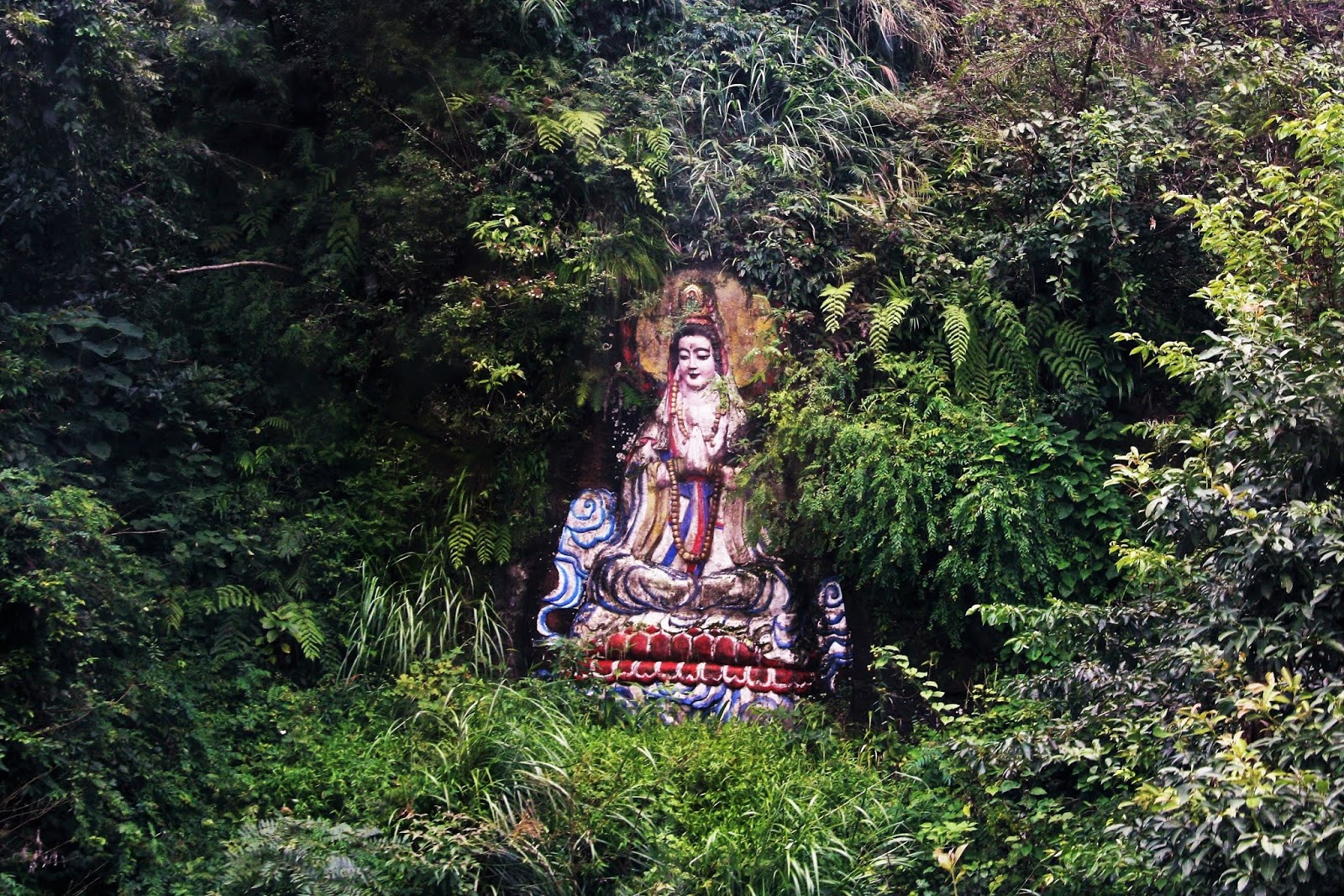
Here was a cable car station and we boarded a gondola that took us up to a high peak. From the gently swaying gondola we could see that the mountainside was covered in thick, almost inpenetrable green vegetation, but there were Buddhist objects hidden in the shrubbery. Having placed them where they were must have taken plenty of determination and effort.


We first arrived at the Ciyun Tower, a wonderfully beautiful structure but with no apparent religious meaning.

We continued on foot across the mountain forest with moss-covered rocks on both sides until we reached a further peak. Mt. Qingcheng is 1,260 meters tall and we must have been close to the highest point. From here the view was exactly like in a classic Chinese ink wash painting from Tang Dynasty (618-907). The view was across a valley with several other peaks standing at various distances giving the impression of depth continuing in eternity. The fog made the landscape look monochromatic.


Continuing our climb, we arrived at the Shangqing Palace. The palace was originally built during the Jin Dynasty (265-420) but was subsequently destroyed and rebuilt during the Qing Dynasty (1644-1912).  The place was decorated with red flags of Buddhism and equally red candles burned in the incense burners. An old monk and a young temple maiden with a long braid down her back were guarding the site. What a blessed life they must lead, I thought.

In the area there are many of Taoism’s most revered buildings amongst the gorgeous natural landscape, each more beautiful than you could imagine.


We continued our hike towards the summit of Mt. Qingcheng from where the views were magnificent. Unfortunately, because of our limited time it was impossible to see even half of this unique place and its incredible cultural history. We had to descend again so that we would be able to catch another train and get to Chengdu by evening. Along the way, we encountered numerous gorgeous buildings, some of which contained shops where one could purchase refreshments and Buddhist items, such as prayer beads.


We retraced our steps, took the cable car down and crossed the lake to the opposite direction. In the process we had walked for several kilometers and given the gradient, I could feel it in my leg muscles. Luckily, though, I did not have to submit to be carried down in a bed suspended between two long bamboo poles. This mode of transportation was readily available. The men in charge cheerfully ran along the mountain paths with their load resting in the crib. Their lungs and circulation must have an incredible capacity to absorb oxygen.


Further down we came across kiosks that sold a large variety of dried mushrooms and other products from the mountain. No doubt they would all have medicinal qualities – perhaps some bore the secret to the porters’ extraordinary stamina.


We returned passing by the Enchanting Pavilion and the Happiness Pavilion until we were back at the Nature’s Pavilion heading towards the Celestial Hall until we reached the clear stream and the gate to Qingchengshan at the elevation of 780 meters above sea level. Here a sign explained that, according to monitoring results, the negative oxygen ion concentration here was 180 times that of the city. This was the result of the particular geological conditions, the dense forest vegetation and the humid climate of Mr. Qingcheng. The sign further explained that when the negative oxygen ion concentration reaches a certain degree, “it will make people breath smoothly and feel refreshed, thus is good for immunity system and health.” Based on my experience today, I have no reason to doubt these beneficial effects on the health of both my body and mind.

Friday, September 27, 2019

Excursion to the Western Mountains


[In September 2019 I attended the annual Asian Evaluation Week in Kunming, Yunnan. In the late-1990s when I was with the United Nations University based in Tokyo, I had a joint project in Yunnan with the Kunming Institute of Botany, which allowed me to visit Kunming and travel around the beautiful province of Yunnan on several occasions. This was my first time back in 21 years. Just earlier this week, I visited my then collaborators with whom I have kept in touch through all these years, Guo Huijun and Liang Luohui. Guo who was a young promising researcher when we worked together has last year been appointed President of the Southwestern Forestry University, a major research university with 22,000 students. Liang, now affiliated with the Chinese Academy of Sciences was the one who introduced me to Yuanmei Jiao.]

Huating Temple
It was a foggy morning and there was a palpable threat of rain in the air when Zhijuan picked us up from the hotel in southwest of Kunming. Miki and I were ready for a short excursion to the hills just 12 km outside of town. Zhijuan Zeng was a graduate student of geography at Yunnan Normal University. Her professor, Yuanmei Jiao, had assigned her to accompany the foreign visitors on this trip. Dismissing our praise for her hospitality and kindness, Yuanmei assured us that the day trip would be good for Zhijuan’s English practice. (Zhijuan’s presence would definitely make the trip easier. A year ago, having attended the same annual meeting in Chengdu, my friend Nanthi and I took another mountain and temple tour by ourselves. We managed well, despite the language barrier.)

Zhijuan, Miki and I took a taxi to the foot of Xi Shan (西山) or Western Mountains. Driving through the town, gave a clear indication of how the city has grown both vertically and horizontally in the intervening two decades I have been away. Thankfully, it still has retained much of its charm, thanks largely to the genuinely welcoming people.

When we reached the base of the mountain, we switched to a bus that would take us further up. The Xi Shan is a protected area and a popular recreation spot for locals because of the clean air and beautiful scenery. My friend Liang, a Yunnan native, says that he comes here at least once a month when he needs some rest for his soul. We first got off the bus at a temple halfway up. Huating is a Buddhist temple with a history that reaches back to the Yuan Dynasty (1271-1368). The temple itself was first established in 1320 but it got its name – Huating – only in 1441 by Emperor Yingzong of the Ming Dynasty (1368-1644). The temple, having been built of wood, suffered several calamities during its history but was always reconstructed. This is a common practice with temples in East Asia and the fact that something has been destroyed and rebuilt many times over the centuries does nothing to reduce its historical value. The current Huating Temple stems from the 1920s. Huating is a National Key Buddhist Temple according to the Chinese government.

The temple consists of two main halls, the Four Heavenly Kings Hall and the Mahavira Hall. When you enter the Four Heavenly Kings Hall, you walk in between large statues of Heng and Ha, two ancient Shang Dynasty generals in Chinese legend, before reaching the statues of Buddha and the bodhisattva Skanda (guardian of Buddhist monasteries) at the center.


Zhijuan explores Huating grounds
Although not particularly large, the Huating is very beautiful and has a peaceful atmosphere. Temple gardens are often important repositories of local biodiversity, as the groves have been spared from cutting down for long periods. There were a few other visitors, all Chinese. Two of the women stopped to pray at the Buddha.


Having spent a good hour admiring the Huating and soaking in its peacefulness, we returned to the roadside to wait for another bus to take us further up the hill. We were lucky as the rain never came. In fact, from time to time the sun would peek out from between the clouds.

We got off at the final stop of where the entrance to the mountain peak was located. Here there were considerably more people but, again, no other foreigners in sight. Soon after the gates, the path started to climb. The famous Longmen Grottoes have been carved into the hillside during a 72-year period starting in 1782 during Qing Dynasty. The grottoes are connected by narrow stone-paved paths and extremely steep steps. I soon started to feel the exercise in my lungs. We were between 2,250 and 2,300 meters above sea level and the thin air together with the strain of the climb were getting to me. Even Miki confessed that he was feeling tired. Although I had been in Kunming for a week and the city itself lies at 1,800 meters’ altitude, I hadn’t gotten accustomed to the elevation. This being a weekday, there were lots of old people on the path. I admired their stamina.


Taking the excuse of studying some historical construct or admiring the view, I rested at every level place during the climb. The 23-year-old Zhijuan didn’t seem to grasp that we were getting rather exhausted but she accepted the frequent stops. Having said that, the views from the hill down to Dianchi Lake and beyond to the city were quite stunning. The air was still rather misty, which limited the visibility. Still, in the balance, I was pleased that the sun wasn’t blaring upon us from a cloudless sky.

The hillsides were extremely steep and at times the path passed through grottoes so low that I had to crouch to get through. The workers who constructed the trail 250 years ago clearly were smaller than I. 
Dianchi Lake with Kunming City in the distance


We eventually reached the destination: the Dragon Gate complex resting on a hillside so steep that the drop is absolutely vertical to the lake shore. Having spent some time admiring the place and taking photographs of each other with the view, just like all the local tourists, it was time to head back. The way down was easier on the lungs, but walking down the narrow stone steps that were moist as a result of the earlier fog, was hard on the legs as one had to tense the thigh muscles constantly in order not to roll down the hill.

The excursion was short but refreshing. Back in the city, we still had daylight to enjoy a leisurely walk around the beautiful Cuihu park with its lakes and waterways covered with lotus waterlilies. Unfortunately, the flowering season was over and only a few of the plants still bore gorgeous flowers. I personally was most happy to be walking on flat land.


Tuesday, September 18, 2018

Ordos: Not quite a ghost town


Ordos, in the Chinese autonomous region of Inner Mongolia, has been called a ‘ghost town’ (see for example Wade Shepard’s 2017 article in Forbes magazine, entitled “China’s Most Infamous ‘Ghost City’ Is Rising from the Desert”). There’s a reason for that; the city is not exactly packed with life. Still the depiction may be unfair. I spent a week there last autumn and found the place to be both intriguing and challenging. It surely is impressive, with its high rises, wide avenues, monumental squares and parks. When I landed at the shiny new airport in the middle of the night, disembarking from an Air China flight from Beijing, the entry was very smooth. There were few people at the airport and a taxi was waiting. We headed off on a road to near total darkness soon to arrive at a brightly lit toll gate with extravagant decorations shining in the night. Then off we went on a drive that felt like an eternity on an empty eight-lane highway, mostly unlit, until we hit the outskirts of the city. I was sharing the ride with an American lady whom we dropped off first at a massive Howard Johnson establishment (I didn’t know these motels came in such sizes) before driving another 5 minutes to reach my hotel, Tieniu, across a large intersection in the middle of the city. In the lobby I was met by a young man dressed in a pale blue uniform explaining the system to me: where the restaurants were, at what time meals were served, etc.; and taking me to my 9th floor room. The room was comfortable, overlooking the intersection and a park behind it, and after a while I settled into the standard hotel bed.

Dongsheng dawn
The morning dawned beautiful. After only a few hours of sleep I woke up and looked out over the intersection and the park. The moon shone over the slowly brightening sky. It was quiet and no movement could be seen. Around 7 am the city started to wake up and loud music with a disco beat started blaring from the park. Presumably it was played to prepare the city’s denizens for another productive day; most likely there were people in the park engaging in rhythmic morning exercises but I couldn’t see it from my room.

The young man in blue from last night, I would find out, belonged to a group of hundreds of student volunteers who had been mobilized to guide the thousands of foreigners who had gathered in town for the 13th meeting of the Conference of the Parties (CoP13) of the United Nations Convention to Combat Desertification (UNCCD). Ordos was hosting the biannual event in its large new Convention Center, apparently one of the first such international gatherings in town. The student guides were an essential part of the success, as the locals certainly were not well equipped to deal with the invasion. While street signs were generally in three scripts – Chinese, Mongolian and Western – they would not be very helpful. Similarly, the ability of the local people to communicate in English was virtually non-existent. Even at the reception of this 4-star hotel, the staff lacked even a rudimentary knowledge of basic English words.

I walked out of the hotel and turned left on what appeared to be a commercial street. The air was dry 
Dongsheng
and the sun shone brightly. There were a few people on the street but nothing that could be described a crowd. After all it was a Saturday. I found an ATM and tried each and every one of my credit and debit cards for some cash, but to no avail. With no luck at the ATM, I wondered into a large shopping complex, walked down the stairs and entered. The shops were open but the place was virtually deserted. It seemed to me that most of the establishments sold clothes and many appeared to focus on fashionable street wear. I entered a shop that sold drinks and was met by a very friendly woman eager to help. She smiled broadly and despite the lack of a common language we managed to select something for me to drink right away as well as some interesting looking Baijiu for a later occasion. As I had no cash, she indicated credit cards would be just fine. She whipped out a credit card machine but it would not accept any of my cards. She fished out another one from a cupboard, a bulky old-fashioned item, dusted it off and plugged it into a wall outlet. Again, the result was the same. After some 10 minutes we both gave up and I walked out without my drinks while the nice lady looked distressed.

I returned to the hotel and asked the group of volunteers in their pale blue outfits about how to get to the Convention Center. A helpful young lady explained that there was a bus that would go straight there and that I wouldn’t have to pay the fare. Apparently, there was a deal that the foreign delegates would ride free; having us understand the payment system and give the right amount of money was clearly more trouble than it was worth. I would just have to walk across the street and wait for bus number 3. Crossing the road was no problem as there was virtually no traffic, so I positioned myself on the bus stop and started to wait.

There were a couple of other people who ogled me with curiosity. Soon two teenage girls approached me. One of them ventured a hesitant ‘hello’ and plenty of giggles followed when I responded in the same way. That was the extent of our mutual vocabulary, but the girls indicated that they wanted to have photographs with me. We asked the other people waiting at the bus stop to take the photos.

Soon bus number 3 arrived and I boarded it. The driver welcomed me with a smile. There was one other passenger, a middle-aged lady who was equally welcoming and said something to me in Chinese. This turned out to be a regular city bus. I placed myself next to an open window, as the day was getting warm and I could welcome the breeze. The bus moved at an extraordinarily slow pace through the vast deserted streets. At a later stop, a young man in the pale blue uniform boarded and the friendly lady beckoned him over. The volunteer confirmed that I was on the right bus and that I should just have to wait until we reached the Convention Center stop; I would not be able to miss it. Soon the bus left the city and entered an eight-lane highway, presumably the same my taxi had used last night. The highway was new and looked very impressive. There was very little traffic. Some cars cruised smoothly past us, while we encountered a few other buses and trucks. The landscape around us, now that I could see it, was open and the blue sky appeared high. Everywhere there were tree plantations with saplings in straight rows sticking out of the dry soil. The landforms were rolling hills. Afforesting the bare hills was obviously an official priority. There was a river and a reservoir with large Chinese letters in bright red inscribed on the adjacent hillside. Perhaps they declared some environmental goal but I could not be certain. The bus crept along the fancy highway at most 50 km/h. The speed limit said 100 km/h, or 80 in areas of intersections. When the road moved uphill, our speed slowed to a crawl. I was concerned that the engine would die and we would be deserted in the middle of an empty stretch with the scorching sun upon us in the merciless sky.
Reservoir between Dongsheng and Kangbashi


The highway passed through empty areas with only neat afforestation projects on both sides. In some places they were irrigated by water trucks. There were old workers in neon vests ambling around the center plantations that separated the traffic going in opposite directions. Occasionally we would see high rise developments that looked empty. Finally, we left the highway and entered another urban area: the Kangbashi New District. The city roads were wide with three lanes going in each direction. On the roadsides there were monuments of large horses – this was Inner Mongolia where horses have played a central part in the culture since the times of the Genghis Khan – and parks with fountains sparing no amount of water in this dry land. We reached the Convention Center stop and I disembarked. The bus ride had taken 70 minutes. I had enjoyed the scenery and the few people on the bus, including the driver, had been very hospitable but I decided I would invest in a taxi ride from now on for the coming week. This would cut the travel time by half.

Convention Center in Kangbashi
The Convention Center occupied large grounds and was very pleasant. The first thing a visitor saw was a display of plant art, dominated by a 7-8 meter tall horse flanked by other Mongolian items. There was a booth selling coffee and cold drinks, as well as other utility booths, before one entered the main building. On the left there was a massive tent that served as the dining area where one could purchase a large variety of Chinese, Western, vegetarian and halal foods (there are lots of Muslims in northwestern China). I spent the rest of the day – and several more to come – in the conference. We also conducted a field visit to environmental projects funded, amongst others, by the Global Environment Facility. But the evenings I would spend in Dongsheng, mostly by myself as my colleagues were all lodged in Kangbashi.

By now I had figured out how these two centers hang together (and here I rely in particular on an article by the geographer Max Woodworth published in the journal Cities in 2015). Located in the valley of the Yellow River, Ordos has historically been a poor area in China, plagued by its dry climate (with an average annual rainfall of only 341 mm) and poor agricultural land. In the early-2000s, however, the town experienced a significant boom period due to exploitation of its abundant natural resources – notably coal and gas, which also experienced high prices at that period. As a consequence, Ordos was dubbed as “China’s new coal capital”: investment poured in and people’s incomes rose rapidly. Dongsheng was the town that had previously formed the urban core of Ordos. In 2001, Ordos Municipality was founded around Dongsheng and a new center, the Kangbashi New District, was established about 25 km north of Dongsheng to form this bi-centered conglomerate. The two centers and other subcenters in between were connected by the fancy new highways that I had now traveled on.  Kangbashi was a planned center with administrative offices, cultural facilities and residential areas – and the Convention Center – popping up at a rapid succession. Kangbashi New District was inaugurated in 2006. Apart from the fine new infrastructure, there was a major greening effort that included planting 200,000 trees – I had observed this on my first trip from Dongsheng to Kangbashi.


The Ordos Performing Arts Center & Ordos Cultural Center
In the decade from 2000 to 2010, the Ordos municipality’s population increased by 39% as some
417,000 people moved in, partly lured by opportunities in the boom town, partly as part of official mass location of entire villages from the ecologically fragile semi-arid areas to the city. Then around 2011, the bubble burst, as the inflated real estate market collapsed simultaneously with a dip in coal prices. Since 2012, two-thirds of the coal mines in Ordos have scaled back or closed down. Up to 200,000 people left Ordos municipality in the next couple of years, mostly recent migrants whose hopes for a better urban life didn’t materialize, thus contributing to the image of a ghost town. While Dongsheng still has some 580,000 inhabitants, Kangbashi’s population is a modest 30,000 with a 70% vacancy rate in the residential developments.

Dongsheng by night
At nighttime, all public buildings and monuments in both Kangbashi and Dongsheng were brightly lit with colorful lights that shifted and flashed forming impressive displays of lightshows. All of the electricity would be provided by coalfired power plants implanted in the surrounding desert. From my hotel room I could see a fountain sprouting water high up in the air in different formations illuminated with spotlights constantly changing colors. The high rise next door had an entire wall decorated with red and blue lights in the pattern of flowing water. Every few minutes a car would pass on the avenues below.

When I had some free time on a Sunday, I walked over to the park. At its center was an artificial lake
The park in Dongsheng
and some children were playing in the water. There was a small temple and some people were walking leisurely around the pond. The park was a well-kept oasis surrounded by the skyscrapers of Donsheng. In fact, I noticed several municipal workers quietly toiling in the gardens and maintaining the paths.


One of the first evenings I returned to the hotel hungry and wanted to have dinner. It was about 8:45 pm and I had been informed that the restaurant would be open until 9:30. My arrival caused considerable commotion. The maître d’, an attractive woman in a black uniform with a short skirt and black stockings, literally ran to the dining room and found that all other patrons (if indeed there had been any) had already departed and the staff were busy closing shop. Luckily there would be room service available. With the help of the nice lady I was able to select a meal to be brought to my room. She didn’t speak any English but there was an English menu and I picked a familiar item: Kung Pao Chicken. She also took me to a room that served as their wine cellar where I selected a bottle of local Great Wall red wine (not bad at all). About 20 minutes later the same maître d’ showed up at my door with a waiter carrying the food and wine.

Ms. Zhang
On another night I repeated the procedure, went to the 2nd floor restaurant reception, negotiated with the lovely maître d’ (by this time I had learned that her name was Zhang) and ordered room service. Mongolian food tends to be heavy on meat and this time my meal was diced beef with onions, leeks and asparagus. It probably was the best meal I had in Ordos. Zhang and a waiter again brought it up to my room. This time she stayed behind for a few minutes and we took selfies with each other. She also showed me some photos on her cell phone.

The selfie theme repeated itself several times during my visit, so rare was the appearance of foreign creatures in these parts. Once when I was returning to Dongsheng from the conference, the taxi driver, a middle-aged man, stopped the taxi, whipped out his cell phone and asked whether he could snap a selfie with me in the back seat. Of course, I had no objections.

One evening as I returned to the hotel I was determined to find somewhere else with a bit of life to sit and enjoy the scenery. I descended to the reception where there were five or six employees behind the counter. I tried to ask about where I could go out for a drink. This drew a blank. Not a single one of the employees understood the word. No worries, soon a young woman in pale blue ran to my rescue. Unfortunately, she was equally lost. I suggested a ‘bar’, but neither was that word familiar to her. But she did have an electronic dictionary and after consulting it for a while, she looked up to me and asked: “So you want to go to a pub?” I said that a pub was close enough and that I would indeed want to go to one. She consulted with the receptionists who still looked lost. I suggested that hotels usually had bars, especially big ones like the Tieniu, but learned that this was not the case in Ordos. We went outside and consulted with two taxi drivers and came to the conclusion that a pub did indeed exist in Dongsheng. So I jumped into the back of the taxi and off we drove into the darkness. I was having second thoughts as the taxi drove through empty avenues further and further away from what I had thought was city center. We passed another smaller hotel in front of which we had to wait as a bus let off a large group of Chinese tourists. We drove across a parking lot and turned onto a street that appeared entirely dark. Lo and behold, the taxi driver curved in front of a building where there indeed was a pub. Hospitable as everyone I had met in Ordos was, the taxi driver got out of the car, walked with me to the establishment and announced my arrival to the staff. I was warmly welcomed as the smiling taxi driver bowed deep and retreated backwards towards his waiting vehicle on the dark deserted street.
The pub


I was ushered to a table. The place had a red theme, wooden tables, and a prominent bar in the middle of the room. There were only two other customers in the establishment, a youngish Western couple chatting over beers at a nearby table. The staff consisted of a man and a woman who served as waiters and another woman on the kitchen side who appeared to be the boss. The man brought me a menu, which had some English and a few pictures. I saw there were a few foreign beers, like Allagash White, but when the waiter suggested the first item on the menu I gladly agreed. Soon I had in front of me a 1.5-liter pitcher of local beer, which would put me back by about $1. I also ordered an item from the menu having first ascertained that it was chicken (I ended up shaking my folded arms as if they were the short wings of a hen and, as that didn’t do the trick, drew a chicken on a napkin; by this time the boss had also emerged from the kitchen and she nodded vigorously in affirmation).


The evening turned very pleasant. Little by little, after 9 pm local kids started to drift into the bar. They all looked relaxed and dressed in jeans or miniskirts in a slightly punkish style. Some carried guitar cases. They ordered beer and chatted. My chicken and beer did the trick and I felt contended. On TV there was a Chinese historical fantasy drama where drop-dead-gorgeous women slashed bad guys with swords. The foreign couple got up and went to the cashier to pay, only to find that their credit cards would not be accepted and they did not have any cash. The boss emerged again from the kitchen and a negotiation ensued. With sign language, the foreigners explained that they lived in a nearby hotel and showed the hotel card. They promised to come back the following day to pay, which I am convinced they would do (they looked very decent). Luckily, I had found a Bank of China branch where I had been able to withdraw cash for the taxi rides and other minor investments, so I had no trouble paying the bill. The nice young lady who was the boss called me a taxi and the male waiter escorted me to the dark empty street when it arrived.

On the following evening after work I returned to the shopping mall next to my hotel. I found the shop where I had tried to purchase drinks on my first day. The same woman was behind the counter and her face lit up when she saw me. She welcomed me warmly like an old friend and quickly ran to fetch the bottles of local liquor I had failed to purchase the first time around. This time I had cash and we separated thanking each other profusely. Then in the basement where the food stores were located, I found a small café that sold beer. It was weak and warm but wet and it made my day.

Ordos Municipality Government offices, Kangbashi New District
On my last afternoon with all work completed I left the Convention Center in Kangbashi and walked maybe 15 minutes alongside the broad and empty avenues towards Ordos Museum. I passed the Kangbashi police headquarters, a big square building flanked by a red flag behind a bank of colorful flowers. Then the Kangbashi New District municipal offices that were housed in four large blocks with a Genghis Khan themed monument in front.

I crossed the avenue, which was not challenging despite its impressive width because of the sparse
traffic, and entered a vast park – the Genghis Khan Square. The space was wide open and the trees that were there had been planted only recently. The entrance to the park sported a statue of two huge horses standing on their hindlegs. Further in, there were equally large and fanciful statues, including a pair of gigantic Mongolian wrestlers positioned against each other across a square. All of these were very creative and entertaining. I spotted another person in the park, a Chinese man taking photographs of the features.


The park was surrounded by some of the most important buildings in Kangbashi, including the Ordos Performing Arts Center, the Ordos Cultural Center, the Ordos Library and the Ordos Museum. They all had very innovative contemporary architecture. I took a direction diagonally across the park towards the museum, passing a very nice and imaginative patch of flowers with larger than life sheep grazing in the middle.


Ordos Museum
The museum itself was definitely worth a visit. The massive building had an impressive contemporary design like a huge egg laid on a high foundation. It was designed by the Chinese architects MAD and opened in 2011. I walked around it in the relentless afternoon sunshine searching for the main entrance (it turned out that I started circling the edifice in the wrong direction and had to walk around almost all of it to land at the main doors). The moment I arrived, I was greeted by a young lady in the same pale blue uniform as those at my hotel, at the conference site and even on the bus. From now on, I would be passed on from one hostess to the next in a relay that would show me everything in the museum. We started on the first floor with some contemporary art by local artists. Very good, I thought. We then proceeded through prehistoric rooms with life-sized woolly mammoths and dioramas of primitive people engaged in daily chores accompanied by archeological finds, advancing through the history of Inner Mongolia all the way to the Communist revolution (again dioramas, this time with Red Guards guiding the local people), to collections of porcelain (that disappointingly were not from the region but were on loan from some coastal museum). At each floor, the current guide handed me over to a next one. All of them were university students with an English major who had been brought here for the duration of the conference. All were knowledgeable and very kind, but I particularly liked one – a student from Hohhot University not far from Ordos – who had a twinkle in her eye and dropped some subtle, yet very funny remarks regarding the exhibits.

Museum insides
I was genuinely impressed by the museum. Not only were the exhibits very interesting and well done, but the architecture of the building was beautiful. On the inside, sunlight pouring through strategically located windows of different shapes created stunning patterns of light and shadows. I asked the last of the ladies to allow me to wander around for a while by myself. I took the stairs down from the top floor back to the entrance admiring the architecture. On the ground floor, I was greeted by all the ladies who had escorted me and led to the museum store. We also took some photographs with ourselves.
The volunteers in the museum


On my last morning, I got up at 5:30 and had a breakfast of fried rice with egg, vegetables, steamed dumplings, tea and juice. Having finished packing, I took a taxi to the airport. The trip through mostly empty highways took some 45 minutes. The airport is truly beautiful but it, too, was virtually empty. I was the only passenger at that early hour checking into the Air China flight to Beijing. At the check-in counter, I was greeted by one of the pale blue volunteers who helped me to get my boarding pass and directed me to the beautiful lounge where a hostess in a silk uniform with a miniskirt welcomed me. I again was the only customer, until three Chinese fellow travelers entered and ended my peaceful reverie.

I felt surprisingly melancholy about leaving this place.


Monday, September 4, 2017

China's Asian Dream: Empire Building along the New Silk RoadChina's Asian Dream: Empire Building along the New Silk Road by Tom Miller
My rating: 4 of 5 stars

Tom Miller, a former journalist and senior analyst at Gavekal Research, is a China expert who has spent years in the country and Asia more broadly, and can speak and read Chinese. This is his second book; the first one, China’s Urban Billion was published by Zed in 2012. He is in an excellent position for having written China’s Asian Dream, that focuses on China’s strategic vision and actions to reclaim what it sees as its rightful place as the undisputed leader in Asia. The book gives a systematic and lively treatise of China’s aspirations on the continent and in the world. It paints a picture that poses significant challenges not only to the neighboring countries in the region, but to the West and the United States in particular.

The first part of the book provides a broad historical and geopolitical context, including a brief overview of China’s long history and its humiliation by Britain and the British East Asia Company in the 1939 Opium War and the 1942 Treaty of Nanking that forced China to open its ports to foreign trade. Then in 1895 followed the defeat in the Sino-Japanese war, no less by a country that China regarded a little brother. Then in 1931 Japan invaded China’s northeast setting up Manchukuo, a puppet state. In 1937, a full-out war broke with Japanese domination for years to come. These were humiliations that China has never forgotten (although Mao later thanked Japan for the invasion, as it eventually enabled the successful Communist takeover in 1949).

Chapter 1 after this introduction tells about the ongoing effort by China to establish a ‘New Silk Road,’ what it calls ‘One Belt, One Road,’ connecting China to its neighbors through both a terrestrial and maritime route eventually leading to Europe. The initiative is tied to financing by the Silk Road Fund and the newly established Asian Infrastructure Development Bank. The aim is to tie Asian countries more tightly to China’s sphere of interest through extensive investment in infrastructure. This more proactive strategy, as Miller points out, is a clear departure from China’s earlier foreign policy established by Deng Xiaoping that “diplomacy must serve the greater goal of domestic development” (p. 26). The current President Xi Jingping has taken a much more aggressive stance in promoting Chinese interests abroad.

The rest of the book is divided into sections based on geography. Here Miller reports first-hand accounts from his travels often to remote local areas in the countries. The first such section focuses on Central Asia, including China’s western Islamic dominated province of Xinjiang (literally, ‘New territory’). The Central Asian republics of Kazakhstan, Kyrgyzstan, Tajikistan, Uzbekistan and Turkmenistan used to belong to the Soviet Union and, while becoming independent after the breakup of the empire, have maintained close ties to Russia. Recently, however, China has made a concerted effort to muscle itself into Central Asia and its expansive oil fields. “Economically, China – not Russia – is now top dog in Central Asia,” writes Miller (p. 75). However, business for the Chinese traders is not always easy, given the need to routinely bribe border guards and the occasional troubles that break out. Tens of thousands of Chinese have settled into Central Asia, but most of them see them as temporary visitors making some money for a few years before returning home. While the Chinese investment is welcomed by the governments, local people fear they are being overtaken by the Chinese – a theme that is quite common throughout the book. Russia at the same time is concerned about losing its grip on Central Asia. Local people in the Stans are worried about Russia’s intentions, especially after Putin’s annexation of Crimea in 2014. Russia remains militarily dominant in the region and its cultural ties to Central Asia are definitely closer than those of China.

The next part deals with Laos and Cambodia, two of Southeast Asia’s poorest countries downstream in the Mekong basin from China’s Yunnan Province. Yunnan shares a 4,000 km long border with Southeast Asia and the Chinese planners have made it a priority to connect these two parts with extensive road and railway connections, as well as air links. China has designated Yunnan as ‘bridgehead’ for Southeast Asia’s development. As Miller notes, ‘bridgehead’ is a military term, which may have unfortunate connotations (p. 98). Laos is also one of the few remaining communist countries ruled by the Lao People’s Revolutionary Party. It is traditionally closely allied with Vietnam and was heavily bombed by the American air force during the Vietnam War, although Laos was not officially a party in the war. When I worked there a decade ago, the Vietnamese presence was still prevalent and Thailand also had a strong influence. In the northern parts of the country, however, you could see an increasing Chinese influence. Today the capital city, Vientiane, has been transformed by Chinese capital. Miller reports from Udomxai, the biggest town in northern Laos where the Chinese make up some 15% of the inhabitants. Even Chinese farmers are moving to Laos to take advantage of the country’s cheap and fertile land. Moving to the infamous opium growing Golden Triangle where Laos meets Thailand and Myanmar, Miller finds industrial scale agricultural plantations operated by the Chinese. Chinese-owned casinos have sprouted up there to cater to Chinese and Thai gamblers; and even the working girls are imported from China (p. 111). Further south, in Cambodia, the Chinese money and influence are equally important and eagerly received by the thuggish Hun Sen regime, which ranked as one of the most corrupt countries in the world by Transparency International. As a consequence, Cambodia has often been out of line with its fellow members of the Association of Southeast Asian Nations (ASEAN), regularly supporting China in its controversial and expansionist policies pertaining to Tibet, Taiwan, Xinjiang and, importantly, the South China Sea. While the elites in these countries are all too happy to receive China and its investments, the relationships between the regular people and the Chinese immigrants who are not known for their respect for other people’s cultures is not always equally friendly. Furthermore, as Miller points out, there is a fine balance to be achieved in foreign relations: for instance, China’s increasing influence in Cambodia is resented in Vietnam (p. 124).

Myanmar provides a cautionary tale as to the perils of associating with undemocratic and corrupt regimes. In the following chapter Miller reports on how China “lost” Myanmar, where it was the closest (in fact only) international ally to the notorious military regime. When the junta dissolved in 2012, anti-Chinese protests ensued, in particular against Chinese state-owned firms operating a giant dam, a copper mine, and oil and gas mines. The Chinese were accused of taking land with poor compensation from locals, as well as destroying the environment and ransacking natural resources (p. 127). Myanmar’s democratic transition coincided by the American government’s ‘pivot to Asia,’ which worried China. Anti-Chinese feelings are widespread in Myanmar and the democratization and consequent freedom of expression led quickly to popular protests against China. Public pressure even caused the new president to suspend work on the $3.6 billion Myitsone Dam that was a Chinese flagship project. The leaders in China were shocked about how popular opinion could lead to such a disastrous outcome – obviously, they were not used to the fact that people’s views mattered – and Chinese analysts started talking about the ‘loss’ or Myanmar (p. 128). Miller claims that in the recent years the Chinese firms have started to understand that they need to improve their relations with local populations (p. 134). The Chinese state has also taken unprecedented steps as a mediator between the government of Myanmar and the Kachin rebels up north. Despite the tensions China should not be counted out in Myanmar. Trade between China and Myanmar stands for a high share of Myanmar’s GDP – and this is not counting the highly significant illegal trade in timber, opium, meta-amphetamines and jade. The environmental watchdog Global Witness estimates that the jade trade in alone 2014 was worth a whopping $31 billion and a significant driver of the armed conflict with the Kachin (p. 141). In the late 1990s, when traveling in the border region of Yunnan and Myanmar, I could witness an incredibly buoyant trade in jade that was by no means under ground. Miller travels to Lashio, the largest town in northeastern Myanmar to seek evidence of a reported ‘Chinese invasion,’ but finds little by way of new arrivals. He concludes that Myanmar doesn’t need to worry about being overrun by Chinese people, but rather by Chinese money: “Myanmar’s problem is less one of outsiders arriving and taking over than one of outsiders taking what they want and then leaving” (p. 148).

One of the reasons why Myanmar is so important is because of China’s desire to gain access to the Bay of Bengal. Such a western seaboard for China would notably improve its energy supplies and reduce the risks of importing most of its oil through the narrow Straits of Malacca that could be blocked by US or other war ships during a time of conflict. Some years ago the Chinese national petroleum company constructed oil and gas pipelines from the Myanmar coast to Yunnan. These pipelines, which were subject to protests during their construction, started pumping natural gas from the Myanmar’s Shwe gas field in 2013 and two years later the first oil was pumped, bringing billions of dollars to the government of Myanmar as well as benefiting China. A Chinese port on the Bay of Bengal is also seen as important for facilitating exports to Bangladesh, India and beyond. Importantly, the economic corridor from Yunnan to the Bay of Bengal allows Beijing to extend its sphere of influence to the Indian Ocean (p. 150). Miller concludes that much depends on how Myanmar’s new government, in effect led by Aung San Suu Kyi, receives China’s approaches and whether Chinese companies there behave responsibly.

In a chapter entitled “A String of Pearls” Miller turns his attention to the Indian Ocean where China has become increasingly active. Indian analysts believe that the Chinese are systematically building naval bases around Indian ocean establishing what they have called ‘a string of pearls’ in order to enhance their dominance of what India considers their backyard. India and China have a half century long history of mutual distrust. Latest this summer, the two countries’ armies were at loggerheads across their land border in the Himalayas. Indian concerns about the ‘string of pearls’ has further intensified since Xi Jinping announce the plan to build a Maritime Silk Road in 2013 (p. 167). Indian analysts that Miller has talked to see China’s advancement as a conscious step by Beijing to expand its dominance in the region. While India could benefit from cooperating with China on initiatives, such as the Bangladesh-China-India-Myanmar Economic Corridor, there are significant security-related concerns. In Miller’s judgment, these are exaggerated: “Beijing is far more interested in securing alternative routes for its energy imports and in protecting commercial sea lanes than it is in building a new empire” (p. 171). This despite the fact that Miller recognizes that China’s schemes have geostrategic as well as commercial motives. India is concerned about Sri Lank sliding into China’s sphere. However, a particular sore point is the long-standing friendship between China and Pakistan, an expression of which is the Chinese port development in Gwadar on the coast of Baluchistan and the associated plan to develop a China-Pakistan Economic Corridor running from Gwadar to the Chinese border and Kashgar in Xinjiang. Apart from opening up an alternative route for energy imports, according to Miller, China also wants to use this massive economic cooperation to persuade Pakistan’s government to rule in Islamic extremists whose tentacles reach across the border to Xinjiang (p. 176). Importantly, the Gwadar port provides a valuable permanent maritime base for China on Indian Ocean, near the shipping lanes from the Middle East and Africa.

China had a close relationship with the government of Mahenda Rajapaksa, former dictatorial and thuggish president of Sri Lanka, supplying the bulk of arms he used in the prolonged civil war against the Tamil population in the north of the island country. During that period, Chinese banks financed major projects in Sri Lanka constructed by Chinese firms. The banks loaned money at high interest rates so that these could be used to provide kickbacks to Rajapaksa and his cronies. After the civil war ended and Rajapaksa died, these high interest rate loans have been a major bone of contention between the new government and China. As Miller states: “For China, Sri Lanka offers a test case of how nimbly its leaders and enterprises can react to the vicissitudes of foreign politics” (p. 195). He quotes a Sri Lankan intellectual saying: “The Chinese do not quite understand how to deal with countries that are democracies, where you have political transitions as we have seen here .. They would rather deal with a corrupt dictatorship and not worry about it.”

The final chapter of the book deals with the fiery waters of South China Sea, an area where tensions have risen in recent years as China has aggressively pursued an expansionist policy (see also Hayton, 2014; Kaplan, 2015). China has claimed sovereignty over most of South China Sea causing conflict with many of its neighbors. It claims the Paracel Islands southeast of Hainan. These are also claimed by Taiwan and Vietnam, but China has controlled them since it wrested them from South Vietnam in a maritime battle in 1974. Much further away from the Chinese mainland and its exclusive economic zone as recognized by international law lie the Spratly Islands, which are also subject to disputes between China, Vietnam, Malaysia, Philippines, Brunei and Taiwan. Using its military power, China has in the past several years focused on creating ‘facts on the ground’ by carrying out massive reclamation works to create artificial islands and building garrisons on them. The Chinese government has, somewhat disingenuously, used both claims based on international law and, when they have been unsuccessful, historical claims to the ownership of the islands. Already in 1975, Deng Xiaoping told his Vietnamese counterpart that the islands of South China Sea had “belonged to China since ancient times” (p. 202). As demonstrated by Bill Hayton in his excellent book The South China Sea and summarized here by Miller, these historical claims are at best dubious. For most part of its 2000 years of history, the South China Sea was a trading area for the various peoples belonging to shifting kingdoms that occupied the littoral. The Chinese empire was not even active in maritime affairs for most of that period. The claims to the South China Sea started appearing in Chinese maps for the first time in 1914 and these were used as a basis for claims by the Nationalist government and the Communists after that. In 2009, China for the first time submitted a map to the United Nations Commission on the Limits of the Continental Shelf in which appeared a nine-dash line (also known as the ‘cow’s lick’) and exerting “indisputable sovereignty over the islands in the South China Sea and adjacent waters” (p. 206). The Southeast Asian nations were understandably furious. Since then, Chinese actions in the South China Sea have resulted in numerous conflicts with the neighbors. China has blocked oil exploration in the territorial waters of Vietnam, which it claims to itself. There have been naval standoffs and actual shooting incidents between Chinese and Vietnamese and Philippines forces. And China has harassed fishing vessels from other countries that have ventured into disputed waters.

One of the reasons for China claiming virtually all of South China Sea, including the EEZs of the adjacent Southeast Asian nations pertains to the hydrocarbons to be found in the seabed. However, Miller does not believe this to be a major motivation: it is believed that the region contains relatively little oil and gas, and what is there is hard to exploit due to difficult geology and powerful typhoons. The real reason he says is to gain strategic control of the shipping lanes (p. 210). Miller appears to have some sympathy for China’s position, although he recognizes that its position is weakened by its selective adherence to the United Nations Convention on the Law of the Sea (UNCLOS) of which it is part, and its refusal to accept a ruling in 2016 by the Permanent Court of Arbitration in favor of the Philippines regarding the Scarborough Shoal, a triangular group of reefs and rocks off the coast of the Philippines. The events have also led to tensions with other countries, including Japan, Australia and the US. In fact, the American navy destroyer U.S.S. John McCain, which collided with a tanker off Singapore on August 21st, 2017, was returning from a ‘freedom of navigation’ mission in South China Sea sailing through international waters that China claims. This has led Beijing to believe that there is a US-led anti-Chinese coalition being built involving its Southeast Asian neighbors, as well as Japan, Australia and India.

Tom Miller ends his excellent book with a brief but powerful 10-page conclusion that both acknowledges China’s rightful concerns and its need to “start acting like a great power” (p. 239) given the size of its population and economy, as well as recognizes the challenges that the country itself and the region as a whole face. President Xi’s “proactive” foreign policy in Asia, he writes, “offers a straightforward deal: China will deliver trade, investment and other economic goodies to all partners that accommodate – or, at the very least, do not challenge – its core interests” (p. 240). China’s persuasive power comes from the economic incentives it can provide. It faces questions of trust with its Asian neighbors and partners, especially those that have disputes or historical reasons to distrust China. Also in newly democratic countries, like Myanmar and Sri Lanka, where China is associated with support to previous suppressive regimes, there will be challenges.

However, as Miller, states, “the reality is that China will become a much more visible presence in Asia in the coming decades” (p. 242). And as Chinese nationals and firms spread across the region and the world, President Xi has sworn to protect nationals abroad, using military force if necessary (p. 243). These factors risk blowing up in the future. Still, despite a certain militarization, China has thus far emphasized trade, commercial interests and economic growth, rather than political or geographical expansion (notwithstanding its occupation of Tibet and claims to Taiwan as a rogue province). In President Xi’s words: “We Chinese love peace … No matter how much stronger it may become, China will never seek hegemony or expansion” (p. 245). Miller sees China’s determination to gain control of the region as quite rational and something that the US and regional powers must accept. He finishes the book with the following passage (p. 248):

“It is hardly my place to prescribe how the US and China should avoid war. I do believe, however, that the US and its regional allies must accept China’s determination to carve out its own sphere of influence across Asia. And having accepted the inevitability of China’s rise, the safest course of action is to accommodate it within a remodeled regional security structure. Whether China would accept such an accommodation is another question, and much will depend on the relative strengths of both sides in the decades to come. But as China pursues its vision of national rejuvenation, something has to give. If it does not, the “Chinese dream” might tragically morph into an Asian nightmare.”

Tom Miller has written a very fine book on a topic that is one of the most important developments in the world today. His writing is smooth and entertaining, while he combines historical and political analysis with reporting from the frontlines. Everyone interested in security and development in Asia and the world would benefit from reading this book.

References:

Hayton, Bill (2014). The South China Sea: The Struggle for Power in Asia. New Haven and London: Yale University Press.

Kaplan, Robert D. (2015). Asia’s Cauldron: The South China Sea and the End of a Stable Pacific. New York: Random House.

View all my reviews