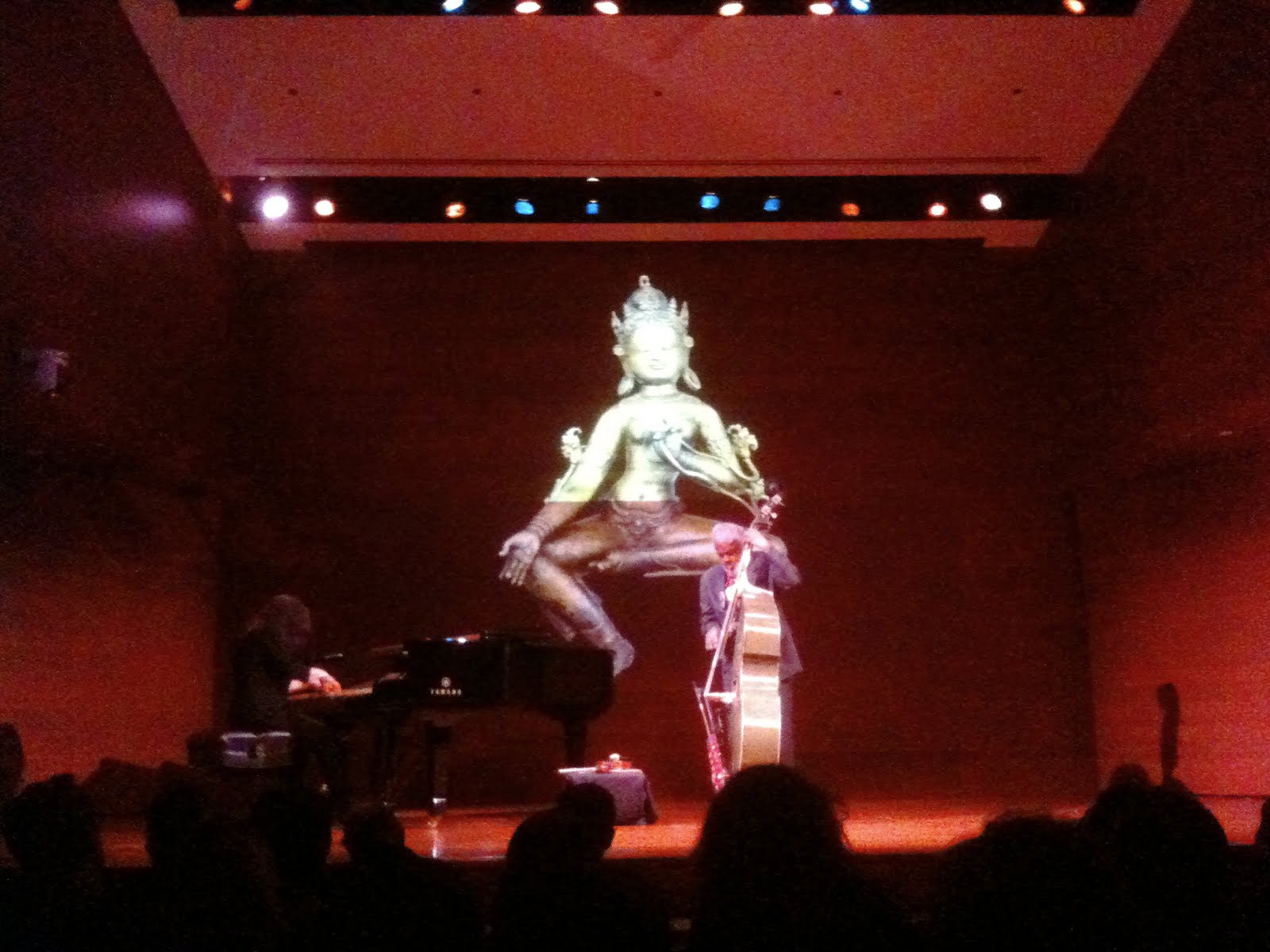
On that fatal Friday, March 11, 2011, when the massive earthquake and tsunami struck Japan, the Tenri Gagaku orchestra was scheduled to play a concert at the Tenri Cultural Institute (TCI) near Union Square in Manhattan. Our phones were ringing as the TV poured live coverage of the wreckage in the distant island nation. My wife Yoko’s home prefecture, Iwate, was at the heart of the disaster and she was not able to get in touch with family. She also plays ryuteki, a vertical bamboo flute in Tenri Gagaku. At last, it was decided that the concert would go on but that all proceeds from the ticket sales would be sent to Japan. Most certainly, this became the first in a long series of benefit concerts to aid the earthquake and tsunami victims. In the days and weeks to come when the extent of the disaster became clearer—and a nuclear hazard was added to the original woes—and that likely between 20,000 and 30,000 people had perished and many more left homeless and without livelihood, many musicians in New York, Japanese and foreign alike, joined forces to create some of the most innovative musical events to support the recovery in Japan. I had the honor of witnessing several of them and, thus in a small way, chipping in.


Tenri Gagaku @ Tenri Cultural Institute, 11 March 2011
Gagaku—literally translated as ‘elegant music’—is the oldest form of orchestral music that has survived continuously in the world and Tenri Gagaku Music Society is arguably (but then again, I might be biased) the best gagaku group outside of Japan. The music has its roots in the Silk Road period during which gagaku-like music was widely played in various parts of Asia, ranging from China to Southeast Asia. From the Tang Dynasty (AD 618-907) court in China it traveled east and landed in the Japanese islands via the Korean peninsula. In its new home, Gagaku was refined over centuries and passed down through generations of court musicians who belonged to hereditary guilds. While Gagaku has disappeared from countries in continental Asia, in Japan it was played in the homes of the military aristocracy and later preserved as living tradition in the ceremonies of the Imperial family.
The instrumentation used in gagaku today consists of a number of wind, string and percussion instruments, such as the ryuteki, hichiriki (a kind of double-reed oboe with a nasal tone), sho (a mouth organ), the biwa lute, the koto zither, and various drums, the kakko (small drum), shoko (metallic percussion) and taiko (large drum). Gagaku has a quality to it that sounds odd to the unaccustomed ear, but it definitely grows on you when you listen to it more.
On this evening Tenri Gagaku played a set of slow court pieces, starting with ‘Etenraku.’ This is probably the most well-known piece in the gagaku repertoire. It has a simple but catchy melody played alternately by hichiriki and ryuteki. Gagaku as music is monophonic, meaning that the melodies are played in unison by all instruments. The only real harmonies are provided by the sho, which provides a kind of solid mat of sound to the music (think harmonium in Indian traditional music).
The last piece of the concert was a dance number, bugaku, performed by Tazuko Ikedo dressed in a heavy and colorfully decorated costume. This was Tazuko’s last performance before returning to Japan after several years in New York, so it was not to be missed. Her slow and deliberate movements to the plodding music produced a somewhat hypnotic mood that definitely captivated the audience of some 100 people who had crowded into the TCI hall. Gagaku and bugaku are a total experience that provide a feast for both the visual and auditory senses.


Concert for Japan @ Tenri Cultural Institute, 27 March 2011
Some two weeks later another Concert for Japan took place at TCI, this time featuring some of the foremost artists specializing in traditional Japanese music in New York. This concert was particularly precious for me, as it featured three shakuhachi masters: James Nyoraku Schlefer, Ronnie Nyogetsu Reishin Seldin and Ralph Samuelson. The concert started with ‘Banshiki,’ a tune belonging to the Meian Honkyoku tradition. The three masters were joined on stage with five shakuhachi students from the Tenri Cultural Institute. Clearly, ‘Banshiki’ was a tune that the students had to study and the group produced a decent version of the piece played on eight flutes that were only slightly out of tune. Some of the three men and two women were following closer in the footsteps of their teachers than others.
The concert also highlighted the versatility of the instrument to reflect the character of not only the music but equally the musicians. The temperaments of the three artists could not be more different and it was very interesting—and pleasurable—to observe how three players who are each trained in Japanese musical tradition and have reached the top levels in their chosen instrument could produce such differing artistic impressions. After the initial tune, the first concert performance was ‘Haru no Umi’ (or ‘The Sea in Spring’) featuring Nyoraku together with Masayo Ishigure, a masterful player of koto. ‘Haru no Umi’ is not a traditional Honkyaku piece, but rather a modern number composed by Michio Miyagi. It features lively dialogue between the two traditional instruments played in a not so traditional manner. The main theme of the composition is lovely and the variations indeed bring to mind the fickleness of the sea in springtime. It requires considerable skill from both instrumentalists and James played his part so smooth and clean that one could imagine listening to a Western flute instead of its bamboo ancestor.
‘Jinbo Sanya’ in the hands of Nyogetsu was an entirely different affair. The big man approaches shakuhachi from its original Buddhist perspective and had chosen this other Meian Honkyoku piece as his first solo number of the evening. The tune is haunting and Nyogetsu’s interpretation used the full range of possibilities that the simple five-holed tube offers. The way he bent the tones using different techniques involving breathing, fingering, movement of lips, blowing angle and neck twists (known as kubi-furi, this is an essential, but hard to master technique for shakuhachi) produced remarkable sounds and effects that transported the listener to a medieval monastery in the misty mountains of Japan where the spirits of generations of Buddhist monks still linger.
Samuelson’s first solo number was also a Honkyoku piece, but from a somewhat different tradition. The song entitled ‘Choshi’ was accompanied by the dancer Sachiyo Ito whose slow and sparse movements mirrored the music. Wearing a white kimono covered with a thin red coat, she moved deliberately with two fans in her hands to emphasize her choreography.
The first part of the concert ended with a koto solo by Masayo. It was ‘Asa no Uta’ or ‘Morning Song’ composed by her own teacher, Tadao Sawai. True to Sawai’s style, this piece emphasized rapid movements and complex arpeggios. It was a koto player’s delight, demonstrating virtuosity.
After the intermission, the three shakuhachi players returned each playing a solo piece. Nyoraku again started the set with a non-traditional tune, ‘Ichijo’ by Seiho Kinea. He explained to the audience in his jovial manner how the composer—a shamisen player who composed plenty of music for all Japanese instruments—had composed this tune in shock after a dear friend had “just dropped dead” after a pleasant evening they had spent together. The piece, in English ‘Immutability,’ conveyed the unpredictability of life and was therefore suitable for the occasion. I was not familiar with the composer, let alone the piece itself, but this would change after I heard the wonderful music. James was again smooth and perfect in his playing, but this time the song itself contained elements that were specifically shakuhachi-style, rather than any other flute. It was to me the highlight of the evening.
Ralph followed with a Honkyoku from the Kinko Ryu school, entitled ‘Kyo Reibo.’ Standing against the white wall and pieces of contemporary art Ralph, as usual dressed all in black, provided a stark contrast that suited the austerity of the song. His performance was less flashy or decorated than those of his peers, but it was deep, sincere and moving.
Nyogetsu returned with a jinashi shakuhachi that was longer than a regular shakuhachi and had a lower range. His final piece was another Meian Honkyoku with the title ‘Futaiken Reibo.’ The deep tonality of the slow moving tune resonated in the room, which has acoustics as if made for the sound of the flute.
The evening ended with a ritual: ‘Chanting from the Heart’ created by Sachiyo Ito. It involved Buddhist chants, dance movement and ringing of a traditional bell. Ito was this time dressed in an all white and light grey outfit. She was assisted by three younger ladies—Keiko Ehara, Hazuki Honma and Yukiko Yamamoto—all dressed in black trousers and shirts. One had the role of sitting on her knees throughout the performance, still and with a blank face, except when it was her turn to sound the large brass bell in front of her. As a final, all audience was invited to join in a walking meditation following the lead dancer.


Plastic Ono Band and Others @ Le Poisson Rouge, 29 March 2011
On the following Tuesday, an historical event took place at Le Poisson Rouge. Sean Ono Lennon had put together an amazing program for a Japan benefit concert. We arrived at the venue around 9:30 pm and the queue was literally around the corner from Bleecker Street down Thompson Street. Luckily the night was not particularly cold, as we waited in line until the doors opened at 10:30 pm. The crowd was very mixed, but many were middle aged and looked like they had a history of listening to rock. All the tables and chairs had been removed and we crowded around the slightly elevated stage. The floor was already flowing with beer, as someone had dropped a pint. We took our place close to a rowdy group of rather rough looking lesbians.
The music started when Miho Hattori and Yuka Honda climbed on the stage. The two Japanese woman form the band Cibo Matto, which clearly has a large following of its own. I understand very well, as their music is charming and intelligent despite being essentially produced by electronic keyboards by Yuka over which Miho sings. After two songs played by the duo the stage was suddenly crowded by musicians, including Yuko Araki who sat behind the drum kit, two horn players, a guitarist and Sean Lennon on bass. Understandably the sound expanded and the rhythms became funkier. A somewhat silly looking male singer whose name eluded me joined Miho in a flowing version of the Bossa Nova classic 'Águas de Março.' After a few intensive pieces in which the horns provided funky riffs and the interplay between bass and drums worked, Cibo Matto and their entourage left the stage.
After a short break, the house erupted, as Patti Smith entered the stage. Her set was entirely acoustic, except for the electric bass played by Tony Shanahan (during the concert, the bass was passed around and the two guitarists also took turns playing it, while Shanahan grabbed a guitar or sat behind the piano), and she took the audience by her sheer charisma and the amazing musical quality of the performance. The lanky Lenny Kaye, with his long hair flowing to his shoulders, played some exquisite solos on the acoustic guitar which were some of the most beautiful moments of the evening. Patti chatted with the audience and appeared to be in a good mood, although she did attempt to block the lenses of some of the more intrusive photographers next to the stage. The whole performance was thrilling and I had tears streaming down my cheeks when Patti and her crew performed a magical version of ‘Ghost Dance’ dedicated to the people of Japan: “We shall live again.”
Shortly after midnight, Sean Lennon announced that his mother, Yoko Ono, had entered the premises and right at that moment the diminutive lady dressed in black and donning a hat and large sunglasses perched on her nose climbed on the stage. That is when the real party began, with a new version of Plastic Ono Band led by Sean setting the tempo. The band was extended, with three guitars (including Sean and Shimmy Hirotaka Shimizu), keyboards, drums and trumpet. Time has not mellowed Yoko who started—and ended—the show with her trademark wails and screams. Throughout the night she jumped around the stage energetically, betraying her age: in February, Yoko Ono had just turned 78! Apart from directing the music, Sean played some of the most inspired guitar solos of the evening. Given that women so often in rock music have been relegated to the role of singers and dancers, it was very satisfying to see three highly professional female musicians solidifying the backbone of the band: tiny Yuko Araki whose tight beats kept the music rolling; the tall supermodel looking bassist who excelled in particular in some of the slower numbers where her musicality came through best; and Yuka Honda handling the keyboards.
As the night progressed, more guests climbed on the stage. The most prominent of them was Lou Reed. At mere 69, he should have been a real spring chicken compared with the evening’s leading lady, but Reed appeared stiff and unsteady in his walking. He performed one long number with the band, a heavy rolling rock song, egging the little drummer girl to beat the cans ever harder. A man in the audience next to me said, incredulously, “I can’t believe that these two are both together on stage!” I don’t know whether this had ever happened before, but it was indeed historical to have Yoko Ono, Lou Reed and Patti Smith all in one concert! Another guest star was Antony who sang a number of duets with Yoko Ono. The large man with long hair and a baby face sang with a sweet voice and the entire impression was quite a contrast to the older star of the night.
The evening culminated in an extended version of ‘Give Peace a Chance’ during which most of the musicians who had performed during the evening returned on the stage. Sean Lennon standing next to his mother led them into the iconic song made famous by his father. Miho Hattori took the lead during the second verse until the others—and the audience—joined in. At 01:30 am as the concert wound to a close, we all felt the warmth and love channeled by the music to the people in Japan.

Taka Kigawa @ Le Poisson Rouge, 2 April 2011
When we returned to Le Poisson Rouge later in the same week, the place had been restored to its normal setting with tightly packed tables. The waitresses were cruising between them while we settled at a table in the second row in front of the stage. We were early and had time for a light meal before the show.
I used the word “show” intentionally, as that is what was in store for us. Taka Kigawa is a classical musician who plays the music as the composers meant it to be played without any tricks or gimmicks. But his interpretations are strong and engaging—and he communicates with the audience. He talked about the concert and commented on the pieces in between. Dressed in an open red shirt and black jeans, his long dark hair covering part of his face, Taka looked more like a rock musician than a classical pianist. All of this is why he has created a following that tonight sold out the large space. For tonight, Taka had put together an extraordinary program that would captivate everyone in the room. And as he would explain, there was a logic behind every piece that he had placed on the program. Obviously, much of the music would be Japanese, but those pieces that were not all had a reason to be included.
The concert started with two contemporary pieces by Japanese composer: ‘atardecer/a...retraced’ by Hiroya Miura and ‘Crystalline’ by Karen Tanaka. Taka is a specialist in contemporary music and plays it forcefully and with amazing concentration. However, on this emotional evening it was important to connect with everyone in the audience. This happened next when Taka played ‘Images, Book I’ by Debussy, with its three parts: ‘Reflets dans l’eau,’ ‘Hommage à Rameau,’ and ‘Mouvement.’ These lovely pieces demonstrated Taka’s fluency in Debussy’s language and the fluidity of especially his left hand. This was followed by two works by Chopin, ‘Prelude in C-sharp minor, Op. 45’ and the wonderful ‘Ballade No. 4 in F minor, Op. 52,’ Chopin’s last, which Taka interpreted with incredible dynamism and emotion, earning him a huge ovation from the audience. Speaking about these choices, Taka explained how Chopin, while living in Paris, never forgot about and was always concerned about his home country of Poland, implying a similar feeling inside of him regarding Japan.
Next Kigawa inserted three more pieces by Japanese contemporary composers: ‘Rain Tree Sketch II (In Memoriam Olivier Messiaen)’ by Toru Takemitsu; a short piece, like the title implies, by Toshio Hosokawa, ‘Haiku for Pierre Boulez,’ and ‘Joule’ by Dai Fujikura, which Taka had premiered in the USA in January 2010.
The rest of the concert consisted of guaranteed crowd pleasers that Taka Kigawa played with unusual flair. Stravinsky’s ‘Trois Mouvements de Petrouchka,’ derived from the ballet and transcribed for solo piano by the composer himself, in Taka’s performance was simply incredible. The rhythm, the power, the energy just overwhelmed the audience who exploded in applause and cheers. The pianist came to the edge of the stage to take a bow after the piece, which could have been the grand finale for the concert. But he remembered having scheduled one more number in the program, Ravel’s lovely ‘Pavane pour une infante défunte.’ The exquisite and pensive piece brought the thoughts back to the sadness of the situation in Japan.
Inspired by the cause and the enthusiasm of the audience, Taka took not one, but four encores, the highlight of which was Debussy’s ‘L'isle joyeuse,’ an obvious reference to what the pianist—and we all—hope that Japan will once again be in the not too distant future.


Concert for Japan @ The Japan Society, 9 April 2011
The Japan Society had put up a nonstop musical program that lasted for 12 straight hours on this Saturday. Finally, after a long and cold winter there was spring in the air and the sun was shining from a blue sky as Yoko and I approached the Society’s headquarters in front of Dag Hammarsköljd Park in Midtown. There was a large crowd gathered on the street and in the park to listen to a Taiko drum performance outside of the entrance to the premises. There were also vendors selling Japanese food from several stalls, proceeds from which would be donated to the earthquake relief fund. The day’s program alternated between free concerts of both Japanese traditional music and Western classical music, with two sold-out ‘Gala Blocks’ with reserved seating and big ticket items. We heard performances by Sadahiro Kakitani on solo ryuteki; Masayo Ishigure with a large group of koto, shamisen and shakuhachi players; James Nyoraku Schlefer playing his shakuhachi both solo and in group; and Yumi Kurosawa, whose piece on a 20-string koto impressed us.
For us the main attraction of the day was the first of the Gala Blocks, which featured Philip Glass. While we have often heard his music played in concerts in several cities, it was the first time ever to witness the composer himself behind the piano playing his own music. There was excitement in the air as we took our seats in the middle of the second row. The concert started with a performance in which Hal Willner read poetry by Allen Ginsberg accompanied by Philip Glass. Both of the performers had personally known Ginsberg and the jolly Willner explained the context of the poems that had been written over a lengthy period of time from the 1950s to the 1970s. There were some powerful images (and some very amusing ones, too) conjured up by the poems (note to self: reacquaint yourself with Ginsberg’s works) and the pianist followed and strengthened the moods expertly.
Musically, however, what followed was more interesting. Philip Glass played against a film by Harry Smith, ‘Early Abstractions’ from 1946. I was not familiar with Smith, but according to Hal Wilner he was one of the greatest creative geniuses of the 20th Century, creating films and other works, including an anthology of American music, while never gaining wide recognition. As the abstract pictures moved on the large screen behind the piano, Philip Glass created an equally hectic music through his trademark fast and repetitive motifs that flowed into the hall seamlessly mixing with the visual media.
The final part of the concert was a 20-minute collective creation by three unorthodox features of New York’s art scene: John Zorn, Laurie Anderson and Lou Reed. Zorn with his alto saxophone was flanked on both sides by arrays of electronics associated with Anderson and Reed. The latter took a very different role today from his recent rocker performance with the Plastic Ono Band. This was experimental music in which his contributions were through innovative effects on guitar and other electronics. The piece was loosely structured around segments and motifs but most of the playing appeared improvised. Laurie Anderson alternated between solos and accompanying effects on her electric violin. John Zorn blew into his alto at times lyrically just to be followed by aggressive bursts of raw energy as the piece grew in intensity. The culmination was when the trio was joined on stage by a Japanese Taiko player who beat thunderously into the large drum towards the final shock and awe of the music.
The above constitutes just a sample of all great (and some less so) music played to benefit the victims of the earthquake and tsunami that struck Northeastern Japan in March. It is wonderful to see all the empathy and support for the people on the other side of the world facing an unimaginable challenge to recover from the loss of families and loved ones and to start rebuilding the nation from the rubble. But this will not be the first time Japan raises from destruction. I do believe in the resilience of the nation.


Tenri Gagaku @ Tenri Cultural Institute, 11 March 2011
Gagaku—literally translated as ‘elegant music’—is the oldest form of orchestral music that has survived continuously in the world and Tenri Gagaku Music Society is arguably (but then again, I might be biased) the best gagaku group outside of Japan. The music has its roots in the Silk Road period during which gagaku-like music was widely played in various parts of Asia, ranging from China to Southeast Asia. From the Tang Dynasty (AD 618-907) court in China it traveled east and landed in the Japanese islands via the Korean peninsula. In its new home, Gagaku was refined over centuries and passed down through generations of court musicians who belonged to hereditary guilds. While Gagaku has disappeared from countries in continental Asia, in Japan it was played in the homes of the military aristocracy and later preserved as living tradition in the ceremonies of the Imperial family.
The instrumentation used in gagaku today consists of a number of wind, string and percussion instruments, such as the ryuteki, hichiriki (a kind of double-reed oboe with a nasal tone), sho (a mouth organ), the biwa lute, the koto zither, and various drums, the kakko (small drum), shoko (metallic percussion) and taiko (large drum). Gagaku has a quality to it that sounds odd to the unaccustomed ear, but it definitely grows on you when you listen to it more.
On this evening Tenri Gagaku played a set of slow court pieces, starting with ‘Etenraku.’ This is probably the most well-known piece in the gagaku repertoire. It has a simple but catchy melody played alternately by hichiriki and ryuteki. Gagaku as music is monophonic, meaning that the melodies are played in unison by all instruments. The only real harmonies are provided by the sho, which provides a kind of solid mat of sound to the music (think harmonium in Indian traditional music).
The last piece of the concert was a dance number, bugaku, performed by Tazuko Ikedo dressed in a heavy and colorfully decorated costume. This was Tazuko’s last performance before returning to Japan after several years in New York, so it was not to be missed. Her slow and deliberate movements to the plodding music produced a somewhat hypnotic mood that definitely captivated the audience of some 100 people who had crowded into the TCI hall. Gagaku and bugaku are a total experience that provide a feast for both the visual and auditory senses.


Concert for Japan @ Tenri Cultural Institute, 27 March 2011
Some two weeks later another Concert for Japan took place at TCI, this time featuring some of the foremost artists specializing in traditional Japanese music in New York. This concert was particularly precious for me, as it featured three shakuhachi masters: James Nyoraku Schlefer, Ronnie Nyogetsu Reishin Seldin and Ralph Samuelson. The concert started with ‘Banshiki,’ a tune belonging to the Meian Honkyoku tradition. The three masters were joined on stage with five shakuhachi students from the Tenri Cultural Institute. Clearly, ‘Banshiki’ was a tune that the students had to study and the group produced a decent version of the piece played on eight flutes that were only slightly out of tune. Some of the three men and two women were following closer in the footsteps of their teachers than others.
The concert also highlighted the versatility of the instrument to reflect the character of not only the music but equally the musicians. The temperaments of the three artists could not be more different and it was very interesting—and pleasurable—to observe how three players who are each trained in Japanese musical tradition and have reached the top levels in their chosen instrument could produce such differing artistic impressions. After the initial tune, the first concert performance was ‘Haru no Umi’ (or ‘The Sea in Spring’) featuring Nyoraku together with Masayo Ishigure, a masterful player of koto. ‘Haru no Umi’ is not a traditional Honkyaku piece, but rather a modern number composed by Michio Miyagi. It features lively dialogue between the two traditional instruments played in a not so traditional manner. The main theme of the composition is lovely and the variations indeed bring to mind the fickleness of the sea in springtime. It requires considerable skill from both instrumentalists and James played his part so smooth and clean that one could imagine listening to a Western flute instead of its bamboo ancestor.
‘Jinbo Sanya’ in the hands of Nyogetsu was an entirely different affair. The big man approaches shakuhachi from its original Buddhist perspective and had chosen this other Meian Honkyoku piece as his first solo number of the evening. The tune is haunting and Nyogetsu’s interpretation used the full range of possibilities that the simple five-holed tube offers. The way he bent the tones using different techniques involving breathing, fingering, movement of lips, blowing angle and neck twists (known as kubi-furi, this is an essential, but hard to master technique for shakuhachi) produced remarkable sounds and effects that transported the listener to a medieval monastery in the misty mountains of Japan where the spirits of generations of Buddhist monks still linger.
Samuelson’s first solo number was also a Honkyoku piece, but from a somewhat different tradition. The song entitled ‘Choshi’ was accompanied by the dancer Sachiyo Ito whose slow and sparse movements mirrored the music. Wearing a white kimono covered with a thin red coat, she moved deliberately with two fans in her hands to emphasize her choreography.
The first part of the concert ended with a koto solo by Masayo. It was ‘Asa no Uta’ or ‘Morning Song’ composed by her own teacher, Tadao Sawai. True to Sawai’s style, this piece emphasized rapid movements and complex arpeggios. It was a koto player’s delight, demonstrating virtuosity.
After the intermission, the three shakuhachi players returned each playing a solo piece. Nyoraku again started the set with a non-traditional tune, ‘Ichijo’ by Seiho Kinea. He explained to the audience in his jovial manner how the composer—a shamisen player who composed plenty of music for all Japanese instruments—had composed this tune in shock after a dear friend had “just dropped dead” after a pleasant evening they had spent together. The piece, in English ‘Immutability,’ conveyed the unpredictability of life and was therefore suitable for the occasion. I was not familiar with the composer, let alone the piece itself, but this would change after I heard the wonderful music. James was again smooth and perfect in his playing, but this time the song itself contained elements that were specifically shakuhachi-style, rather than any other flute. It was to me the highlight of the evening.
Ralph followed with a Honkyoku from the Kinko Ryu school, entitled ‘Kyo Reibo.’ Standing against the white wall and pieces of contemporary art Ralph, as usual dressed all in black, provided a stark contrast that suited the austerity of the song. His performance was less flashy or decorated than those of his peers, but it was deep, sincere and moving.
Nyogetsu returned with a jinashi shakuhachi that was longer than a regular shakuhachi and had a lower range. His final piece was another Meian Honkyoku with the title ‘Futaiken Reibo.’ The deep tonality of the slow moving tune resonated in the room, which has acoustics as if made for the sound of the flute.
The evening ended with a ritual: ‘Chanting from the Heart’ created by Sachiyo Ito. It involved Buddhist chants, dance movement and ringing of a traditional bell. Ito was this time dressed in an all white and light grey outfit. She was assisted by three younger ladies—Keiko Ehara, Hazuki Honma and Yukiko Yamamoto—all dressed in black trousers and shirts. One had the role of sitting on her knees throughout the performance, still and with a blank face, except when it was her turn to sound the large brass bell in front of her. As a final, all audience was invited to join in a walking meditation following the lead dancer.


Plastic Ono Band and Others @ Le Poisson Rouge, 29 March 2011
On the following Tuesday, an historical event took place at Le Poisson Rouge. Sean Ono Lennon had put together an amazing program for a Japan benefit concert. We arrived at the venue around 9:30 pm and the queue was literally around the corner from Bleecker Street down Thompson Street. Luckily the night was not particularly cold, as we waited in line until the doors opened at 10:30 pm. The crowd was very mixed, but many were middle aged and looked like they had a history of listening to rock. All the tables and chairs had been removed and we crowded around the slightly elevated stage. The floor was already flowing with beer, as someone had dropped a pint. We took our place close to a rowdy group of rather rough looking lesbians.
The music started when Miho Hattori and Yuka Honda climbed on the stage. The two Japanese woman form the band Cibo Matto, which clearly has a large following of its own. I understand very well, as their music is charming and intelligent despite being essentially produced by electronic keyboards by Yuka over which Miho sings. After two songs played by the duo the stage was suddenly crowded by musicians, including Yuko Araki who sat behind the drum kit, two horn players, a guitarist and Sean Lennon on bass. Understandably the sound expanded and the rhythms became funkier. A somewhat silly looking male singer whose name eluded me joined Miho in a flowing version of the Bossa Nova classic 'Águas de Março.' After a few intensive pieces in which the horns provided funky riffs and the interplay between bass and drums worked, Cibo Matto and their entourage left the stage.
After a short break, the house erupted, as Patti Smith entered the stage. Her set was entirely acoustic, except for the electric bass played by Tony Shanahan (during the concert, the bass was passed around and the two guitarists also took turns playing it, while Shanahan grabbed a guitar or sat behind the piano), and she took the audience by her sheer charisma and the amazing musical quality of the performance. The lanky Lenny Kaye, with his long hair flowing to his shoulders, played some exquisite solos on the acoustic guitar which were some of the most beautiful moments of the evening. Patti chatted with the audience and appeared to be in a good mood, although she did attempt to block the lenses of some of the more intrusive photographers next to the stage. The whole performance was thrilling and I had tears streaming down my cheeks when Patti and her crew performed a magical version of ‘Ghost Dance’ dedicated to the people of Japan: “We shall live again.”
Shortly after midnight, Sean Lennon announced that his mother, Yoko Ono, had entered the premises and right at that moment the diminutive lady dressed in black and donning a hat and large sunglasses perched on her nose climbed on the stage. That is when the real party began, with a new version of Plastic Ono Band led by Sean setting the tempo. The band was extended, with three guitars (including Sean and Shimmy Hirotaka Shimizu), keyboards, drums and trumpet. Time has not mellowed Yoko who started—and ended—the show with her trademark wails and screams. Throughout the night she jumped around the stage energetically, betraying her age: in February, Yoko Ono had just turned 78! Apart from directing the music, Sean played some of the most inspired guitar solos of the evening. Given that women so often in rock music have been relegated to the role of singers and dancers, it was very satisfying to see three highly professional female musicians solidifying the backbone of the band: tiny Yuko Araki whose tight beats kept the music rolling; the tall supermodel looking bassist who excelled in particular in some of the slower numbers where her musicality came through best; and Yuka Honda handling the keyboards.
As the night progressed, more guests climbed on the stage. The most prominent of them was Lou Reed. At mere 69, he should have been a real spring chicken compared with the evening’s leading lady, but Reed appeared stiff and unsteady in his walking. He performed one long number with the band, a heavy rolling rock song, egging the little drummer girl to beat the cans ever harder. A man in the audience next to me said, incredulously, “I can’t believe that these two are both together on stage!” I don’t know whether this had ever happened before, but it was indeed historical to have Yoko Ono, Lou Reed and Patti Smith all in one concert! Another guest star was Antony who sang a number of duets with Yoko Ono. The large man with long hair and a baby face sang with a sweet voice and the entire impression was quite a contrast to the older star of the night.
The evening culminated in an extended version of ‘Give Peace a Chance’ during which most of the musicians who had performed during the evening returned on the stage. Sean Lennon standing next to his mother led them into the iconic song made famous by his father. Miho Hattori took the lead during the second verse until the others—and the audience—joined in. At 01:30 am as the concert wound to a close, we all felt the warmth and love channeled by the music to the people in Japan.

Taka Kigawa @ Le Poisson Rouge, 2 April 2011
When we returned to Le Poisson Rouge later in the same week, the place had been restored to its normal setting with tightly packed tables. The waitresses were cruising between them while we settled at a table in the second row in front of the stage. We were early and had time for a light meal before the show.
I used the word “show” intentionally, as that is what was in store for us. Taka Kigawa is a classical musician who plays the music as the composers meant it to be played without any tricks or gimmicks. But his interpretations are strong and engaging—and he communicates with the audience. He talked about the concert and commented on the pieces in between. Dressed in an open red shirt and black jeans, his long dark hair covering part of his face, Taka looked more like a rock musician than a classical pianist. All of this is why he has created a following that tonight sold out the large space. For tonight, Taka had put together an extraordinary program that would captivate everyone in the room. And as he would explain, there was a logic behind every piece that he had placed on the program. Obviously, much of the music would be Japanese, but those pieces that were not all had a reason to be included.
The concert started with two contemporary pieces by Japanese composer: ‘atardecer/a...retraced’ by Hiroya Miura and ‘Crystalline’ by Karen Tanaka. Taka is a specialist in contemporary music and plays it forcefully and with amazing concentration. However, on this emotional evening it was important to connect with everyone in the audience. This happened next when Taka played ‘Images, Book I’ by Debussy, with its three parts: ‘Reflets dans l’eau,’ ‘Hommage à Rameau,’ and ‘Mouvement.’ These lovely pieces demonstrated Taka’s fluency in Debussy’s language and the fluidity of especially his left hand. This was followed by two works by Chopin, ‘Prelude in C-sharp minor, Op. 45’ and the wonderful ‘Ballade No. 4 in F minor, Op. 52,’ Chopin’s last, which Taka interpreted with incredible dynamism and emotion, earning him a huge ovation from the audience. Speaking about these choices, Taka explained how Chopin, while living in Paris, never forgot about and was always concerned about his home country of Poland, implying a similar feeling inside of him regarding Japan.
Next Kigawa inserted three more pieces by Japanese contemporary composers: ‘Rain Tree Sketch II (In Memoriam Olivier Messiaen)’ by Toru Takemitsu; a short piece, like the title implies, by Toshio Hosokawa, ‘Haiku for Pierre Boulez,’ and ‘Joule’ by Dai Fujikura, which Taka had premiered in the USA in January 2010.
The rest of the concert consisted of guaranteed crowd pleasers that Taka Kigawa played with unusual flair. Stravinsky’s ‘Trois Mouvements de Petrouchka,’ derived from the ballet and transcribed for solo piano by the composer himself, in Taka’s performance was simply incredible. The rhythm, the power, the energy just overwhelmed the audience who exploded in applause and cheers. The pianist came to the edge of the stage to take a bow after the piece, which could have been the grand finale for the concert. But he remembered having scheduled one more number in the program, Ravel’s lovely ‘Pavane pour une infante défunte.’ The exquisite and pensive piece brought the thoughts back to the sadness of the situation in Japan.
Inspired by the cause and the enthusiasm of the audience, Taka took not one, but four encores, the highlight of which was Debussy’s ‘L'isle joyeuse,’ an obvious reference to what the pianist—and we all—hope that Japan will once again be in the not too distant future.


Concert for Japan @ The Japan Society, 9 April 2011
The Japan Society had put up a nonstop musical program that lasted for 12 straight hours on this Saturday. Finally, after a long and cold winter there was spring in the air and the sun was shining from a blue sky as Yoko and I approached the Society’s headquarters in front of Dag Hammarsköljd Park in Midtown. There was a large crowd gathered on the street and in the park to listen to a Taiko drum performance outside of the entrance to the premises. There were also vendors selling Japanese food from several stalls, proceeds from which would be donated to the earthquake relief fund. The day’s program alternated between free concerts of both Japanese traditional music and Western classical music, with two sold-out ‘Gala Blocks’ with reserved seating and big ticket items. We heard performances by Sadahiro Kakitani on solo ryuteki; Masayo Ishigure with a large group of koto, shamisen and shakuhachi players; James Nyoraku Schlefer playing his shakuhachi both solo and in group; and Yumi Kurosawa, whose piece on a 20-string koto impressed us.
For us the main attraction of the day was the first of the Gala Blocks, which featured Philip Glass. While we have often heard his music played in concerts in several cities, it was the first time ever to witness the composer himself behind the piano playing his own music. There was excitement in the air as we took our seats in the middle of the second row. The concert started with a performance in which Hal Willner read poetry by Allen Ginsberg accompanied by Philip Glass. Both of the performers had personally known Ginsberg and the jolly Willner explained the context of the poems that had been written over a lengthy period of time from the 1950s to the 1970s. There were some powerful images (and some very amusing ones, too) conjured up by the poems (note to self: reacquaint yourself with Ginsberg’s works) and the pianist followed and strengthened the moods expertly.
Musically, however, what followed was more interesting. Philip Glass played against a film by Harry Smith, ‘Early Abstractions’ from 1946. I was not familiar with Smith, but according to Hal Wilner he was one of the greatest creative geniuses of the 20th Century, creating films and other works, including an anthology of American music, while never gaining wide recognition. As the abstract pictures moved on the large screen behind the piano, Philip Glass created an equally hectic music through his trademark fast and repetitive motifs that flowed into the hall seamlessly mixing with the visual media.
The final part of the concert was a 20-minute collective creation by three unorthodox features of New York’s art scene: John Zorn, Laurie Anderson and Lou Reed. Zorn with his alto saxophone was flanked on both sides by arrays of electronics associated with Anderson and Reed. The latter took a very different role today from his recent rocker performance with the Plastic Ono Band. This was experimental music in which his contributions were through innovative effects on guitar and other electronics. The piece was loosely structured around segments and motifs but most of the playing appeared improvised. Laurie Anderson alternated between solos and accompanying effects on her electric violin. John Zorn blew into his alto at times lyrically just to be followed by aggressive bursts of raw energy as the piece grew in intensity. The culmination was when the trio was joined on stage by a Japanese Taiko player who beat thunderously into the large drum towards the final shock and awe of the music.
The above constitutes just a sample of all great (and some less so) music played to benefit the victims of the earthquake and tsunami that struck Northeastern Japan in March. It is wonderful to see all the empathy and support for the people on the other side of the world facing an unimaginable challenge to recover from the loss of families and loved ones and to start rebuilding the nation from the rubble. But this will not be the first time Japan raises from destruction. I do believe in the resilience of the nation.