Showing posts with label sustainable development. Show all posts

Monday, March 9, 2026

Why development evaluation must change

Across the world, communities are already living with the consequences of climate change and environmental degradation. Farmers face unpredictable rains. Coastal communities confront rising seas. Forest-dependent peoples see their livelihoods erode as ecosystems decline. In response, development agencies, international financial institutions, NGOs, and others are scaling up efforts that aim — often simultaneously — to reduce poverty, strengthen resilience, protect ecosystems, and contribute to global climate goals.


Yet a persistent challenge remains: how do we know whether these investments are delivering results that last in a world of environmental limits?

Evaluation plays a powerful — if often underestimated — role in answering that question. It shapes what is considered effective, what gets funded and scaled, and what is ultimately abandoned. Yet most evaluations still focus narrowly on short-term social or economic results, paying scant attention to environmental sustainability.

This is no longer sufficient. In an era defined by climate change, biodiversity loss, and resource scarcity, evaluation must move beyond linear models and adopt a systems perspective that recognizes the interdependence of human and natural systems. Evaluation is not just a technical exercise; it helps identify what works, for whom, under what conditions — and whether success today may undermine sustainability tomorrow.

Paradoxically, however, many development evaluations continue to treat the environment as a backdrop rather than a central actor. Projects are assessed primarily for how well they deliver intended social and economic benefits, while environmental effects — positive or negative — are relegated to side notes or omitted altogether. If development interventions are to be sustainable, this must change.

Development does not happen in a vacuum

Two simple premises should guide any evaluation at the environment–development nexus. First, every intervention takes place in a specific social, economic, political, and ecological context that shapes its chances of success. Second, virtually all human activity affects the natural environment, whether intentionally or not. Agriculture, infrastructure, energy, water supply, and even social programs leave environmental footprints.

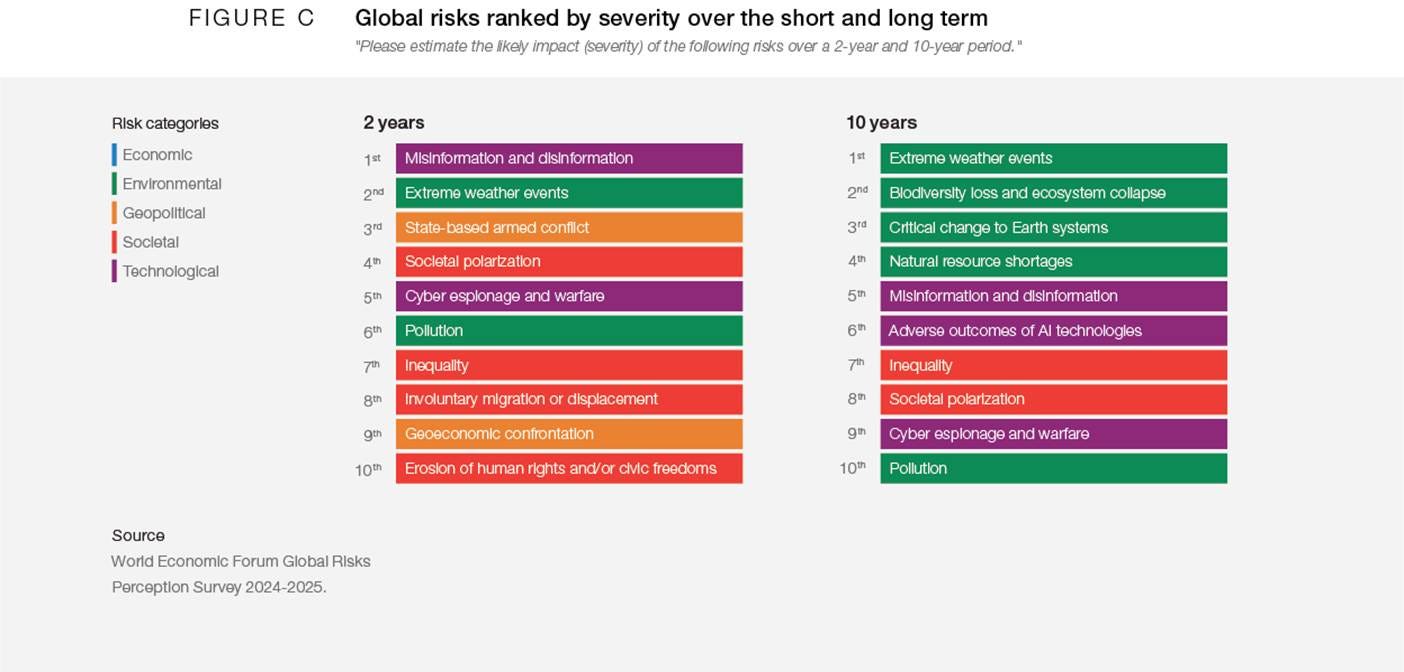
The World Economic Forum’s Global Risks Report 2025 captures a sobering reality: environmental risks now dominate the medium- and long-term outlook. Climate extremes, ecosystem collapse, water stress, and pollution are increasingly shaping humanity’s trajectories. These risks interact with inequality, food insecurity, fragility, and conflict, multiplying their effects and complicating policy responses.
A screenshot of a computer

AI-generated content may be incorrect.

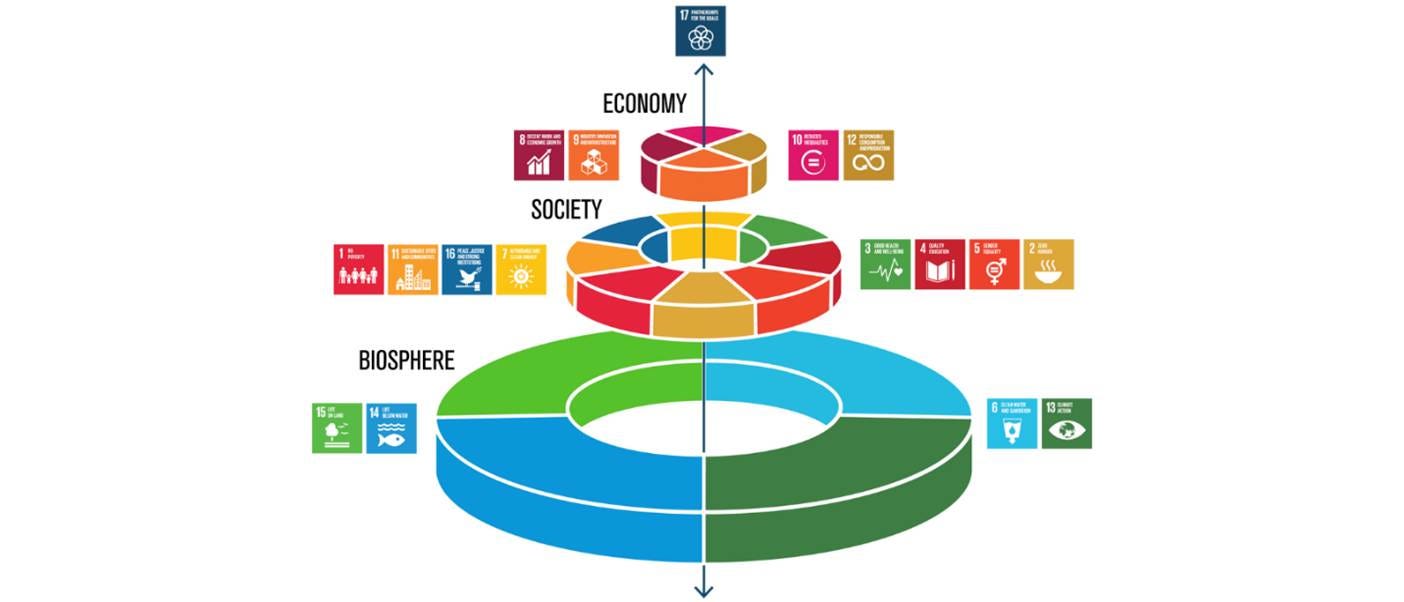
The Sustainable Development Goals (SDGs) explicitly recognize this interdependence. The now-familiar SDG wedding cake offers a useful reminder: the biosphere is the foundation upon which societies and economies rest. Without stable ecosystems, neither poverty reduction nor inclusive growth can be sustained. For policy-makers and evaluators alike, this has a clear implication: assessing development outcomes without assessing environmental sustainability is no longer credible.
A diagram of a pie chart

AI-generated content may be incorrect.

Yet in practice, progress remains fragmented. Social and economic goals often advance at the expense of environmental ones, despite growing evidence that environmental degradation ultimately undermines development gains. As a result, development portfolios may deliver short-term gains while inadvertently increasing long-term vulnerability.

This matters because humanity has already crossed several planetary boundaries — the safe operating space for Earth systems. These include biosphere integrity, biogeochemical flows, novel entities, and climate change. Development interventions that fail to account for these dynamics risk solving one problem while worsening another.

A gap between ambition and practice in evaluation

Despite growing awareness, evaluation practice has struggled to keep pace. Reviews by evaluation networks show growing demand for sustainability-informed evaluations. Both project proponents and intended beneficiaries want evidence that interventions are not only effective today, but durable tomorrow. However, environmental dimensions remain underrepresented in most evaluations.

Two factors stand out as explaining this gap. The first is scope. Many evaluations (and evaluation commissioners) define their evaluand narrowly, focusing on project activities and short-term outcomes while ignoring broader environmental interactions. The second is capacity. Evaluators are usually trained in social science methods but lack confidence or expertise in environmental and ecological analysis.

Traditional project models and evaluation approaches rely on linear theories of change: inputs lead to outputs, which lead to outcomes and impacts. Such models struggle to capture the feedback loops, thresholds, and unintended effects characteristic of complex development contexts.

Seeing development as a coupled human–natural system

To address this gap, evaluation must embrace a systems perspective — often described as coupled human and natural systems (CHANS) or social-ecological systems (SES). This approach recognizes that humans are not separate from nature; we are embedded within it, constantly interacting with ecological processes in dynamic and adaptive ways. It recognizes that development interventions operate within dynamic systems shaped by policies, markets, institutions, and ecological processes.

The intellectual roots of this perspective are perhaps best associated with Elinor Ostrom, Nobel laureate in economics. Ostrom challenged the idea that shared natural resources inevitably lead to overexploitation — the so-called tragedy of the commons. She demonstrated that communities can develop governance arrangements that manage resources sustainably, provided institutions align with ecological realities.

For evaluation, this means examining not only what interventions do, but how they interact with broader systems, and how those systems respond. For evaluation, this insight is profound. It means that social outcomes, economic incentives, governance structures, and environmental processes must be analyzed together. Change in one domain often triggers unintended effects in another, creating feedback loops that can either reinforce or undermine sustainability.

Evaluations that focus narrowly on income generation, yields, or service delivery without examining environmental sustainability provide an incomplete — and potentially misleading — picture of impact. Interventions designed to improve resilience or livelihoods may inadvertently undermine the ecological foundations on which those livelihoods depend. Without a systems lens, evaluations risk missing these contradictions — and thus misjudging both impact and sustainability.

When does the environmental dimension matter most?

While all development interventions have environmental implications, some clearly demand deeper analysis. These include, first, interventions with explicit environmental objectives, such as protecting a natural habitat or reducing chemical pollution. In such cases, assessing the environmental impacts is obviously central.

Second are interventions whose success depends on a healthy environment, even if environmental improvement is not an explicit goal. Nowhere is the need for integrated evaluation clearer than in agriculture and rural development. Agriculture sustains billions of livelihoods, yet it is also a major driver of deforestation, water stress, biodiversity loss, and greenhouse gas emissions. Around three billion people live in areas highly vulnerable to climate change, many of them smallholder farmers, pastoralists, and fishers. Women, Indigenous peoples, and marginalized groups are disproportionately affected. By 2030, drought alone could displace hundreds of millions of people.

At the same time, nature underpins food systems. Healthy soils regulate water and store carbon. Pollinators support the majority of global food crops. Forests and wetlands buffer communities against climate shocks. When these systems are degraded, food security and incomes suffer.

Third are interventions that use or alter natural resources, like land, water or forests, or are implemented near environmentally sensitive areas. Large-scale or long-term projects, in particular, can disrupt established patterns of resource use, wildlife movement, or waste generation, with cascading effects over time.

Finally, any intervention that introduces pollutants — whether chemicals, waste, heat, noise, or biological agents — should assess environmental consequences. Pollution is not limited to toxic substances but includes anything that degrades ecosystems or makes them less hospitable to life qualifies.

Drawing system boundaries — and asking the right questions

A systems-based evaluation begins by situating the intervention within its broader context. This includes policies, markets, institutions, and other programs operating in the same space. Too often, well-intentioned initiatives work at cross-purposes, undermining each other’s effects.

Defining system boundaries is not about including everything; it is about including what matters. Crucially, systems thinking pushes evaluators beyond asking whether activities were implemented as planned. It asks whether the intervention actually made a difference to the problem it set out to address, and whether that difference is likely to last.

What distinguishes systems-focused evaluations is their attention to interactions across space and time. Environmental effects may manifest far from project sites or long after implementation ends. Conversely, external environmental changes — such as climate shocks or land-use change — may shape project outcomes in ways that standard evaluations overlook. Expanding the analytical lens makes unintended effects more visible.

Systems thinking also shifts attention from symptoms to root causes. Environmental degradation is rarely driven by local behavior alone. Economic incentives, agricultural policies, land tenure systems, and market forces all shape how resources are used. Evaluations that ignore these drivers risk overstating the expected results while underestimating the risks to sustainability.

Working across disciplines — and worldviews

Environmental issues cut across sectors and disciplines, from agronomy and ecology to economics, engineering, and public policy. Evaluators therefore need to engage with expertise beyond their own comfort zones. This includes not only scientists, but also Indigenous peoples and local communities, who often possess the most intimate knowledge of local ecosystems and livelihoods.

Bringing these perspectives together is not easy. Different disciplines and stakeholder groups use different languages, value systems, and ways of knowing. Facilitation and translation are therefore as important as technical methods. The goal is not to force consensus, but to build a coherent picture of how the system functions and how the intervention has interacted with it.

Methods fit for complexity

A systems perspective does not prescribe specific methods, but it does influence how methods are chosen. The starting point should always be the evaluation questions, not the evaluator’s toolkit. Methods that are particularly useful for tracing how interventions contribute to change in complex, non-linear systems, offer alternatives to overly linear cause-and-effect models that rarely reflect reality.

Geospatial approaches deserve special mention. Satellite imagery, remote sensing, and spatial analysis can fill critical data gaps, especially in large, remote, or insecure areas. They allow evaluators to track land-use change, deforestation, vegetation cover, and infrastructure and settlement expansion over time, and even reconstructing baselines retrospectively.

However, geospatial data show what changed, not necessarily why. Social, economic, and institutional mechanisms still require qualitative inquiry, fieldwork, and stakeholder engagement. The strongest evaluations combine geospatial evidence with more traditional methods.

Evaluation for a world of limits

Evaluation must evolve if it is to remain credible and useful in a world defined by environmental limits. This does not mean turning every evaluation into an ecological impact assess]ment, nor does it imply adding complexity for its own sake. It means recognizing a basic reality: development outcomes and environmental sustainability are inseparable. Interventions that degrade ecosystems may deliver short-term gains, but they ultimately undermine the resilience and equity they seek to promote. Conversely, efforts to protect nature will not endure unless they also improve human well-being. A systems perspective — one that takes human and natural systems seriously, together — allows evaluation to move from counting outputs to understanding lasting change. In an era of climate risk, biodiversity loss, and constrained resources, this is not simply a methodological choice. It is a responsibility.

[This piece draws on an article by Jeneen R. Garcia and Juha I. Uitto in Evaluation and Program Planning journal in 2025.]

Monday, September 16, 2024

Evidence for Hope -- A Review


This is an interesting and quite original book. The topic is very important, given the two crises facing humanity today: those of environmental sustainability (or lack thereof) and misinformation / disinformation. Rob van den Berg, the former director of evaluation at the Global Environment Facility and, before that the Netherlands government, tackles these interconnected challenges from a personal perspective. Anchored in an understanding of philosophical traditions, he emphasizes the importance of worldviews to how evidence is perceived. A historian by training, van den Berg explores the historical roots of such worldviews and how the understanding of what constitutes evidence has evolved from religious texts to science to more heterodox views.

He identifies four worldviews that are prevalent today and how they view evidence. These are: sustainable economic growth; social and economic interactions; social, economic and environmental sustainability; and populism, patriotism and conspiracies. He points out that “detachment from evidence may be a contributing factor to our failures to reign in conspiracy theories and/or racist inspired theories of our world” (p. 4).

Van den Berg defines evidence as consisting of observations, explanation, and expectations. He points out that data and observations per se do not constitute evidence. Explanation is based on theories of what the observations tell us. As for expectations, “(I)f we have credible observations that are explained by a credible theory, we can verify that the observations and explanations are correct, by making a hypothesis on what we would observe in the future” (p. 33). Evidence is thus the well-considered and reasoned judgement of the above three.

He is not afraid of expressing controversial views (in the biography at the end of the book he states that he prides himself on "independence of mind"). A main target is the mechanistic perspective adopted by many scientists. He critiques medical science that relies on randomized controlled trials as the only method for testing and approving medicines and treatments (recognizing the commercial interests of the pharmaceutical industry)—and the evaluators who have embraced RTCs as a “gold standard.” He is equally critical of physicists who focus on sub-atomic level and extrapolate these rules to human behavior (he does find some consolation in physics that recognizes the interconnectedness of all things). The strongest arguments are contained in the chapters on causality (9-10). He takes a systems perspective, arguing that higher level systems behave in non-linear ways and human actions are intentional and informed by our own will, rather than predetermined by molecular interactions. 

While causality has fallen out of favor among some physical scientists, the author makes a strong case for the importance of causality in the real world. It is also essential for the applied science and practice of evaluation (as well as policy in general). His argument is that “If we want to be successful in dealing with the sustainability crises, we need to agree on the meaning of causality, and how it helps us get out of the hole we dug for ourselves and our societies and this planet” (p. 179) and that “causality is a key ingredient to come to action based on reasoned judgements of evidence” (pp. 193-194). However, causality in real life is rarely linear: it is nearly always composite and very often complex. Two further concepts that emerge as important refer to blocked causality (in essence, barriers to change) and catalytic causality. Two chapters (10 & 11) focus on systems, including causality for transformational change and how to transform systems.

While environmental, social and economic sustainability is a constant backdrop to the book, it is in the last few chapters where it takes center stage. The penultimate chapter (12) focuses on action for transformational change based on evidence. Referring to the title of the book, the author outlines what he calls “evidence for despair” before moving to “evidence for hope.” He draws primarily from the fast advancements in energy generation and storage, and their catalytic impact. He also cites his own experiences, including with the Transformational Change Learning Partnership of the Climate Investment Funds. The author remains critical of the orthodox economics worldview but he also thinks of ways of harvesting this kind of thinking for transformation. One such way pertains to how market forces are harnessed for the energy transition. He points out that, contrary to the misinformation supplied by the fossil fuel companies and their allies, renewable energy is actually getting cheaper than the traditional alternatives, which will make market transformation inevitable. He calls for the systematization of knowledge into an easily accessible repository, thus turning “a mountain of evidence” into “a fountain of knowledge” (pp. 264-267).

Rob van den Berg is ultimately an optimist. At no point minimizing the challenges we face, he still concludes that the world is on the verge of a sustainability revolution—in fact, it is the only option for humanity. Refreshingly, he notes that many climate activists argue that “humanity needs to scale down, needs to live close to nature, needs to become sober, needs to return to living off the land, needs to stop consuming and so on” (p. 276). However, their approach would basically doom humanity to poverty and scarcity. According to van den Berg, renewable sources have the potential to provide enough energy for all of us not needing to sacrifice our comforts. “The Third Energy Revolution has barely started but shows huge promise!” (p. 278).

Rob van den Berg is extremely well-read in a wide variety of subjects and disciplines, citing equally from philosophical and historical tracts, as well as texts concerning economics and the environment. This alone makes his line of argumentation compelling and fascinating. Despite the heavy content, the book is an easy read. This is largely because of Rob’s writing style, which is quite conversational, drawing on his personal experiences and emphasizing his own viewpoints.

Highly recommended to people from a variety of backgrounds—and a variety of worldviews—this is an important contribution towards how we understand evidence and causality, and how we can all contribute to a sustainability transition.

Monday, February 21, 2022

Confronting Storms, Fires, and Pestilence: Meaningful Evaluation for a Hazardous World

The world as we know it would appear to have suddenly become more hazardous than ever before in our living memory. This may not actually be so considering the entire hazardscape, but the types of societal threats have changed. The sweet complacency of the affluent West has been disrupted. Instead of history ending in an unstoppable march of globalisation and economic growth, we are suddenly faced with natural and social calamities that threaten the sustainability of our common future. 

Before looking at the role of evaluation in development and transformational change, the root causes of destruction are examined, along with the maldistribution of the repercussions of this destruction. It is argued that evaluation must take a broad view within a complex system that includes the natural environment if it is to make a contribution to a world that is socially, economically, and environmentally sustainable.

The full article is available (open access) in the journal Evaluation Matters—He Take Tō Te Aromatawai 7:21.

Tuesday, May 11, 2021

Evaluating Environment in International Development: New Open Access Edition

Evaluating Environment in International Development

 We live in a rapidly changing world although we don’t always notice it as our lives unfold in the midst of these changes. Only when you think back, even only a few years, to a specific time and you compare how life was then, do you notice how different it is now. I had this epiphany when I worked on the new revised edition of Evaluating Environment in International Development. The book was originally published in 2014—only seven years ago—so I was somewhat surprised and distinctly pleased when the publisher approached me for an update. At the time of its publishing, the book had been quite unique in its specific focus on how evaluation of international development programs incorporated the environment. Since then, the need for evaluating the results and effectiveness of environmental interventions has only grown.

As I started updating the work, I realized how much had happened in the intervening years. Today there is hardly anyone who doesn’t recognize global environmental degradation as a terrifying problem affecting our future and the future of coming generations. Climate change, in the words of the UN Secretary-General António Guterres, has become the defining issue of our time. Greta Thunberg, the young Swedish activist, is now a recognized leader of a movement calling for urgent action to halt climate change, perhaps reflecting the fact that a large share of kids in Sweden and elsewhere suffer from what has been termed climate anxiety. The effects of climate change are increasingly undeniable, with unprecedented wildfires raging from Australia to the Pantanal, from Siberia to California; and fierce hurricanes and typhoons battering coastlines of the Atlantic, Pacific and Indian Oceans.

While the human and financial costs of these disasters skyrocket, we are losing more biodiversity than ever since the mass extinctions before humans inhabited the planet. Climate change contributes to this devastation, but the root causes of biodiversity loss are in human activity that destroys habitats through deforestation, agricultural expansion, extensive animal husbandry, mining and natural resource extraction, and urbanization. These same forces that have brought us in ever closer communion with non-human animals, have brought us the COVID-19 pandemic, caused by a zoonotic virus that has spilled over to humans. We also face a third environmental crisis, that of pollution and waste that threatens both human and ecosystem health, not least the living ocean. We need to know how best to tackle these existential problems informed by evaluative evidence.

The good news is that there has been an awakening, of sorts. Many important milestones have been reached since the publication of the original book. The Paris Climate Agreement has been ratified by a vast majority of countries in the world. The Sendai Framework was created to galvanize action for disaster risk reduction, acknowledging that climate change is one of the main drivers. And then there are the Sustainable Development Goals that recognize that development must balance the social, environmental, and economic to produce positive outcomes for the people, planet and prosperity. These are all great initiatives but without implementation, without true commitment by all sectors of society, they will add up to too little too late. We see positive signs of real change. Countries have set targets for reaching carbon neutrality at specific dates: the United States in 2050, China a decade later. Enlightened business leaders have understood that there are no profits to be made on a devastated planet. Renewable energy is becoming increasingly competitive and major car makers have set timetables to phase out the internal combustion engine.

Earlier this year, the Dasgupta Review was released by the UK Government, making a strong case for changing how we measure success. Economic calculations must start to account fully for the costs of environmental degradation. Before this happens, there is little hope that change will be more than a greenwash. For the first time in its 30-year history, UNDP’s Human Development Index included planetary pressures in its calculations, clearly showing how the countries that measure at the highest levels of human development do so at the cost of unsustainable use of natural resources.

This all demonstrates how the environmental agenda is also a social justice agenda. The rich countries continue to overstretch the planetary boundaries denying the poorer countries opportunities. It is also the poorest people, including in the rich countries, that are the most vulnerable to climate change impacts and suffer most from pollution and environmental degradation. These are the people—and their ranks include disproportionally minorities and women—whose health, lives and livelihoods are most at risk.

The importance and appreciation of evaluation continue to increase, for there is a recognition that we must better understand what policies, strategies, programs and projects are effective in addressing these pressing challenges. We only have limited time to move towards a more sustainable path before the window closes, before climate change and environmental degradation lead to major societal destabilization on a global scale. We must ensure that we learn from the past efforts what has worked, for whom, under what circumstances. One size does not fit all, clearly, and global “best practices” are elusive. All interventions take place in specific contexts where social, economic, historical, geographical, cultural, and institutional factors interact in complex ways. Successful approaches to policymaking, programming, and evaluation must be sensitive to context and gauge the impacts, both intended and unintended, on different groups of people as well as the environment.

The second edition of Evaluating Environment in International Development brings together contributions from 22 evaluation thinkers and practitioners who reflect on their experiences from work with major international organizations, civil society, private sector and academia. They share their accumulated wisdom in 16 chapters that cover topics from the conceptual to the practical, based lessons from the field. There is no preferred approach or methodology; on the contrary, the complex challenges and varied situations require a broad range of approaches to evaluation, from quantitative and quasi-experimental, including the use of remote sensing and geospatial techniques, to qualitative. The cases covered range from program evaluation to evaluating policy and normative work. Examples highlighted come from Africa, Asia, Latin America, and the Caribbean. To be accessible to as many readers as possible, especially those from these regions and younger readers, the book is available as an open access publication free of charge.

It is my sincere hope that the book will provide food for thought about how to utilize evaluation even more as an important tool for better policy development and programming. And I hope it will help inspire new ideas for improved evaluation practice that can help us tackle the pressing problems of environment and development.

Originally published on Earth-Eval.