Showing posts with label water. Show all posts

Sunday, September 28, 2025

The Wild Side of Japan


Beyond the neon skylines, crowded subways, and hi-tech innovations lies another Japan – a wilder world of mountains, forests, and rice paddies that reveal the country’s deep relationship with nature.


The hills are shaped like traffic cones, except that they’re green. Many of them reach up to over 1,000 meters; the tallest ones nearly 3,000 meters. They stand on both sides of the road – Akita Expressway – blocking any view beyond them except for the sky, which that day was overcast. The forested slopes look virtually impenetrable. There are signs warning of mountain goats, tanuki-raccoon dogs – and bears – along the roadside.

Tohoku, consisting of the northern prefectures on the main island of Honshu, has been called the wild side of Japan. If Japan conjures up images of avant-garde high-rises, hi-tech attractions, and people in dark suits or outrageous anime costumes rushing at subway stations, then you should visit Tohoku. It is another world up here.

We were speeding through the mountains in Kikuchi-san’s Daihatsu Cocoa overtaking many larger vehicles as she pushed the little car to 120 kph. Mami, which is her name, is a hotelier and restaurateur in Iwate and a dear old friend of my wife Yoko. She was taking us from their mutual hometown of Oshu to Akita City in the adjacent prefecture with the same name. The road cut across the north-south mountain range that forms the backbone of Honshu, from Iwate Prefecture in the east to Akita Prefecture in the west, from the Pacific ocean to the Sea of Japan coast. Cutting through the mountains can be taken literally: there are about ten tunnels, most of them short but a few about 2.5 km long. Altogether, one spends more than 10 km driving under the huge mountain masses. What an engineering feat it has been to construct these tunnels!

In between, the road rises to higher ground and occasional bridges cross fertile valleys in the shadow of the steep mountains. These valleys are intensively utilized for farming. Small clusters of farmhouses are surrounded by green rice paddies.
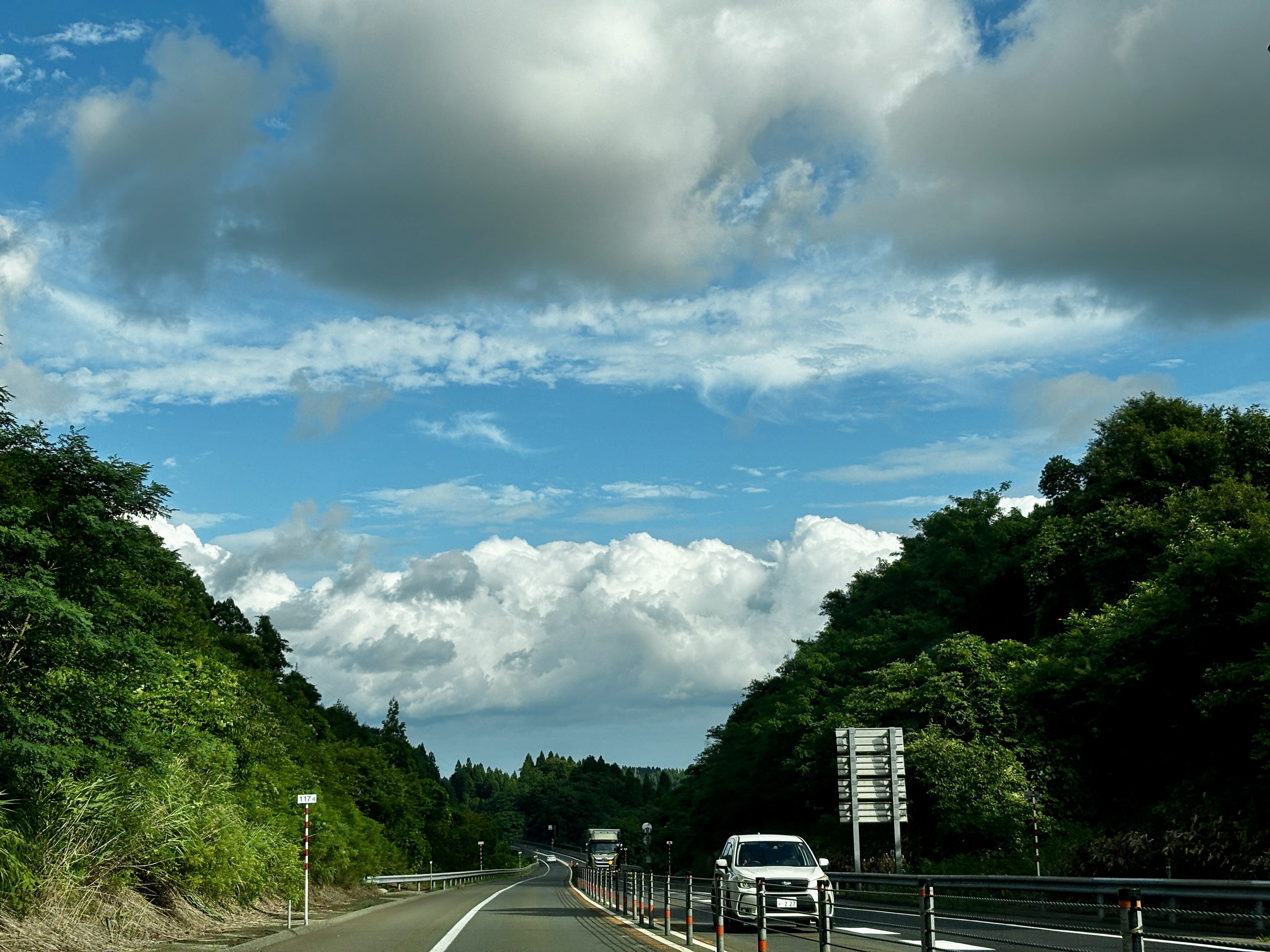
Akita Expressway cuts east to west through the mountains (photo by author).

Rice is the staple in Japan. But it is also more than just food, as the anthropologist Emiko Tierney Ohnuki explains in her book, Rice as Self: “As a metaphor of self, rice paddies are our ancestral land, our village, our region, and ultimately, our land, Japan. They also represent our pristine past before modernity and foreign influences contaminated it” (p. 10). Later she explains, “The notion that each rice grain has a soul and that rice is alive in the hull are fundamental to the meanings assigned to rice in Japanese culture…” (p. 55). The rice paddies prevail even as the countryside empties of people and the farming population ages. This phenomenon also explains the widespread resistance to foreign rice by Japanese consumers, even as rice prices have soared this year and been a major contributor to rising inflation.

Tohoku, with its relatively cold climate, has experienced several rice famines in the recorded history, many of them linked to natural disasters, such as cooling climate after volcanic eruptions. Latest in 1934, the rice crop in Iwate failed due to cold weather, causing many poor farm families to send their children to Tokyo and beyond as laborers, or to work in the water trade, or to join the military, all of which contributed to the pre-war unrest. In better times, Tohoku rice is arguably the best in the world, thanks to the clean environment and water.

Japan’s environmental history is at best checkered. The case of mercury poisoning in Minamata on the southwestern island of Kyushu starting in the late 1950s is perhaps the most famous incident of industrial pollution with dramatic consequences to people’s health. But there were plenty of others where the environment and human health were sacrificed to the altar of progress in post-war Japan, such as the Itai-Itai disease caused by cadmium poisoning discovered in 1967 or the PCB poisoning in and around Kitakyushu the year after. Opposition to industrial pollution was silenced, communities divided, and victims shunned, as the country focused on rebuilding and getting rich at any cost.

Since those years, much has been done to improve the environment. Environmental consciousness is high: practically no one litters, recycling is religiously practiced, and the cities are clean. Air and water pollution are now controlled. The largest urban conglomerations – Tokyo, Yokohama, Osaka, Kobe, Kyoto – are concentrated in the Central and Western Kanto and Kansai areas.

The Japanese culture has been largely based on the desire to control nature. This has its traditional expression in Japanese gardens in which nature has been forced into beautiful, but artificial depictions of, well, idealized nature. The tortured, but gorgeous bonsai trees are another example. For many Japanese, nature is at its most beautiful when it is well regimented.

Another factor playing into the tendency to control nature is the prevalence of natural hazards. Japan consists of a chain of volcanic islands in the middle of the largest ocean of the world, the Pacific. The country is prone to earthquakes that happen daily (although larger ones are of course rarer). Despite its name, the ocean frequently acts in ways anything but pacific, sending typhoons and tsunamis to the coasts. The eruption of the iconic volcano, Mt. Fuji, is long overdue. If a natural hazard exists, Japan is bound to have it in quantities. Consequently, Japan is also the best prepared nation towards natural hazards: even massive earthquakes tend to have relatively few victims.

There are exceptions, the most prominent one in recent history being the earthquake that hit Tohoku on the Pacific side on March 11, 2011. The 9.1 magnitude earthquake and the ensuing tsunami flattened out much of the Sanriku coastal zone in Miyagi and Iwate prefectures and killed almost 20,000 people. The tsunami also caused the meltdown of the Fukushima nuclear power plant resulting in the worst nuclear accident in human history, barring the Chernobyl accident in current-day Ukraine in 1986.

Up in in the mountains between Iwate and Akita, nature is largely unspoiled thanks to a low density of human population, little urbanization and even less industry. That in itself is largely the result of the mountainous topography, the harsh winters, and the relatively short growing season. Yet, virtually all flat valleys are under cultivation.

The topography is also what has saved Japan’s forests. This is one of the most forested countries in the world outside of the tropics, with 67% of land area covered in forests. Japan in the post-World War II years extensively replanted forests, with species like sugi and the Japanese cypress. According to environmental historian Catherine Knight, about 40% of Japan’s forests are currently man-made plantations, not naturally occurring ecosystems.

The forests would most certainly have been decimated had it been easier and more economical to exploit them. Instead, it is said that Japan has outsourced deforestation, especially to Southeast Asia where its companies have long maintained logging operations thereby saving the forests on the home islands.

What is evident even up here in Tohoku is the careful management of natural hazards and nature itself. Mountainsides where roads cross them are protected by engineering works to prevent landslides, which can be caused by earthquakes or just erosion of the slopes.

Japan has been referred to as the “construction state.” The Ministry of Construction and the numerous big and small companies operating in the sector wield significant power. They provide substantial employment and spend remarkable amounts of money as they fix the real and sometimes self-created problems.

In the decades following World War II, most rivers in Japan, notably near urban centers on the Kanto Plain, were straightened and channelized in concrete to control natural flow and meandering. Contrary to expectations, however, these works meant for flood control often had the opposite effect, while also harming ecosystems along the rivers. The government, to a degree, recognized the mistakes and mended its ways, leading the River Bureau of the Ministry of Land, Infrastructure, Transport and Tourism to reverse engineer riverine habitats since the 1990s. Today, Tohoku’s largest river – and to me the dearest – Kitakami-gawa flows quite freely from its origins at Mt. Nanashigure to the Pacific Ocean.

But the time of the construction follies is not over. Following the March 2011 earthquake and tsunami, which destroyed virtually all small fishing ports on the Sanriku coast, many survivors left. Especially younger people moved to Sendai and other cities. Few of the refugees had any intention to return to the coast. Given this and the fact that the tsunami threat will not disappear, to me the sensible thing would have been to develop the coastline to an area for nature and recreation. Instead, the government has invested tremendous amounts of resources to massive earth moving and construction works to raise the coastline, in the process destroying much of the nature literally flattening hills. This for a handful of mostly old people who may return. That just demonstrates the natural tendency of the authorities and the construction industry to find an engineering solution to any problem.

Driving through the central mountains, however, these problems are far away. Yet, just like Sanriku coast, the countryside in the remote sparsely populated areas is further emptying. Most of the young people have moved to cities and the small farmers have few heirs to take over their plots (although there is a small back-to-the-land movement driving some younger urbanites to a more organic lifestyle in the rural areas). One might think that depopulation might lead to rewilding of the land – a popular concept in some parts of Europe – and there may be some benefits to the wildlife. However, the traditional farming system – satoyama – is surprisingly well adapted to the natural ecosystem. The rice paddies themself are ecotopes of their own, with a vibrant fauna and flora. There are studies that suggest that losing this agricultural landscape is a threat to the biodiversity that has evolved in them.

Japan is making measurable progress on climate and environmental fronts and is rolling out a nature-positive economy strategy, which includes the “30 by 30” conservation target, aiming to protect 30% of land and marine regions by 2030. Yet, challenges remain, not least as global temperatures rise affecting climate and weather in this island nation.

Tohoku’s rugged landscapes remind us that Japan’s story is not just one of futuristic glory and control of the environment, but of coexistence with nature, which offers lessons in resilience and balance that Japan, and the world, will need more than ever.


Saturday, November 9, 2019

Ruminations from Hurghada: Environment, Climate and Development in Egypt


Recently I was in Hurghada. Maybe not a name that immediately strikes a light in one’s head but still quite a significant place on the Egyptian Red Sea, not far south from the more famous Sharm El Sheikh. The UN Development Programme (UNDP) had agreed with the Egyptian government to organize the 6th National Evaluation Capacities conference there.

Upon arrival, the participants found themselves in an all-inclusive resort surrounded by thousands of half-naked German, Russian, British and other tourists indulging in numerous different pools, water games and, less so interestingly, the beautiful sandy beach lining the sea. And of course, the watering holes in this dry seashore where numerous. We found ourselves navigating towards the massive conference center in our dark suits and ties in the heat that in the daytime exceeded 30 degrees Celsius past the inquisitive looks of the sunbathers.

Egypt is one of the world's most vulnerable countries to climate change. Its lifeline is the Nile river that gets its start from two branches beyond the national territory: the White Nile at Lake Victoria in Uganda and the Blue Nile in the highlands of Ethiopia. Merging around Khartoum, the capital city of Sudan and Egypt’s southern neighbor, the river flows into the country that was the birthplace of an ancient civilization that predated that of Rome and Greece. Already that civilization, 5,000 years ago, was dependent on the Nile for enabling food production.
Still today, most of Egypt’s almost 100 million people live along the banks of the Nile. Cairo, the chaotic and fabulous capital city of 9.5 million, lies in the northern parts of the country where the fertile river delta begins to fan out. Cairo is defined by the existence of the river that cuts through it. The famous pyramids of Giza are located just outside of the city where the Saharan sand dunes overtook them already a long time ago.

Decades ago, as a young researcher and evaluator, I well remember driving north – downstream, as the Nile somewhat counterintuitively drains into the Mediterranean – in a Peugeot with some much more experienced experts whom I was lucky to have joined on a joint FAO-IFAD mission to define priorities for new investment projects in the Nile delta. The road was straight but rather narrow and the traffic already then was heavy, which did nothing to make me less uneasy shaking at the back of the car in the African heat. We stopped by the Suez Canal, for some refreshments on our way to Port Said on the Mediterranean coast. I remember vividly seeing the tops of great vessels passing through the canal like ghost ships in the desert.

Our goal was to investigate the environmental status of the coastal lagoons – Lake Burullus and Lake Manzala in particular – in the widening delta of the world’s longest river. Conflict had arisen among fishermen and fish farmers in these parts due to overexploitation of the resources and our task was to figure out initiatives that could help the fisheries and lessen the tensions.

The year was 1986 and climate change was still far down the list of worries of those of us concerned with sustainable use of natural resources, including freshwater. We bunked up in the coastal city of Alexandria and soon walked down to the Mediterranean shore. Our senior team members with the linguistic and bargaining abilities strolled to the fishermen pulling in their nets and secured us a delicious meal of freshly caught shrimp that was cooked right there on the beach.

More than two decades later, I was lucky enough to visit Alexandria again and actually spend time in the fabulous reincarnation of its legendary library, the original version of which was destroyed during the Roman period. I was stunned to see how the city had grown, an almost interminable string along the Mediterranean coast. For it was virtually impossible to expand inland in a more concentric manner: the lagoons prevented it as did the soon encroaching Sahara. In Alexandria, I read Naguib Mahfouz’s lovely and melancholy novel Miramar and imagined how the city must have been in the 1960s: a beautiful and cosmopolitan city, distinctly part of the Mediterranean cultural sphere, where cafés dotted the waterfront. It was still lovely, but had grown with too little planning, with traffic on the coastal boulevard threatening pedestrian life both with its speed and its pollution.

Meanwhile in Hurghada by the other sea, a traditional fishing village was being developed with an intrusion of foreign money. In a couple of decades it grew from a small sleepy settlement into a conglomeration of resorts to cater to wealthy Europeans who wanted to explore the fabulous corals of the Red Sea (or just turn coral red themselves from the sun and booze at the resorts). I’ve been to such resorts in the Caribbean and the only thing different in Hurghada was the accent of the people working there and the fact that their first instinct was to address you in German rather than English.

The Red Sea corals suffer equally from multiple threats: sewage from the tourist industry, the massive onslaught by the visiting snorkelers and divers who can’t keep their hands and feet away from them, as well as the global problems of climate change and ocean acidification. Surprisingly, it has been found that the corals in the northern parts of the Red Sea appear to be rather resilient to climate change, but those in the south are barely surviving at their maximum temperature tolerance.

At the conference that focused on how evaluation can contribute to the achievement of the 2030 Sustainable Development Agenda with its stated goal of “leaving no one behind,” my plea to the participants who included high government officials from Egypt (including a Deputy Minister) and from numerous other countries in the South and the North, as well as staff from UN organizations, civil society, private sector and academia, was that “sustainable development” as it is proclaimed rests on the foundations of the natural environment. If there is someone or something that should not be left behind, it is the natural environment with all its wonders.

Today, climate change combined with population growth that continues at an annual rate of 1.9% is posing tremendous challenges to Egypt, as it is to many countries in arid North Africa and the Middle East. The scarce water resources of the country – 85% of freshwater in Egypt is supplied by the Nile – are overused and abused by urban, agricultural and industrial development (another threat is posed by the upstream countries that need the water to develop their own economies, thus potentially leading to conflict: as I write this, Ethiopia is building a massive dam on the Blue Nile). The unique biological diversity along the Nile is also on the verge of extinction, just like the coral reefs in the southern parts of Red Sea.

A country that has invested so much in its role as a political, economic, cultural and touristic hub in the region, is seeing its natural and cultural assets erode. And it is facing a problem of burgeoning numbers of young people with little hope for advancement despite better education This latter issue, of course, is a major contributor to discontent, social upheaval, rise of Islamism and all the issues that these bring along.

Alexandria, the seaside center up north with a population of more than 5 million, the port where not only fish, but also cosmopolitan ideas and cultural tolerance have landed for millennia, is slowly taken over by the Mediterranean. Sea-level rise has led to rapidly increasing and more frequent floods that severely disrupt life and cause massive amounts of economic loss. The rising Mediterranean also leads to saltwater intrusions into the fertile delta that threaten both agriculture and freshwater resources.

The country that contributes less than 1% of the global greenhouse gas emissions is feeling the brunt of the impacts. As always, when the going gets rough, it’s the poor people that suffer the most.

The good news is that the Government of Egypt appears quite aware of what these challenges mean to the continued economic and social development of the country. The government has attempted to integrate its national strategy for climate change adaptation into its National Development Plan. A number of initiatives related to energy, water, agriculture, coastal zone management and other factors to enhance sustainability and resilience are underway. For the sake of the ancient country and the whole world, we need to hope that these succeed in time.

Sources

Altzitser, Sonia (2019). Red Sea Corals may be Resilient to Climate Change. The Maritime Executive [https://www.maritime-executive.com/editorials/red-sea-corals-may-be-resilient-to-climate-change]

Conniff, Richard (2017). The Vanishing Nile: A Great River Faces a Multitude of Threats. Yale Environment 360 [https://e360.yale.edu/features/vanishing-nile-a-great-river-faces-a-multitude-of-threats-egypt-dam]

Eissa, Hesham (n.d.). Egyptian Development & Climate Change. Presentation to the UN Framework Convention on Climate Change (UNFCCC) [https://unfccc.int/files/adaptation/application/pdf/nwa_1.2_development_planning_and_climate_change_in_egypt.pdf]

Fine, M., Cinar, M., Voolstra, C.R., Safa, A., Rinkevich, B, Leffoley, D., Hilmi, N. and Allemand, D. (2019). Coral reefs of the Red Sea – Challenges and potential solutions. Regional Studies in Marine Science 25: 100498.

Khalil, Maha T. (2019). Egypt’s Lukewarm Response to Climate Change. Worldcrunch [https://www.worldcrunch.com/tech-science/egypt39s-lukewarm-response-to-climate-change]

UNEP (2018). How Climate Change and Population Growth Threaten Egypt’s Ancient Tresures. United Nations Environment Programme ;https://www.unenvironment.org/news-and-stories/story/how-climate-change-and-population-growth-threaten-egypts-ancient-treasures]


Tuesday, January 9, 2018

The GEF in the Changing Landscape of Environmental Finance

[Published in Earth-Eval]
We have recently completed the Sixth Comprehensive Evaluation of the GEF (known by its acronym OPS6). The Comprehensive Evaluations are conducted by the Independent Evaluation Office every four years as critical inputs to the GEF replenishment process. I presented the final draft of the OPS6 to the second replenishment meeting in Addis Ababa, Ethiopia, in October 2017 and the GEF Council in November. The donors to the GEF recognized the evaluation as a foundation for determining the programmatic directions for the next, seventh, GEF replenishment period. OPS6 was a major collective effort, which kept us at the IEO occupied for the better part of two years. It brought together 29 separate evaluations and studies that focused on a wide set of issues, ranging from the results and impacts of the GEF and its various focal areas and programs, to organizational and institutional issues. In conducting the evaluation, we utilized mixed methods, both quantitative and qualitative, to ensure the best approach to answer the evaluation questions posed. Many of the approaches were innovative, such as the use of geospatial tools and methods to track impact and value for money of GEF funded programs and projects on the ground. We also applied formative approaches to evaluate progress made in the Integrated Approach Pilots that were launched during the current GEF cycle. While each of the component evaluations has its own detailed conclusions and recommendations, the Comprehensive Evaluation brings them together at a high strategic level.
Judging from the terminal evaluations of completed projects, the GEF continues to perform well at the aggregate level. Some 81% of the completed projects were judged to have satisfactory or higher outcome ratings. The GEF has also exceeded its co-financing targets raising $8.8 to each dollar invested by the GEF. More challenging is ensuring the continuation of the global environmental benefits after the projects are closed. Only 62% of the projects were judged to have outcomes that are likely to be sustained. The reasons behind this drop often appear to lie in institutional capacity and financial sustainability in the program countries. Indeed, proof of this seems to be that middle-income countries tend to perform better on sustainability than do least developed countries. Furthermore, projects in biodiversity and land degradation face bigger sustainability challenges than those in climate change, likely because of the limited alternative sources of funding and the lack of private sector involvement. These are crucial issues that we need to understand better and, consequently, the IEO has embarked on an exercise to unpack the mechanisms behind sustainability. We expect to present this study to the Council in its next meeting in June 2018, so stay tuned.
Another important development in GEF programming in the past years has been the increase in programmatic approaches, as well as the rise of multifocal area projects that address simultaneously biodiversity conservation, sustainable forest management, land degradation, and climate change and carbon sequestration. Two major evaluations focused on these, finding that projects under programs do indeed tend to perform slightly better than standalone projects, although increased complexity when programs involve multiple countries or agencies and cut across focal areas poses some challenges that need to be managed. The multifocal area projects do produce benefits on multiple fronts when trade-offs, especially between environmental and socioeconomic outcomes, are well managed. (For the findings of the formative evaluation of the Integrated Approach Pilots, see earlier blogs by Dennis Bours.)
The Comprehensive Evaluation concluded that the GEF’s main comparative advantage in the rapidly changing and expanding global environmental finance landscape lies in its ability to address a broad range of environmental issues and the synergies between them, not just climate change, and to serve multiple Conventions and multilateral environmental agreements. It is virtually the only public funding source for the biodiversity, land degradation, and chemicals conventions, and provides important support to many regional and global agreements around international waters. In the increasingly crowded field of climate finance, the GEF still plays a central role but must define its niche more clearly. The GEF also has proven strengths in working with governments to create an enabling environment in countries through legal and regulatory reforms that lay the ground for lasting improvements in environmental management. A study we conducted identified conditions, which are necessary for programming to lead to transformational change. These include a level of ambition and setting in place mechanism for sustainability from the outset.
The recommendations of OPS6 build upon the conclusions regarding the GEF’s comparative advantages regarding its strategic positioning in the broad global environmental field and the strengths of its work on transformational change. The evaluation recognizes the value of integration in programming that addresses multiple environmental issues, but also calls for caution in managing complexity. Integration should be based on the need when the environmental problems call for integrated solutions, and on GEF’s additionality. Not everything is entirely rosy either. Despite its solid performance over a quarter century, the GEF still has areas where more progress needs to be made. Its track record on engaging with the private sector is still rather patchy. Progress has been made in integrating the gender dimension and in engaging with indigenous peoples in GEF programming, but more remains to be done to ensure that the organization applies internationally recognized good practice standards.
The third replenishment meeting of the GEF will take place at the end of January in Brazil. As instructed by the GEF Council, the GEF Secretariat has taken the OPS6 recommendations and fed them into their plans for the programming directions and policy agenda for the next GEF cycle. As an evaluator, I am naturally very pleased as I see that our hard work is having a concrete real-time impact on how we approach global environmental challenges that are fundamental to the survival of humankind.